A comprehensive review of the fundamental molecular mechanisms in fermentation and explores the microbiology of fermentation technology and industrial applications
Microbial Sensing in Fermentation presents the fundamental molecular mechanisms involved in the process of fermentation and explores the applied art of microbiology and fermentation technology. The text contains descriptions regarding the extraordinary sensing ability of microorganisms towards small physicochemical changes in their surroundings. The contributors — noted experts in the field — cover a wide range of topics such as microbial metabolism and production (fungi, bacteria, yeast etc); refined and non-refined carbon sources; bioprocessing; microbial synthesis, responses and performance; and biochemical, molecular and extra/intracellular controlling.
This resource contains a compilation of literature on biochemical and cellular level mechanisms for microbial controlled production and includes the most significant recent advances in industrial fermentation.
The text offers a balanced approach between theory and practical application, and helps readers gain a clear understanding of microbial physiological adaptation during fermentation and its cumulative effect on productivity. This important book:
Presents the fundamental molecular mechanisms involved in microbial sensing in relation to fermentation technology
Includes information on the significant recent advances in industrial fermentation
Contains contributions from a panel of highly-respected experts in their respective fields
Offers a resource that will be essential reading for scientists, professionals and researchers from academia and industry with an interest in the biochemistry and microbiology of fermentation technology
Written for researchers, graduate and undergraduate students from diverse backgrounds, such as biochemistry and applied microbiology, Microbial Sensing in Fermentation offers a review of the fundamental molecular mechanisms involved in the process of fermentation.
1 Biochemical Aspects of Microbial Product Synthesis: a Relook
G. Gallastegui1, A. Larrañaga2, Antonio Avalos Ramirez3, and Thi Than Ha Pham3,4
1 Department of Chemical and Environmental Engineering, Faculty of Engineering Vitoria‐Gasteiz, University of the Basque Country (UPV/EHU), Spain
2 Department of Mining‐Metallurgy Engineering and Materials Science & POLYMAT, Faculty of Engineering of Bilbao, University of the Basque Country (UPV/EHU), Spain
3 Centre National en Électrochimie et en Technologies Environnementales, Shawinigan, Québec, Canada
4 Université de Sherbrooke, Sherbrooke, Québec, Canada
1.1 Introduction
Microbes are living unicellular or multicellular organisms (bacteria, archaea, most protozoa, and some fungi and algae) that must be greatly magnified to be seen. Despite their tiny size, they play an indispensable role for humanity and the health of ecosystems. For instance, until the discovery of an artificial nitrogen fixation process by the German chemists Fritz Haber and Carl Bosch in the first half of the 20th century, some soil microbes on the roots of peas, beans, and a few other plants were the solely responsible for the nitrogen release necessary for plants growth (Hager, 2008). This invention allowed to feed billions more people than the earth could support otherwise.
Besides, humanity has exploited some of the vast microbial diversity like miniature chemical factories for thousands of years in the production of fermented foods and drinks, such as wine, beer, yogurt, cheese and bread. In fact, the use of yeast as the biocatalyst in foodstuffs making is thought to have begun around the Neolithic period (ca. 10 000‐4000 BCE), when early humans transitioned from hunter‐gatherers to living in permanent farming communities (Rasmussen, 2015). Vinegar, the first bio‐based chemical (not intended as a beverage) produced at a commercial scale was known, used and traded internationally before the time of the Roman Empire (Licht, 2014).
The staggering transformation undergone by biotechnology from serendipity and black‐box concepts to rational science and increasing understanding of biological systems has led to not only a direct influence of microbes on human lives, but the emergence of new industries that take advantage of these organisms in large‐scale processes devoted to the manufacture of high value‐added compounds, energy production and environmental protection. Nevertheless, scientists and engineers are still discovering the broad array of complex signalling that microorganisms have developed to ensure their survival in a wide range of environmental conditions, and making their utmost effort to direct them towards our own ends (Manzoni et al., 2016). In this chapter, a brief summary regarding the historical production of microbial products, their niche in the current global market and the importance of microbial sensing (and other new disciplines) to convert biological systems in industrially relevant actors is presented.
1.2 History of Industrial Production of Microbial Products
In the 1800s, Louis Pasteur (and later Eduard Buchner) proved that fermentation was the result of microbial activity and, consequently, the different types of fermentations were associated with different types of microorganisms. In more recent times (1928), Alexander Fleming understood that the Penicillium mould produces an antibacterial bio‐chemical (antibiotics discovery), which was extracted, isolated and named penicillin. Subsequent periods of conflicts (e.g., World Wars I and II) intensified the needs of the population and, at the same time, the creativity and inventiveness of scientists and engineers, who developed large‐scale fermentation techniques to make industrial quantities of drugs, such as penicillin, and biofuels, such as biobutanol and glycerol, giving rise to industrial biotechnology. In 1952, Austrian chemists at Biochemie (now Sandoz) developed the first acid‐stable form of penicillin (Penicillin V) suitable for oral‐administration and achieved an extraordinary success in the treatment of infections during World War II (Williams, 2013).
Biobutanol production is recognized as one of the oldest industrial‐scale fermentation processes. It was generated by anaerobic ABE (acetone–butanol–ethanol) fermentation of sugar extract using solventogenic clostridia strains, with a typical butanol:acetone:ethanol mass fraction ratio around 6:3:1. Until the 1920s, acetone was the most sought‐after bioproduct of commercial interest. An emerging automotive paint industry and the need of quick‐drying lacquers, such as butyl acetate, changed the economic landscape and by 1927 butanol displaced acetone as the target product (Rangaswamy et al., 2012). From 1945 to 1960, about two thirds of the butanol production in North America was based on the conventional ABE fermentation. Nevertheless, butanol yield by anaerobic fermentation remained sub‐optimal, and this biobased product was progressively replaced by low cost petrochemical production (Maiti et al., 2016).
When Watson and Crick (with the valuable help from Wilkins and Franklin) worked out the structure of DNA in 1953, they barely imagined that this latter discovery supposed a milestone in the development of modern industrial biotechnology. Thus, in the following decades traditional industrial biotechnology merged with molecular biology to yield more than 40 biopharmaceutical products, such as erythropoietin, human growth hormone and interferons (Demain, 2000). Since then, biotechnology has steadily developed and now plays a key role in several industrial sectors, such as industrial applications, food and beverages, nutritional and pharmaceuticals or plastics and fibers, providing both high value products and commodity products (Heux et al., 2015).
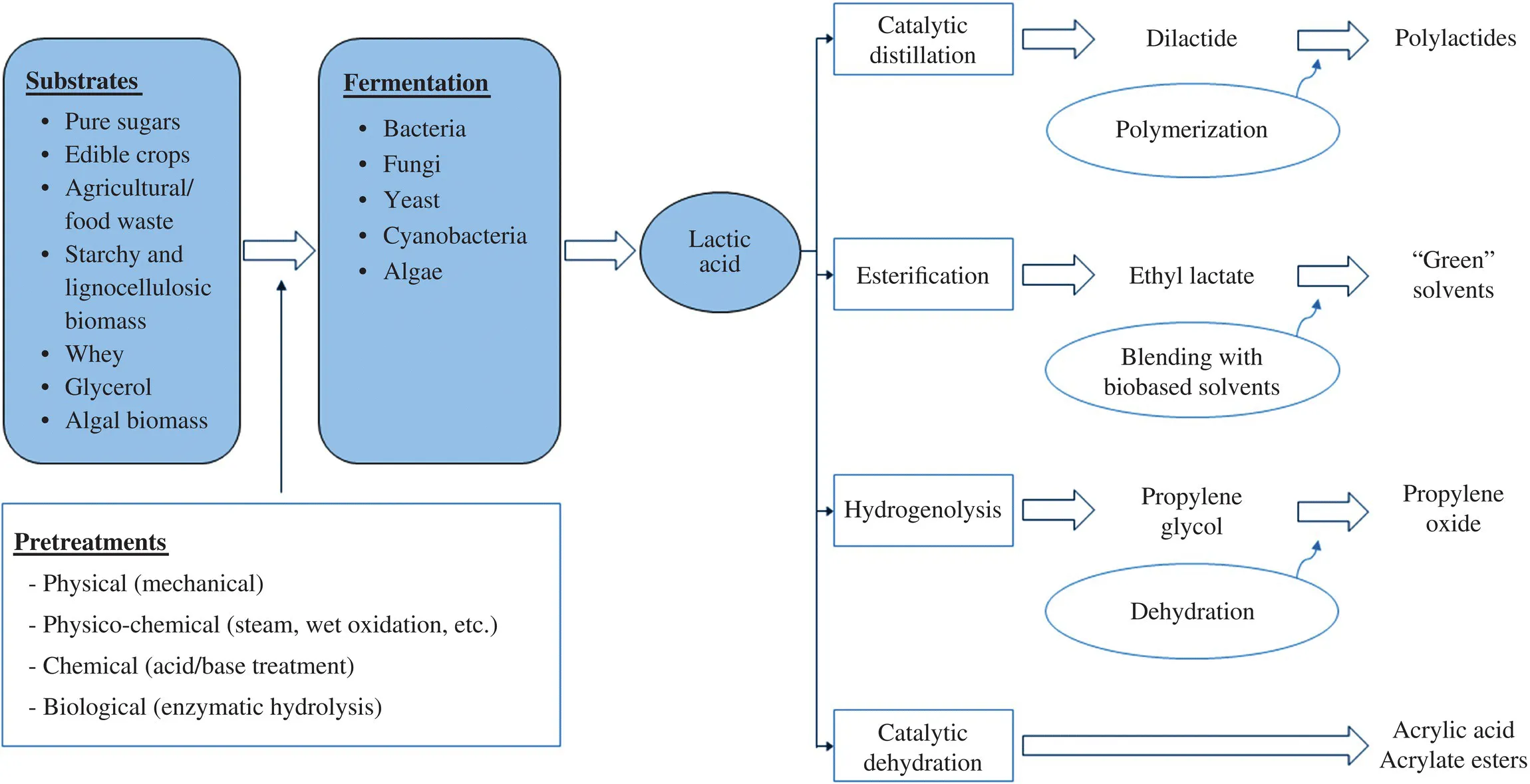
Although, as shown in the previous paragraphs, the use of microorganisms and enzymes for the production of essential items has a long history, the recent linguistic term “white biotechnology” has been assigned to the application of biotechnology for the processing and production of chemicals, materials and energy. It is based on microbial fermentation processes and it works with nature in order to maximize and optimize existing biochemical pathways that can be used in manufacturing. The development of cost effective fermentation processes has allowed industry to target previously abandoned fermentation products and new ones which used to be of small interest for the naphtha‐relying chemical industry, such as succinic acid or lactic acid. In the latter case, and although the chemical synthesis of lactic acid from petrochemical feedstock is more familiar to chemists, approximately 90% of its production is accomplished by microbial fermentation (Wang et al., 2015). Nowadays, this platform molecule is used as a building block for the synthesis of chemicals such as acrylic acid and esters (by catalytic dehydration), propylene glycol (by hydrogenolysis) and lactic acid esters (by esterification) (Figure 1.1).
Figure 1.1 Production of lactic acid by microbial fermentation and its derivatives.
1.2.1 Advances of Biochemical Engineering and Their Effects on Global Market of Microbial Products
Economic viability of bio‐derived products, especially in the case of biofuels, has been traditionally limited to a large extent by the selection of cheap carbon‐rich raw materials as feedstock, applied production mode, downstream processing and the scarcity of naturally occurring microorganisms that are able to deliver the desired compounds at a high production‐rate. Conventional bio‐based products ultimately turned out so expensive to compete with petroleum‐derived chemicals that they were hardly worth producing.
Despite these drawbacks, advances in biotechnology in recent years have enabled the reengineering of the bioprocesses incorporating several transformation or purification steps into only one, reducing time and operating costs. This has involved the increase of bioprocesses yield, boosting production of biobased materials. Currently, biotechnology advances (microbial, enzymatic and biology engineering) can be considered among the new technological revolutions, havi...
Table of contents
Cover
Table of Contents
1 Biochemical Aspects of Microbial Product Synthesis: a Relook
2 Cellular Events of Microbial Production: Important Findings So Far
3 Microbial Metabolism in a Refined Carbon Source: Generalities
4 Non‐refined Carbon Sources and Microbial Performance
5 Cellular versus Biochemical Control over Microbial Products
6 Pre‐Treatment of Alternative Carbon Source: How Does it Make Sense to Microorganism at Cellular Level?
7 Microbial Metabolic Pathways in the Production of Valued‐added Products
8 Communication for a Collective Response to Environmental Stress
9 Biochemical and Cellular Events in Controlling Microbial Performance
10 Qualitative vs. Quantitative Control Over Microbial Products
11 Microbes and Their Products as Sensors in Industrially Important Fermentations
12 Practical Aspects and Case Studies of Industrial Scale Fermentation
13 Future Market and Policy Initiatives of New High Value Products
Index
End User License Agreement
Trusted by 375,005 students
Access to over 1.5 million titles for a fair monthly price.
Study more efficiently using our study tools.
Frequently asked questions
Yes, you can cancel anytime from the Subscription tab in your account settings on the Perlego website. Your subscription will stay active until the end of your current billing period. Learn how to cancel your subscription
No, books cannot be downloaded as external files, such as PDFs, for use outside of Perlego. However, you can download books within the Perlego app for offline reading on mobile or tablet. Learn how to download books offline
Perlego offers two plans: Essential and Complete
Essential is ideal for learners and professionals who enjoy exploring a wide range of subjects. Access the Essential Library with 800,000+ trusted titles and best-sellers across business, personal growth, and the humanities. Includes unlimited reading time and Standard Read Aloud voice.
Complete: Perfect for advanced learners and researchers needing full, unrestricted access. Unlock 1.5M+ books across hundreds of subjects, including academic and specialized titles. The Complete Plan also includes advanced features like Premium Read Aloud and Research Assistant.
Both plans are available with monthly, semester, or annual billing cycles.
We are an online textbook subscription service, where you can get access to an entire online library for less than the price of a single book per month. With over 1.5 million books across 990+ topics, we’ve got you covered! Learn about our mission
Look out for the read-aloud symbol on your next book to see if you can listen to it. The read-aloud tool reads text aloud for you, highlighting the text as it is being read. You can pause it, speed it up and slow it down. Learn more about Read Aloud
Yes! You can use the Perlego app on both iOS and Android devices to read anytime, anywhere — even offline. Perfect for commutes or when you’re on the go. Please note we cannot support devices running on iOS 13 and Android 7 or earlier. Learn more about using the app
Yes, you can access Microbial Sensing in Fermentation by Satinder K. Brar, Ratul K. Das, Saurabh J. Sarma, Satinder K. Brar,Ratul K. Das,Saurabh J. Sarma in PDF and/or ePUB format, as well as other popular books in Biological Sciences & Microbiology. We have over 1.5 million books available in our catalogue for you to explore.