- Represents the first compilation of information on the design, prototyping, and manufacture of medical devices into one volume
- Offers in-depth coverage of medical devices, beginning with an introductory overview through to the design, manufacture, and applications
- Features examples of a variety of medical applications of devices, including biopsy micro forceps, micro-needle arrays, wrist implants, spinal spacers, and fixtures
- Provides students, doctors, scientists, and technicians interested in the development and applications of medical devices the ideal reference source
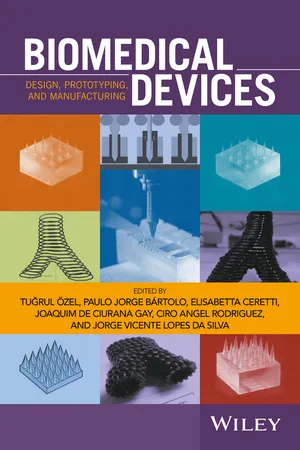
eBook - ePub
Biomedical Devices
Design, Prototyping, and Manufacturing
- English
- ePUB (mobile friendly)
- Available on iOS & Android
eBook - ePub
Biomedical Devices
Design, Prototyping, and Manufacturing
About this book
Biomedical Devices: Design, Prototyping, and Manufacturing features fundamental discussions of all facets of materials processing and manufacturing processes across a wide range of medical devices and artificial tissues.
Information
Chapter 1
OVERVIEW
Joaquim De Ciurana Gay, Tuğrul Özel and Lidia Serenó
Department of Mechanical Engineering and Industrial Construction, University of Girona, Girona, Catalonia, Spain
Department of Industrial and Systems Engineering, School of Engineering, Rutgers University, Piscataway, NJ, USA
1.1 INTRODUCTION
Medical devices are defined as articles that are intended to be used for medical purposes. Several official definitions exist for the term “medical device” depending on the geographic market. Therefore, *medical device definition, classification, and regulation follow market location and governmental regulations according to the required level of control considering invasiveness, contact to the patient, and potential risk in case of misuse or failure. This situation concerning the differences in classification strategies has blocked the spread of innovative medical devices across countries. Nevertheless, in 2011, the International Medical Device Regulators Forum (IMDRF) was conceived to discuss future directions to harmonize the medical device regulatory field and accelerate international convergence.
Two of the most important medical device markets worldwide are the European and the North American. Therefore, the official definitions and classifications of both regions are detailed in this chapter.
For the European market, medical devices are governed by a regulatory framework of three directives:
- 93/42/EEC: Medical Devices Directive (MDD)
- 90/385/EEC: Active Implantable Medical Device Directive (AIMDD)
- 98/79/EC: In vitro diagnostic medical devices (IVDMD)
According to them, a medical device is defined as “any instrument, apparatus, appliance, software, material or other article, whether used alone or in combination, including the software intended by its manufacturer to be used specifically for diagnostic and/or therapeutic purposes and necessary for its proper application, intended by the manufacturer to be used for human beings for the purpose of:
- diagnosis, prevention, monitoring, treatment or alleviation of disease,
- diagnosis, monitoring, treatment, alleviation of or compensation for an injury or handicap,
- investigation, replacement or modification of the anatomy or of a physiological process,
- control of conception,
and which does not achieve its principal intended action in or on the human body by pharmacological, immunological or metabolic means, but which may be assisted in its function by such means.”
Similarly, for the North American market and as a part of the Federal Food Drug and Cosmetic Act (FDC Act), a medical device is defined as “an instrument, apparatus, implement, machine, contrivance, implant, in vitro reagent, or other similar or related article, including a component part, or accessory which is:
- recognized in the official National Formulary, or the United States Pharmacopeia, or any supplement to them,
- intended for use in the diagnosis of disease or other conditions, or in the cure, mitigation, treatment, or prevention of disease, in man or other animals, or
- intended to affect the structure or any function of the body of man or other animals, and which does not achieve its primary intended purposes through chemical action within or on the body of man or other animals and which is not dependent on being metabolized for the achievement of any of its primary intended purposes.”
Therefore, any product labeled, promoted, or used in a manner that meets the above-mentioned definition will be regulated by the US Food and Drug Administration (US FDA) as a medical device and will be subjected to pre- and postmarketing regulatory controls.
Both definitions of medical devices exclude other regulated products such as drugs, the primary intended use of which is achieved through chemical action or by being metabolized by the body, biological products including blood and blood products, or products used with animals.
In order to classify a medical device, the manufacturer should, first of all, decide whether the product concerned is considered a medical device as defined in the previous section. Then, depending on the situation, medical devices can be classified following national or governmental rules. In this chapter, the classification given is based on the European Union (EU) and the US FDA regulations.
According to the EU, the classification of medical devices is based on the potential risks associated with the devices. This approach allows the use of a set of criteria that can be combined in various ways and be applied to a vast range of different medical devices and technologies. These criteria are referred to as the “classification rules” and are described in Annex IX of Directive 93/42/EEC. Therefore, the medical device manufacturer must determine the type of device following the rules listed in Annex IX. The rules depend on a series of factors including
- duration: how long the device is intended to be in continuous use,
- invasiveness: whether or not the device is invasive or surgically invasive,
- type: whether the device is implantable or active,
- function: whether or not the device contains a substance, which in its own right is considered to be a medicinal substance and has action ancillary to that of the device,
and are divided as follows:
- Rules 1–4: for noninvasive devices,
- Rules 5–8: for invasive devices,
- Rules 9–12: for active devices,
- Rules 13–18: special rules for products that merit a higher classification than they might otherwise be assigned.
When multiple rules apply, the manufacturer must use the highest risk class. Nevertheless, a small number of products may be more difficult to classify due to their unusual nature or situations where the classification would result in the wrong level of conformity assessment in light of the hazard represented by the devices.
Furthermore, based on these rules described in Directive 93/42/EEC, the devices are divided into four classes, ranging from low risk to high risk:
- Class I: low-risk medical devices,
- Class IIa: medium-risk medical devices,
- Class IIb: medium-risk medical devices,
- Class III: high-risk medical devices.
Thus, in order to classify a medical device, the manufacturer must determine the classification of the medical device (class I, class IIa, class IIb, or class III) considering the Annex IX rules described later. Then, a notified body has to carry out the appropriate conformity assessment procedure to validate and confirm the classification.
As an example, a manufacturer willing to classify a silicone tracheal stent must consider the rules associated with an invasive medical device (Rules 5–8):
- Rule 5 (invasive in body orifice or stoma—not surgically)
If it is for transient use Class I If it is for short-term use Class IIa However, if it is for oral cavity, ear canal, or nasal cavity Class I If it is for long-term use Class IIb However, if it is for oral cavity, ear canal, or nasal cavity and it will not be absorbed by the mucous membrane Class IIa If it is connected to an active medical device in class IIa or higher Class IIa - Rule 6 (surgically invasive—transient use)
If it is surgically invasive for transient use Class IIa If it is used to control/diagnose/monitor/correct a defect of the hear...
Table of contents
- Cover
- Title Page
- Copyright
- Table of Contents
- Contributors
- Foreword
- Chapter 1: Overview
- Chapter 2: Design Issues in Medical Devices
- Chapter 3: Forming Applications
- Chapter 4: Laser Processing Applications
- Chapter 5: Machining Applications
- Chapter 6: Inkjet- and Extrusion-Based Technologies
- Chapter 7: Certification for Medical Devices
- Index
- End User License Agreement
Trusted by 375,005 students
Access to over 1.5 million titles for a fair monthly price.
Study more efficiently using our study tools.
Frequently asked questions
Yes, you can cancel anytime from the Subscription tab in your account settings on the Perlego website. Your subscription will stay active until the end of your current billing period. Learn how to cancel your subscription
No, books cannot be downloaded as external files, such as PDFs, for use outside of Perlego. However, you can download books within the Perlego app for offline reading on mobile or tablet. Learn how to download books offline
Perlego offers two plans: Essential and Complete
- Essential is ideal for learners and professionals who enjoy exploring a wide range of subjects. Access the Essential Library with 800,000+ trusted titles and best-sellers across business, personal growth, and the humanities. Includes unlimited reading time and Standard Read Aloud voice.
- Complete: Perfect for advanced learners and researchers needing full, unrestricted access. Unlock 1.5M+ books across hundreds of subjects, including academic and specialized titles. The Complete Plan also includes advanced features like Premium Read Aloud and Research Assistant.
We are an online textbook subscription service, where you can get access to an entire online library for less than the price of a single book per month. With over 1.5 million books across 990+ topics, we’ve got you covered! Learn about our mission
Look out for the read-aloud symbol on your next book to see if you can listen to it. The read-aloud tool reads text aloud for you, highlighting the text as it is being read. You can pause it, speed it up and slow it down. Learn more about Read Aloud
Yes! You can use the Perlego app on both iOS and Android devices to read anytime, anywhere — even offline. Perfect for commutes or when you’re on the go.
Please note we cannot support devices running on iOS 13 and Android 7 or earlier. Learn more about using the app
Please note we cannot support devices running on iOS 13 and Android 7 or earlier. Learn more about using the app
Yes, you can access Biomedical Devices by Tugrul Özel, Paolo Jorge Bártolo, Elisabetta Ceretti, Joaquim De Ciurana Gay, Ciro Angel Rodriguez, Jorge Vicente Lopes Da Silva, Tugrul Özel,Paolo Jorge Bártolo,Elisabetta Ceretti,Joaquim De Ciurana Gay,Ciro Angel Rodriguez,Jorge Vicente Lopes Da Silva in PDF and/or ePUB format, as well as other popular books in Biological Sciences & Biotechnology. We have over 1.5 million books available in our catalogue for you to explore.