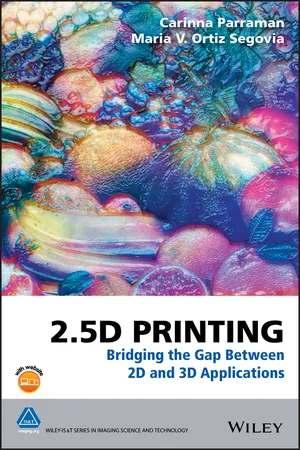
A guide that examines the history and current state of 2.5D printing and explores the relationship between two and three dimensions
2.5D Printing: Bridging the Gap Between 2D and 3D Applications examines the relationship between two- and three-dimensional printing and explores the current ideas, methods, and applications. It provides insights about the diversity of our material culture and heritage and how this knowledge can be used to design and develop new methods for texture printing. The authors review the evolving research and interest in working towards developing methods to: capture, measure and model the surface qualities of 3D and 2D objects, represent the appearance of surface, material and textural qualities, and print or reproduce the material and textural qualities.
The text reflects information on the topic from a broad range of fields including science, technology, art, design, conservation, perception, and computer modelling. 2.5D Printing: Bridging the Gap Between 2D and 3D Applications provides a survey of traditional methods of capturing 2.5D through painting and sculpture, and how the human perception is able to judge and compare differences. This important text:
Bridges the gap between the technical and perceptual domains of 2D and 3D printing
Discusses perceptual texture, color, illusion, and visual impact to offer a unique perspective
Explores how to print a convincing rendering of texture that integrates the synthesis of texture in fine art paintings, with digital deposition printing
Describes contemporary methods for capturing surface qualities and methods for modelling and measuring, and ways that it is currently being used
Considers the impact of 2.5D for future technologies
2.5D Printing is a hands-on guide that provides visual inspiration, comparisons between traditional and digital technologies, case studies, and a wealth of references to the world of texture printing.
Please visit the companion website at: www.wiley.com/go/bridging2d3d
What is the relationship between textures we see in the real world and as a reproduction? How convincing are these? As more images are digitally reproduced and printed, standardised methods may result in a uniform ubiquity, whereby prints, posters, photos and reproductions of paintings are all printed in the same way, and likewise objects that are fabricated using the same materials, using the same layer upon layer fabrication methods. On the one hand, we can say that digital technologies have assisted in printing things faster, cheaper, bigger, bolder; on the other hand, we could suggest these things fall short of expected levels of quality. We could suggest that quantity may have been achieved at the cost of quality or ubiquity at the cost of diversity. In our manufacturing world, as more and more things are designed and created digitally, how do we bridge the gap between images we see on screen and how it is physically reproduced?
Texture can be described as the microstructural details that can be perceptually distinguished from one surface property to another. One could consider texture as multisensory; we only need to look at a surface to gain a quick understanding of its textural properties, which may then be reinforced by other senses (smell, taste and touch) (Klatzky and Lederman, 2011). Texture could be broadly categorised according to whether it is tactile or visual, it can be described by its appearance, as a noun or adjective and by comparison or difference.
Tactile texture. Tactile or physical texture describes the minute variations in the surface elevation created by the changes in orientation, density and distribution of tiny particulates of the surface. At our most primitive level and from birth, we engage with the world as a tactile experience and by using all our senses, we are compelled to touch materials, surfaces and objects to find out whether they are smooth or rough, soft or hard, or understand their material properties, for example, by handling a fabric to discern whether it is flexible or stiff or how it drapes. As a survival mechanism, it is highly important to recognise whether a food appears rotten (discoloured, wrinkled, mouldy) or whether an object may do us harm (prickles, barbs, spikes) (see Figure 1.1).
Visual texture. Visual texture usually refers to flat changes on the surface, a sort of drawing that demonstrates certain properties of periodicity and colour but does not present topographical changes. For instance, a plastic table designed to look like wood may appear to be wood at a first glance (visual texture) as the drawing or projection of a picture is presented to be real wood, but may not feel like wood to the touch (tactile texture). We may miss the minute ridges, the roughness/smoothness of the material or the feeling of warmth. On a perceptual level, we use our library of knowledge to quickly recognise and chose from the range of materials and textures, and from a priori experience we no longer need to touch, for example, tree bark, velvet, brick. We can begin to order materials, for example, according to roughness or gloss. We can differentiate between the properties of materials or discern their suitability for a particular application, for example, different roughness, weight or pliability of a paper, or whether a shiny material is made of plastic or glass. Likewise, from our knowledge of handling fabric we can begin to use these for different garments.
Appearance of texture. In order to represent different textures or demonstrate an object's material qualities, it is important to render with convincing likeness. Artists have sought to paint and draw realistic representations of material surfaces and objects for hundreds of years, and now, through computer modelling, textures can be created virtually, whereby objects can be rendered for a wide variety of applications (film, animation, games, architecture) and bodies can be dressed in garments that drape and move in a lifelike way.
Taxonomy of texture. Using our skills to compare different textures, we are able to sort, categorise and name the appearance of a wide range of materials; some terms may be specific to different trades, subject areas, cultures and countries. From this, we have developed a rich vocabulary of adjectives to describe the differences and nuances of appearance (rough, smooth, prickly, slippery, slimy) or to describe their chemical or mineral appearances (gold, copper, granite, limestone) and material properties (denim, silk, wood, leather).
Figure 1.1 Texture is useful for recognising the difference between something fresh and rotten (courtesy: Grace Parraman).
1.1.1 How to Quantify Texture
How may one quantify the appearance of a texture – by its characteristics or material properties? Some terms have different connotations depending on subject specialisms and requirements. Analogous to the many colour models that have evolved to suit different requirements, specialists and industries have developed their own quantitative methods – scales, comparisons and measurements – to define the parameters of manufacture or appearance and assist in selection, for example, roughness through the International Roughness Index (IRI), surface qualities of metals (R) (Black and Kohser, 2011), measurement of different aspects of the gloss of a surface (Hunter) Gloss Units (GU) or the dynamic viscosity of a liquid (centipoise cP). In commercial specifications it is sometimes easier to predict the behaviour of a material by comparing its material properties to well‐known materials. For example, a manufacturer of adhesives, in approximating the viscosity of different products to a client, might achieve this by suggesting different domestic fluids and foodstuffs as a comparison: at 300 000 cP toothpaste is a highly viscous material that does not move without being squeezed, whereas a syrup at 4000 cP can be poured or dripped, and water has a low viscosity at 1–3 cP, and can be easily poured.
1.1.2 How do Artists Convey the Appearance of Texture?
Since the beginning of art history and throughout the centuries practitioners craftspeople, artists, designers, engineers and technologists – have been fascinated by the material they use, and by selecting different materials and mediums are able to translate meaning and concepts into form. A visit to any museum may well demonstrate a diversity of historical artefacts, each created using different tools, and each designed to achieve a specific mark. Over time, makers have developed different craft skills and tacit knowledge of materials, tool and techniques, and this knowledge passed down through workshops and studios.
The relationship between two and three dimensions is a long and enduring area of interest for technologists and artists. Artists have been constantly fascinated by the pictorial representation of a three‐dimensional world through the two‐dimensional media of painting and drawing, and by employing drawing elements such as perspective, illusion, colour, texture, light and shade to create more convincing and immersive environments.
Over the last one hundred years, photography and photomechanical processes have also played an important role in recording and reproducing images for mass consumption. Over the last few decades, sophisticated computer graphical interfaces have transformed methods of image construction, so that now we can no longer easily detect which components of an image are computer generated. Now we are presented with images that are ‘a plausible rendering of visual effects that create the illusion of life‐likeness’. Surprisingly, this reference was made by art historian E.H. Gombrich (1909–2001) in his critique and analysis of the psychological aspects of image making (Gombrich, 1959, p. 246). Gombrich, most noted for his book The Story of Art (1950), also wrote prolifically during the latter half of the twentieth century on the arts and sciences. His writing demonstrates that our enquiry is certainly not new, but can be reappraised within this new digital context, namely of the development of surface fabrication and digital fabrication technologies.
So‐called rapid prototyping and additive manufacturing technologies have shifted the technological focus from 2D inkjet printing to 3D digital printing, whereby a virtual object that has been generated and designed on computer can be exported and printed in layers to create a physical three‐dimensional object. 2.5D printing, as an ad hoc and evolving technology, has borrowed elements from 2D wide‐format inkjet and 3D digital printing systems. It has incorporated similar design workflow components to 3D printing, enabling printers to apply multiple layers of ink (and/or other materials) until a desired low relief elevation per layer, pixel or unit is achieved. The resulting surface could be considered either as a flat surface with some sort of topographic feature, or as a skin to wrap 3D objects.
Artists have created images using different mediums including stone, wood, paint and drawing as low‐relief and two‐dimensional narratives, scenes and pictures. From the perspective of appearance, materiality may also relate to the choice of material that an artist or a designer has cho...
Table of contents
Cover
Table of Contents
Dedication
About the Authors
Series Editor's Preface
Preface
Acknowledgements
About the Companion website
Introduction
Chapter 1: Defining the Field of 2.5D Printing
Chapter 2: The Past
Chapter 3: The Present: Materials, Making, Capturing and Measuring
Chapter 4: The Future
Chapter 5: Case Studies
Index
End User License Agreement
Trusted by 375,005 students
Access to over 1.5 million titles for a fair monthly price.
Study more efficiently using our study tools.
Frequently asked questions
Yes, you can cancel anytime from the Subscription tab in your account settings on the Perlego website. Your subscription will stay active until the end of your current billing period. Learn how to cancel your subscription
No, books cannot be downloaded as external files, such as PDFs, for use outside of Perlego. However, you can download books within the Perlego app for offline reading on mobile or tablet. Learn how to download books offline
Perlego offers two plans: Essential and Complete
Essential is ideal for learners and professionals who enjoy exploring a wide range of subjects. Access the Essential Library with 800,000+ trusted titles and best-sellers across business, personal growth, and the humanities. Includes unlimited reading time and Standard Read Aloud voice.
Complete: Perfect for advanced learners and researchers needing full, unrestricted access. Unlock 1.5M+ books across hundreds of subjects, including academic and specialized titles. The Complete Plan also includes advanced features like Premium Read Aloud and Research Assistant.
Both plans are available with monthly, semester, or annual billing cycles.
We are an online textbook subscription service, where you can get access to an entire online library for less than the price of a single book per month. With over 1.5 million books across 990+ topics, we’ve got you covered! Learn about our mission
Look out for the read-aloud symbol on your next book to see if you can listen to it. The read-aloud tool reads text aloud for you, highlighting the text as it is being read. You can pause it, speed it up and slow it down. Learn more about Read Aloud
Yes! You can use the Perlego app on both iOS and Android devices to read anytime, anywhere — even offline. Perfect for commutes or when you’re on the go. Please note we cannot support devices running on iOS 13 and Android 7 or earlier. Learn more about using the app
Yes, you can access 2.5D Printing by Carinna Parraman,Maria V. Ortiz Segovia in PDF and/or ePUB format, as well as other popular books in Technology & Engineering & Electrical Engineering & Telecommunications. We have over 1.5 million books available in our catalogue for you to explore.