Africa is a laboratory for managerial and societal innovations built out of pragmatic arrangements. Some African companies offer products and services that go beyond the standard practices of their international counterparts, based on original and inventive managerial characteristics. Such success stories outline a new model of management and innovation for companies in the digital era.
The African innovations that have emerged over the past ten years are directly linked to a managerial model that perfectly meets the demands of the digital era. These new organizations indicate that good managerial practices and innovation models also come from the Global South and no longer exclusively from the East Coast of the United States. Understanding these dynamics is of great theoretical and practical interest for the many companies struggling to seize the opportunities for growth in Africa.
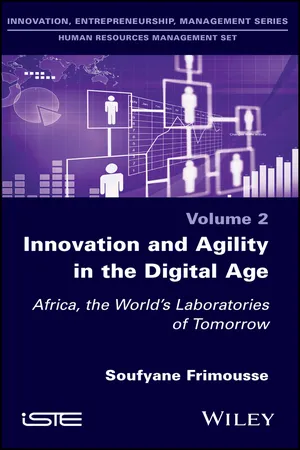
eBook - ePub
Innovation and Agility in the Digital Age
Africa, the World's Laboratories of Tomorrow
- English
- ePUB (mobile friendly)
- Available on iOS & Android
eBook - ePub
Innovation and Agility in the Digital Age
Africa, the World's Laboratories of Tomorrow
About this book
Information
1
Disrupters, Breadcrumbs and the Managerial Revolution
The digital revolution is one of the major turning points of humanity, at the same level as the invention of writing and the invention of printing by Gutenberg which made possible the emergence of the Enlightenment. The digital transformation is a technological revolution comparable to the appearance of electricity, except that it has changed the world in 20 years instead of a century!
Google, Facebook, Amazon, Airbnb and the like have attacked and disintermediated a large number of professions which thought themselves untouchable, like booksellers, advertisers, taxis, hotels and so on. Today, instead of going to a bookstore, a 21st-Century person goes to the Amazon website.
After four years, the Airbnb startup offers over 200 countries more rooms to rent every day than the Hilton group, which has built up its heritage over a hundred years. Uber, like Airbnb, shows that user experience is superior to regulation. Uber not only interacts with 10 million customers and 200,000 drivers, but also interacts with banks, payment systems, traffic information systems, social networks and so on. The more the firm interacts, the more it creates value and becomes indispensable for its users. Joël de Rosnay (2016) describes these firms as “disruptors” (or disruption). In the classical model, goods and services are distributed by networks to reach consumers and create a profit margin. In the disruptive model, platforms allow the creation of added value by customers. It is then reused by these firms to resell it to others.
The art of disruption or “Uberization” thus corresponds to businesses who have accomplished the disintermediation of traditional structures through offering more personalized services and products, more rapidly. Disruption is based on technological reappropriation by citizens who create innovative systems which will change habits, ways of life and communication. It is thus not a discovery that will change things.
It is rather the convergence between these elements. Gilles Babinet (2016) adds that innovation is also affected since previously, it was incremental. The best example is that of the internal combustion engine whose performance has progressively developed over a century and a half. Now, innovation also involves disruption.
All these ruptures or disruptions are supported and accelerated by the development of technologies which are shaping a connected, globalized and rapid world in perpetual motion, which profoundly changes ways of thinking, communicating and working. For “Millennials”, the smartphone is not a tool of communication, but a prosthesis. They are capable of carrying out multiple activities by downloading applications. Smartphones in particular allow us to interface with transmitter–receiver tools communicating directly between the body and the machine (Internet of Things). Technologies have changed our perception of space and time! The level of sophistication of these devices is such that we interact with machines more than with people.
These very fast machines lead to shorter time, which is one of the aspects of this anthropological revolution. Technologies have not reduced distances; they have suppressed them. Ways of accessing knowledge have also profoundly changed.
For Michel Serres (2012), computers, including all information technology including the Internet, smartphones, etc., will affect all areas of life (law, politics, commerce, religion, education, finance, etc.). With the digital era, human beings hold the world in their hands. In fact, they hold their devices in their hands and, if they wish, they can communicate with every place in the world and access every piece of information at any moment, and they are slashers (holding down several jobs) or freelancers (in business for themselves).
They overcome natural stupidity and move towards artificial intelligence. Thanks to smartphones, artificial intelligence, robotics and the power of interconnection between them, human beings multiply their capacities due to the emergence of increased collective intelligence. This means a real mutation of the human species.
Joel de Rosnay (2016) predicts the emergence of an “increased collective intelligence” which will lead to hyperhumanism, which according to him is something much more preferable than transhumanism, which promotes the use of science and technology to improve the physical and mental characteristics of human beings. Ray Kurzweil (2005), an icon of transhumanism, believes that exponential technological innovation will allow us to conquer death and eventually give rise to machines that are more intelligent than humans. Kurzweil (2005) identifies genetics, nanotechnology and robotics as the three revolutions that will define our lives in the next few decades. The adepts of transhumanism dream of being able to transcend humanity through artificial intelligence by creating superhumans and individual supra-intelligence. This vision is far from being unanimously welcomed.
For de Rosnay (2016), transhumanism is inhuman, as the transformations foreseen in the body or the brain are reserved for a privileged few, and life and death are inseparable and indispensable. However, transhumanist advances may lead, thanks to philosophical reflection on pushing the limits of the human body, to prolonging life expectancy and may contribute to positive human and social evolution. Already, connected objects act in symbiosis with humans. It is this integrated and collective symbiosis which humanity should create, and this is the challenge that current and future generations should meet. We realize through these crucial questions that digital transformation is not to be addressed solely via the technological angle of digital tools. It is also and especially a matter of human beings – but also of management and organization.
1.1. Digital disruptions of management
The development of digital technology has upset the business world in its organization and its managerial system. Traditional organizations appear outdated and incapable of handling the transformations caused by this mutation. With its descending circuit of information, its centralized decision-making process and its very hierarchical relationships, the classical organization has proved its effectiveness for a long time. These hierarchical, functional, matrical, etc., models of operation, widely studied by Henry Mintzberg (1990), are very useful for building organizational charts, understanding the relationships between support functions and operation functions, and adapting managerial positions. A manager in pyramidal organizations favors a formal mode of reasoning which does not promote the development of intelligence, sensitivity or intuition, but rather the acquisition of automatic behavior patterns and conditioning of the “problem-solving” type.
William Whyte (1956), in The Organization Man, aptly describes how pyramidal firms maintain and create conformism. These days, the need for innovation and agility, associated with the influence of digital technology on behaviors, puts into question this schema, which is proving too constraining to adapt rapidly to changes in clients, the market and employees. It is now necessary for employees to decide quickly and to be empowered to iteratively test which options are the most suited to a given context. In a few years, innovative companies, with outstanding management who break with conventional wisdom, have thus become giants of the global economy. In 2017, these groups have accumulated more than 250 billion dollars in turnover. The GAFA firms (Google, Apple, Facebook and Amazon) are worth 1,740 billion dollars after 23 years of existence. The NATU firms (Netflix, Airbnb, Tesla and Uber) are worth 140 billion dollars after 14 years. The Chinese BATX firms (Baidu, Alibaba, Tencent and Xiaomi) are worth 460 billion dollars after 14 years.
It seems difficult to disconnect such results from the organizational environments that they put in place and the way in which they think about work. Is it a new managerial paradigm? What are its innovative aspects? In the next section, we will explore a few of these.
Amazon’s subsidiary Zappos, an online commerce site, has enacted “holacracy”, which is a mode of organization based on shared responsibilities for employees and transversality of skills. Employees are thus asked to act like entrepreneurs and to take initiative rather than to wait for orders from their manager. Holacracy has already been adopted by more than 300 firms worldwide.
Isaac Getz and Brian M. Carney (2012) describe another form of organization which they name “liberated companies”. These give their employees responsibility, granting them confidence and leaving very wide decision-making autonomy to their workers. This encourages mutual listening and collaborative work. Teams are motivated, involved, faithful and much more productive. In a liberated company, control is not lost; it is shared. Orangina and Michelin are engaged in this approach. Frédéric Laloux (2015) recommends establishing freedom of decision-making at all levels of the organization. Customer satisfaction derives most often from initiative, which is the result of teams being granted autonomy. Frédéric Laloux (2015) cites and analyzes the example of the Favi and Buurtzort companies, which show the importance of “empowerment” of the team which becomes responsible for its business objectives. Laloux (2015) constantly underlines the importance of continuous improvement with the influence of lean management in the sense of the Toyota Way.
As part of the same movement of managerial innovation, Kazuo Inamori (2012) has developed for his group a method called “Amoeba Management”, which consists of dividing the organization into small operational units each under the authority of a leader. They are called “amoebas”. The leader is in charge of creating the goals and action plans for the amoeba with their team. The amoebas function as teams in collaborative mode. “Amoeba Management” is used by approximately 600 companies.
A movement called “adaptive enterprises” or Responsive Organizations has also been created in the United States, which brings together all the features found in holacracy and liberated companies. This movement values collective intelligence. An adaptive organization is “learning”. Galindo (2017) presents the dimensions of the ideal type of human resources management in start-ups through the French acronym C.I.D. (Knowledge (Connaissances), Challenges, Conviviality / Informal, Involvement, Initiatives / Delegation, Right to be wrong (Droit à l’erreur), Distribution of incentives). Human resources are judged by their updated knowledge. They are often challenged. Thus, to avoid the excesses of individualism, maintaining conviviality is a priority. The company favors informality at the level of exchanges and monitors the degree of involvement. The spirit of initiative is encouraged.
Employees are encouraged to become personally involved in resolving collective problems and to self-manage due to delegation of responsibilities. The right to be wrong is part of the firm’s culture. Contributions are recognized via rewards.
Some observers reject these horizontal or cellular models as a fashionable phenomenon1. On our part, the authors believe it is part of a real revolution.
According to Salim Ismail et al. (2014), Amazon, Netflix, Uber, Airbnb, Google and Instagram are exponential organizations (ExO), as they have been able to convert available information into competitive advantage by exploiting the network effect and the acceleration associated with this effect to create a “disruptive” model. This analytical matrix is based on the opposition between linear and exponential structures. While the world of information develops exponentially, our organizational structures are still linear. They are therefore inadequate. These exponential organizations rest on the six Ds defined by Peter Diamandis and Steve Kotler (2012) (Digitalized/Deceptive/Disruptive/Dematerialized/Demonetized/Democratiz ed). Digitalization allows rapid spread.
Afterwards, there is deception because growth is virtually invisible. Then, disruption creates a new market and thus overturns what already exists. Demonetization tends to remove money from services and products, and dematerialization tends to remove the services and products themselves. Video camera, video game, dictaphone, calculator, clock… all these applications have been dematerialized and become free of charge when they once had a significant cost. Even if the applications mentioned above have become free of charge, it is necessary to pay the price of the smartphones in which they have been integrated. Democratization takes place when prices become low enough that they become accessible and affordable to the greatest number.
These exponential organizations are also sometimes called “unicorns”, a term created by Aileen Lee in 2013 to insist on the link to dreams, magic, sympathy and power. The author has re-used the term “unicorn” to describe these new technological firms which have reached values of at least a billion dollars. This very small circle included, at the end of 2016, 179 companies in total worldwide. This exponential vision was theorized by Ray Kurzweil (2005), chief engineer of Google, based on Moore’s law stated in 1965, according to which the power of processors doubles every 18 months.
According to Kurzweil (2005), many people think about the future linearly. They think that they are going to continue to deal with problems by using the tools and progress of today and do not take into account the exponential growth of technologies. Evolutionary processes such as technology accelerate. They function through interaction and create a capacity, then they use this capacity to pass on to the next stage. In other words, the results of faster computers are used to build even faster computers.
Some traditional firms such as Procter & Gamble and Coca-Cola are moving towards this type of exponential organization. For Salim Ismail et al. (2014), this evolution is based on a transformation of leadership and the progressive integration of principles. In fact, to transform organizations, it is first necessary to transform employees and in particular, managers. Leadership must thus change paradigm.
Faced with the crisis of traditional models of leadership, the approach of the positive leader seems to constitute an interesting alternative. A...
Table of contents
- Cover
- Table of Contents
- Foreword
- Introduction
- 1 Disrupters, Breadcrumbs and the Managerial Revolution
- 2 The African Continent: Laboratory of Tomorrow’s World
- 3 The Mediterranean: Marrying the Future without Divorcing the Past
- Conclusion
- Postface
- References
- Index
- End User License Agreement
Trusted by 375,005 students
Access to over 1.5 million titles for a fair monthly price.
Study more efficiently using our study tools.
Frequently asked questions
Yes, you can cancel anytime from the Subscription tab in your account settings on the Perlego website. Your subscription will stay active until the end of your current billing period. Learn how to cancel your subscription
No, books cannot be downloaded as external files, such as PDFs, for use outside of Perlego. However, you can download books within the Perlego app for offline reading on mobile or tablet. Learn how to download books offline
Perlego offers two plans: Essential and Complete
- Essential is ideal for learners and professionals who enjoy exploring a wide range of subjects. Access the Essential Library with 800,000+ trusted titles and best-sellers across business, personal growth, and the humanities. Includes unlimited reading time and Standard Read Aloud voice.
- Complete: Perfect for advanced learners and researchers needing full, unrestricted access. Unlock 1.5M+ books across hundreds of subjects, including academic and specialized titles. The Complete Plan also includes advanced features like Premium Read Aloud and Research Assistant.
We are an online textbook subscription service, where you can get access to an entire online library for less than the price of a single book per month. With over 1.5 million books across 990+ topics, we’ve got you covered! Learn about our mission
Look out for the read-aloud symbol on your next book to see if you can listen to it. The read-aloud tool reads text aloud for you, highlighting the text as it is being read. You can pause it, speed it up and slow it down. Learn more about Read Aloud
Yes! You can use the Perlego app on both iOS and Android devices to read anytime, anywhere — even offline. Perfect for commutes or when you’re on the go.
Please note we cannot support devices running on iOS 13 and Android 7 or earlier. Learn more about using the app
Please note we cannot support devices running on iOS 13 and Android 7 or earlier. Learn more about using the app
Yes, you can access Innovation and Agility in the Digital Age by Soufyane Frimousse in PDF and/or ePUB format, as well as other popular books in Social Sciences & Popular Culture. We have over 1.5 million books available in our catalogue for you to explore.