Chemistry of the Carbonyl Group
eBook - ePub

Chemistry of the Carbonyl Group

A Step-by-Step Approach to Understanding Organic Reaction Mechanisms

  1. English
  2. ePUB (mobile friendly)
  3. Available on iOS & Android
eBook - ePub

Chemistry of the Carbonyl Group

A Step-by-Step Approach to Understanding Organic Reaction Mechanisms

About this book

Teaches and enables students to build confidence in drawing and manipulating curly arrows, a fundamental skill for all organic chemists 

This book is an interactive approach to learning about chemistry of the carbonyl group—inviting students to work through its pages with pencil and paper in hand. It educates with the belief that the most effective way to learn is by practice and interaction. With this in mind, the reader is asked to predict what would happen under a specific set of reaction conditions. The book is divided into frames: each frame poses a question and invites the reader to predict what will happen. Subsequent frames give the solution but then pose more questions to develop a theme further.

Chemistry of the Carbonyl Group: A Programmed Approach to Organic Reaction Mechanisms, Revised Edition provides a solid grounding in the fundamental reactions of carbonyls. Presented in full colour to enhance the understanding of mechanisms within chemistry, the chapters of this step-by-step guide cover: nucleophilic addition to the carbonyl group; nucleophilic substitution; nucleophilic substitution at the carbonyl group with complete removal of carbonyl oxygen; carbanions and enolisation; and building organic molecules from carbonyl compounds.

  • A must-have book for undergraduate chemists to emphasise understanding in carbonyl group chemistry
  • Goes through all the stages of basic carbonyl chemistry, detailing even the simplest mechanisms
  • A step-by-step learning guide to synthetic chemistry for the first year of a chemistry degree, with all the information needed for independent learning
  • Provides a solid grounding in the fundamental reactions of carbonyls which will inform the understanding of many other organic chemistry reactions  

Chemistry of the Carbonyl Group: A Programmed Approach to Organic Reaction Mechanisms - Revised Edition is packed with all the information on synthetic chemistry that every first-year student will need in order to learn independently. 

Frequently asked questions

Yes, you can cancel anytime from the Subscription tab in your account settings on the Perlego website. Your subscription will stay active until the end of your current billing period. Learn how to cancel your subscription.
No, books cannot be downloaded as external files, such as PDFs, for use outside of Perlego. However, you can download books within the Perlego app for offline reading on mobile or tablet. Learn more here.
Perlego offers two plans: Essential and Complete
  • Essential is ideal for learners and professionals who enjoy exploring a wide range of subjects. Access the Essential Library with 800,000+ trusted titles and best-sellers across business, personal growth, and the humanities. Includes unlimited reading time and Standard Read Aloud voice.
  • Complete: Perfect for advanced learners and researchers needing full, unrestricted access. Unlock 1.4M+ books across hundreds of subjects, including academic and specialized titles. The Complete Plan also includes advanced features like Premium Read Aloud and Research Assistant.
Both plans are available with monthly, semester, or annual billing cycles.
We are an online textbook subscription service, where you can get access to an entire online library for less than the price of a single book per month. With over 1 million books across 1000+ topics, we’ve got you covered! Learn more here.
Look out for the read-aloud symbol on your next book to see if you can listen to it. The read-aloud tool reads text aloud for you, highlighting the text as it is being read. You can pause it, speed it up and slow it down. Learn more here.
Yes! You can use the Perlego app on both iOS or Android devices to read anytime, anywhere — even offline. Perfect for commutes or when you’re on the go.
Please note we cannot support devices running on iOS 13 and Android 7 or earlier. Learn more about using the app.
Yes, you can access Chemistry of the Carbonyl Group by Timothy K. Dickens,Stuart Warren in PDF and/or ePUB format, as well as other popular books in Physical Sciences & Organic Chemistry. We have over one million books available in our catalogue for you to explore.

Information

Publisher
Wiley
Year
2018
Print ISBN
9781119459569
eBook ISBN
9781119459552

Chapter 1
Nucleophilic Addition to the Carbonyl Group

Concepts assumed:
  • c01-math-001
    - and
    c01-math-002
    -bonds.
  • ▪ Polarisable bonds.
  • ▪ Electrophile and nucleophile.
  • ▪ Conjugation with
    c01-math-003
    -bonds and lone pairs.
  • ▪ Inductive effects.
  • c01-math-004
    values.
  • ▪ Periodic table.
  • ▪ Transition states.
Concepts introduced:
  • ▪ Acid catalysis.
  • ▪ Instability of R2C(OR)2 in acid solution. Driving equilibria in a chosen direction by the use of acid, solvent, etc.
  • ▪ Stability of different carbonyl compounds. Stability and reactivity as two sides of the same coin.
  • ▪ Effect of substituents on equilibria. Relationship between basicity and nucleophilicity.
  • ▪ Organo-magnesium compounds as nucleophiles.
  • ▪ Use of Grignard reagents in syntheses.
  • ▪ Ease of dehydration of tertiary alcohols in acid solution.
  • ▪ Sources of nucleophilic H.
  • ▪ Use of Al and B compounds and as anion transferring reagents.
  • ▪ Drawing transition states.
  • ▪ Stability of the six-membered ring.
  • ▪ Use of protecting groups.
  • ▪ Use of reaction mechanisms in syntheses.
Have you read the introductions explaining what help you need, what you need to know and how to use the program? It's a good idea to do this before you start.
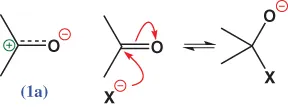
  1. 1. The carbonyl group (1a) has an easily polarisable
    c01-math-005
    -bond with an electrophilic carbon atom at one end easily attacked by nucleophiles:
    Schematic illustration of carbonyl group (1a) which has an easily polarisable Π-bond with an electrophilic carbon atom at one end.
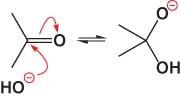
    Write down the reaction (with curly arrows) between acetone and hydroxide ion.
  2. 2. Have you actually written down the formulae of the reagents and drawn the arrows? The program won't be of much help to you unless you do.
  3. 3.
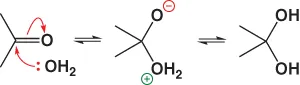
    Schematic illustration of a nucleophile such as water with its lone pair of electrons.
    A nucleophile such as water uses its lone pair electrons (:) to attack and forms a neutral addition compound by proton transfer:
    “Schematic illustration of water using its lone pair of electrons to attack and form a neutral addition compound by proton transfer.”
    Note that only one proton is needed.
    Write down the reaction between the carbonyl compound acetaldehyde and the proton-bearing nucleophile ethanol.
  4. 4. If you find ...

Table of contents

  1. Cover
  2. Title Page
  3. Copyright
  4. Table of Contents
  5. Dedication
  6. Preface
  7. Acknowledgements
  8. Some Help That you May Need
  9. What Do You Need To Know Before You Start?
  10. Introduction
  11. Chapter 1: Nucleophilic Addition to the Carbonyl Group
  12. Chapter 2: Nucleophilic Substitution
  13. Chapter 3: Nucleophilic Substitution at the Carbonyl Group With Complete Removal of Carbonyl Oxygen
  14. Chapter 4: Carbanions and Enolisation
  15. Chapter 5: Building Organic Molecules From Carbonyl Compounds
  16. Index
  17. End User License Agreement