- Organized in a clear, intuitive manner; introducing the reader to an understanding of the anatomical and electrophysiological bases of arrhythmias, then to a comprehensive review of how to diagnose the full range of rhythmic abnormalities, and then to a discussion of specific clinical syndromes in which arrhythmias play a part
- Highly illustrated chapters ensure key concepts are simpler to understand
- Detailed appendices provide quick reference values for diagnostic and therapeutic techniques, and pharmacotherapeutic agents, and Recommendations
- English
- ePUB (mobile friendly)
- Available on iOS & Android
eBook - ePub
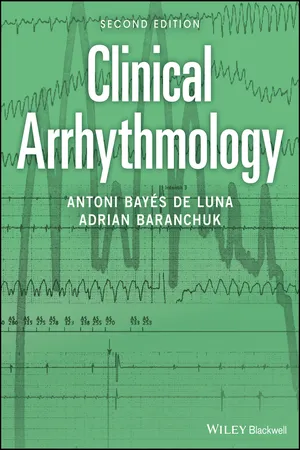
Clinical Arrhythmology
About this book
The second edition of Clinical Arrhythmology provides a fresh, clear, and authoritative overview that will guide readers from a solid understanding of the mechanisms behind cardiac arrhythmias -- which is fundamental to their identification -- to diagnosis via electrocardiograms and other tools, to specific management options for each of the arrhythmias that cardiologists and other clinicians will encounter in clinical practice.
Information
Part I
Anatomical and Electrophysiological Considerations, Clinical Aspects, and Mechanisms of Cardiac Arrhythmias
Chapter 1
Clinical Aspects of Arrhythmias
Definition of Arrhythmia
Arrhythmias are defined as any cardiac rhythm other than the normal sinus rhythm. Sinus rhythm originates in the sinus node. The electrocardiographic characteristics of normal sinus rhythm are:
- An impulse originated in sinus node initiates a positive P wave in I, II, VF, V2-V6, and positive or ± in leads III and V1 that is transmitted through the atria, the atrioventricular (AV) junction, and the intraventricular specific conduction system (ISCS).
- In the absence of pre-excitation, the PR interval ranges from 0.12 to 0.20 s.
- At rest, the sinus node discharge cadence tends to be regular, although it presents generally slight variations, which are usually not evident by palpation or auscultation. However, under normal conditions, and particularly in children, it may present slight to moderate changes dependent on the phases of respiration, with the heart rate increasing with inspiration.
- In adults at rest, the rate of the normal sinus rhythm ranges from 60 to 80 beats per minute (bpm). Thus, sinus rhythms over 80 bpm (sinus tachycardia) and those under 60 bpm (sinus bradycardia) may be considered arrhythmias. However, it should be taken into account that sinus rhythm varies throughout a 24-h period, and sinus tachycardia and sinus bradycardia usually are a physiologic response to certain sympathetic (exercise, stress) or vagal (rest, sleep) stimuli. Under such circumstances, the presence of these heart rates is normal.
- As already stated, it is normal to observe a certain variation of the heart rate during 24 hours. Thus, the evidence of a completely fixed heart rate both during the day and at night is suggestive of arrhythmia. In addition, it is important to remember that:
- i. The term arrhythmia does not mean rhythm irregularity, as regular arrhythmias can occur, often with absolute stability (flutter, paroxysmal tachycardia, etc.), sometimes presenting heart rates in the normal range, as is the case with the flutter 4×1. On the other hand, some irregular rhythms should not be considered arrhythmias (mild to moderate irregularity in the sinus discharge, particularly when linked to respiration, as already stated).
- ii. A diagnosis of arrhythmia in itself does not mean evident pathology. In fact, in healthy subjects, the sporadic presence of certain arrhythmias, both active (premature complexes) and passive (escape complexes, certain degree of AV block, evident sinus arrhythmia, etc.) is frequently observed.
Classification
There are different ways to classify cardiac arrhythmias:
- According to the site of origin: arrhythmias are divided into supraventricular (including those having their origin in the sinus node, the atria, and the AV junction), and ventricular arrhythmias.
- According to the underlying mechanism: arrhythmias may be explained by (i) abnormal formation of impulses, which includes increased heart automaticity (extrasystolic or parasystolic mechanism) and triggered electrical activity, (ii) reentry of different types, and (iii) decreased automaticity and/or disturbances of conduction (see Chapter 3).
- From the clinical point of view arrhythmias may be paroxysmal, incessant, or permanent. In reference to tachyarrhythmias (an example of an active arrhythmia, see later), paroxysmal tachyarrhythmias occur suddenly and usually disappear spontaneously (i.e., AV junctional reentrant paroxysmal tachycardia); permanent tachyarrhythmias are always present (i.e., permanent atrial fibrillation); and incessant tachyarrhythmias are characterized by short and repetitive runs of supraventricular (Figure 4.21) or ventricular (Figure 5.4) tachycardia. Extrasystoles may also occur in a paroxysmal or incessant way (see Chapter 3, Mechanisms Responsible for Active Cardiac Arrhythmias). Some bradyarrhythmias, such as advanced AV block (an example of passive arrhythmia, see later), may also occur in a paroxysmal or permanent form.
- From an electrocardiographic point of view, arrhythmias may be divided into two different types: active and passive (Table 1.1):
- Active arrhythmias due to increased automaticity, reentry, or triggered electrical activity (see Chapter 3 and Table 3.1) generate isolated or repetitive premature complexes on the electrocardiogram (ECG), which occur before the cadence of the regular sinus rhythm. The isolated premature complexes may be originated in a parasystolic or extrasystolic ectopic focus. The extrasystolic mechanism presents a fixed coupling interval, whereas the parasystolic presents a varied coupling interval. Premature complexes of supraventricular origin (p′) are generally followed by a narrow QRS complex, although they may be wide if are conducted with aberrancy. The ectopic P wave (P′) is often not easily seen as it may be hidden in the preceding T wave. In other cases the premature atrial impulse remains blocked in the AV junction, initiating a pause instead of a premature QRS complex (Figures 4.1C and 7.3). The premature complexes of ventricular origin are not preceded by an ectopic P wave, and the QRS complex is always wide (≥⃒0.12 s), unless they originate in the upper part of the intraventricular specific conduction system (see Chapter 5, Electrocardiographic Diagnosis).Premature and repetitive complexes include all types of supraventricular or ventricular tachyarrhythmias (tachycardias, fibrillation, flutter). In active cardiac arrhythmias due to reentrant mechanisms, a unidirectional block exists in some part of the circuit (Figure 3.6).
- Passive arrhythmias occur when cardiac stimuli formation and/or conduction are below the range of normality due to a depression of the automatism and/or a stimulus conduction block in the atria, the AV junction, or the specific intraventricular conduction systems (ICS).From an electrocardiographic point of view, many pas...
-
Table of contents
- Cover
- Title Page
- Copyright
- Table of Contents
- Foreword by Dr. Valentin Fuster
- Foreword by Dr. Pere Brugada i Terradellas
- Preface
- Recommended General Bibliography
- Part I: Anatomical and Electrophysiological Considerations, Clinical Aspects, and Mechanisms of Cardiac Arrhythmias
- Part II: Diagnosis, Prognosis and Treatment of Arrhythmias
- Part III: The ECG and Risk of Arrhythmias and Sudden Death in Different Heart Diseases and Situations
- Appendix
- Index
- End User License Agreement
Trusted by 375,005 students
Access to over 1.5 million titles for a fair monthly price.
Study more efficiently using our study tools.
Frequently asked questions
Yes, you can cancel anytime from the Subscription tab in your account settings on the Perlego website. Your subscription will stay active until the end of your current billing period. Learn how to cancel your subscription
No, books cannot be downloaded as external files, such as PDFs, for use outside of Perlego. However, you can download books within the Perlego app for offline reading on mobile or tablet. Learn how to download books offline
Perlego offers two plans: Essential and Complete
- Essential is ideal for learners and professionals who enjoy exploring a wide range of subjects. Access the Essential Library with 800,000+ trusted titles and best-sellers across business, personal growth, and the humanities. Includes unlimited reading time and Standard Read Aloud voice.
- Complete: Perfect for advanced learners and researchers needing full, unrestricted access. Unlock 1.5M+ books across hundreds of subjects, including academic and specialized titles. The Complete Plan also includes advanced features like Premium Read Aloud and Research Assistant.
We are an online textbook subscription service, where you can get access to an entire online library for less than the price of a single book per month. With over 1.5 million books across 990+ topics, we’ve got you covered! Learn about our mission
Look out for the read-aloud symbol on your next book to see if you can listen to it. The read-aloud tool reads text aloud for you, highlighting the text as it is being read. You can pause it, speed it up and slow it down. Learn more about Read Aloud
Yes! You can use the Perlego app on both iOS and Android devices to read anytime, anywhere — even offline. Perfect for commutes or when you’re on the go.
Please note we cannot support devices running on iOS 13 and Android 7 or earlier. Learn more about using the app
Please note we cannot support devices running on iOS 13 and Android 7 or earlier. Learn more about using the app
Yes, you can access Clinical Arrhythmology by Antoni Bayés de Luna,Adrian Baranchuk in PDF and/or ePUB format, as well as other popular books in Medicine & Cardiology. We have over 1.5 million books available in our catalogue for you to explore.