This bestselling textbook on physical electrochemistry caters to the needs of advanced undergraduate and postgraduate students of chemistry, materials engineering, mechanical engineering, and chemical engineering. It is unique in covering both the more fundamental, physical aspects as well as the application-oriented practical aspects in a balanced manner. In addition it serves as a self-study text for scientists in industry and research institutions working in related fields. The book can be divided into three parts: (i) the fundamentals of electrochemistry; (ii) the most important electrochemical measurement techniques; and (iii) applications of electrochemistry in materials science and engineering, nanoscience and nanotechnology, and industry. The second edition has been thoroughly revised, extended and updated to reflect the state-of-the-art in the field, for example, electrochemical printing, batteries, fuels cells, supercapacitors, and hydrogen storage.
1.1.1 The Transition from Electronic to Ionic Conduction
Physical electrochemistry is a branch of physical chemistry. If one were to describe the essence of electrode kinetics in one short phrase, it would be: “the transition from electronic to ionic conduction.” Naturally, the transfer of charge is influenced by the potential. Conduction in the solution is ionic, whereas in the electrodes and the connecting wires it is electronic. The transition from one mode of conduction to the other requires charge transfer across the interface. The rate of this transfer is controlled by the catalytic properties of the surface and the adsorption on it, the concentration and the nature of the reacting species, and all other parameters that control the rate of heterogeneous chemical reactions. In addition, the potential plays an important role. This is not surprising, since charge transfer is involved, and this process can be accelerated or retarded by the magnitude and the sign of the potential applied across the interface.
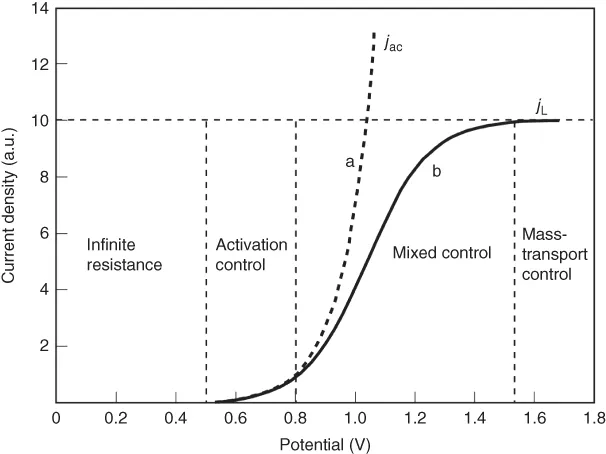
Figure 1.1 shows a typical way that the current density would respond to the potential applied, for the case of a dilute (0.01 M) solution of HI in 1.0 M H2SO4. The reaction concerned is
1.1
Figure 1.1 Schematic j/E plot for the electrolysis of a dilute (0.01 M) solution of HI in 1.0 M H2SO4, employing two Pt electrodes. The minimum potential for DC current flow is 0.59 V.
There is a lot of information in this simple equation, combined with Figure 1.1. The reaction does not occur spontaneously in the direction shown in Eq. 1.1. Electrical energy is needed to break up molecules of HI into H2 and I2. Electrical energy is being converted to chemical energy.
We note that Figure 1.1 has four regions. In the first region there is no current flowing, in other words, the resistance is infinite. It is important to understand that the current flowing here is exactly zero, not just very close to zero and too small to be detected experimentally. This follows directly from the first law of thermodynamics, the law of conservation of energy. The minimal electrical energy required to break up the molecules of HI in the particular reaction in Eq. 1.1 is 0.59 V. Above this threshold, the current rises exponentially with potential, along line a. The rate of the reaction is controlled by the rate of charge transfer jct. Eventually, the mass‐transport limitation takes over, as shown by the horizontal part of line b shown in Fig. 1.1. This is the mass‐transport‐limited current density, jL. In the third region, mixed control occurs; the current density is controlled both by activation and by mass transport.
1.1.2 The Resistance of the Interface can be Infinite
The potential is mostly measured with respect to a suitable reference electrode, and instead of the current, one refers to the current density j. Replacing the platinum electrodes with two copper electrodes and adding some CuSO4 instead of HI changes the situation dramatically. Passing a current between the electrodes causes no net chemical change (copper is dissolved off the positive anode and is deposited on the negative cathode). In this case, current is observed as soon as a potential, small as it may be, is applied between the electrodes.
1.1.3 Mass‐Transport Limitation
The rate of charge transfer can be greatly increased by increasing the potential, but charge can be transferred across the interface only over a very short distance (of the order of 1 nm). Another process is required to bring the reacting species close enough to the surface and to remove the species formed at the surface into the bulk of the solution. This process is called mass transport.
Mass transport and charge transfer are two consecutive processes. It is therefore always the slower of the two that determines the overall rate observed experimentally. When the potential applied is low, barely above its minimum value needed to pass a current, charge transfer is slow and one can ignore mass‐transport limitation. The bottleneck is in transferring the charge across the interface to the electroactive species, not in getting the species to the surface. At high potentials, charge transfer becomes the faster process and ceases to influence the overall rate. Increasing the potential further will increase the rate of charge transfer, but this will have no effect on the observed current density, which will be limited by mass transport. The result is a current density that is independent of potential, which is referred to as the limiting current density, jL, as seen in Figure 1.1. For the observed current density j, one can write the simple equation
1.2
Clearly, the smaller of the two currents is dominant. In a stirred solution, a steady state is reached when the concentration inside the diffusion layer varies linearly with distance. Under such conditions we can express the current density by
1.3
where n is the number of electrons transferred, F is the Faraday constant (96 485 C mol−1), nF is the charge transferred per mole, D is the diffusion coefficient of the species (cm2 s−1), cb is the concentration (mol cm−3) of the electroactive species ...
Table of contents
Cover
Table of Contents
Dedication
Preface
Symbols and Abbreviations
1 Introduction
2 The Potentials of Phases
3 Fundamental Measurements in Electrochemistry
4 Electrode Kinetics: Some Basic Concepts
5 Single‐Step Electrode Reactions
6 Multistep Electrode Reactions
7 Specific Examples of Multistep Electrode Reactions
8 The Electrical Double Layer (EDL)
9 Electrocapillary
10 Intermediates in Electrode Reactions
11 Underpotential Deposition and Single‐Crystal Electrochemistry
12 Electrosorption
13 Fast Transients, the Time‐Dependent Diffusion Equation, and Microelectrodes
14 Linear Potential Sweep and Cyclic Voltammetry
15 Electrochemical Impedance Spectroscopy (EIS)
16 The Electrochemical Quartz Crystal Microbalance (EQCM)
17 Corrosion
18 Electrochemical Deposition
19 Electrochemical Nanotechnology
20 Energy Conversion and Storage
Index
End User License Agreement
Trusted by 375,005 students
Access to over 1.5 million titles for a fair monthly price.
Study more efficiently using our study tools.
Frequently asked questions
Yes, you can cancel anytime from the Subscription tab in your account settings on the Perlego website. Your subscription will stay active until the end of your current billing period. Learn how to cancel your subscription
No, books cannot be downloaded as external files, such as PDFs, for use outside of Perlego. However, you can download books within the Perlego app for offline reading on mobile or tablet. Learn how to download books offline
Perlego offers two plans: Essential and Complete
Essential is ideal for learners and professionals who enjoy exploring a wide range of subjects. Access the Essential Library with 800,000+ trusted titles and best-sellers across business, personal growth, and the humanities. Includes unlimited reading time and Standard Read Aloud voice.
Complete: Perfect for advanced learners and researchers needing full, unrestricted access. Unlock 1.5M+ books across hundreds of subjects, including academic and specialized titles. The Complete Plan also includes advanced features like Premium Read Aloud and Research Assistant.
Both plans are available with monthly, semester, or annual billing cycles.
We are an online textbook subscription service, where you can get access to an entire online library for less than the price of a single book per month. With over 1.5 million books across 990+ topics, we’ve got you covered! Learn about our mission
Look out for the read-aloud symbol on your next book to see if you can listen to it. The read-aloud tool reads text aloud for you, highlighting the text as it is being read. You can pause it, speed it up and slow it down. Learn more about Read Aloud
Yes! You can use the Perlego app on both iOS and Android devices to read anytime, anywhere — even offline. Perfect for commutes or when you’re on the go. Please note we cannot support devices running on iOS 13 and Android 7 or earlier. Learn more about using the app
Yes, you can access Physical Electrochemistry by Noam Eliaz,Eliezer Gileadi in PDF and/or ePUB format, as well as other popular books in Physical Sciences & Physical & Theoretical Chemistry. We have over 1.5 million books available in our catalogue for you to explore.