eBook - ePub
OMICS-Based Approaches in Plant Biotechnology
- English
- ePUB (mobile friendly)
- Available on iOS & Android
eBook - ePub
OMICS-Based Approaches in Plant Biotechnology
About this book
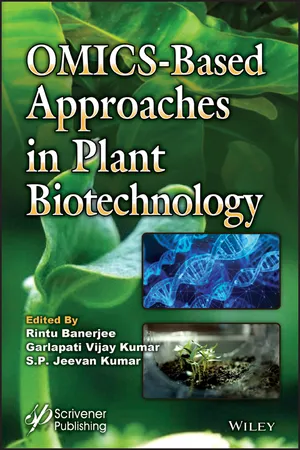
Burgeoning world population, decreased water supply and land resources, coupled with climate change, result in severe stress conditions and a great threat to the global food supply. To meet these challenges, exploring Omics Technologies could lead to improved yields of cereals, tubers and grasses that may ensure food security. Improvement of yields through crop improvement and biotechnological means are the need-of-the-hour, and the current book "OMICS-Based Approaches in Plant Biotechnology", reviews the advanced concepts on breeding strategies, OMICS technologies (genomics, transcriptomics and metabolomics) and bioinformatics that help to glean the potential candidate genes/molecules to address unsolved problems related to plant and agricultural crops. The first six chapters of the book are focused on genomics and cover sequencing, functional genomics with examples on insecticide resistant genes, mutation breeding and miRNA technologies. Recent advances in metabolomics studies are elucidated in the next 3 chapters followed by 5 chapters on bioinformatics and advanced techniques in plant biotechnology and crop breeding. The information contained in the volume will help plant breeders, plant biotechnologists, plant biochemists, agriculture scientists and researchers in using this applied research to focus on better crop breeding and stress adaptation strategies.
Information
Part 1
GENOMICS
Chapter 1
Exploring Genomics Research in the Context of Some Underutilized Legumes—A Review
Patrush Lepcha, Pittala Ranjith Kumar and N. Sathyanarayana*
Department of Botany, Sikkim University, Gangtok, East Sikkim, India
*Corresponding author: [email protected]
Abstract
Broadening legume resource base is imperative to meet the ever-increasing demand for protein-rich diet in the developing world. Many legumes species considered to be minor on a global scale have now been investigated and found to possess excellent nutritional value. Some of them are even a storehouse of rare drug molecules. Till date, their large-scale adoption for cultivation has remained unmet owing to poor research investments in these crops. Many of them have skipped genomics revolution and lack targeted genetic improvement programs. Recently, there has been renewed interest in these crops, and progress in genetic and genomics resources development is catching up, fueling greater promise toward molecular breeding and gene discovery programs in the near future. This review focuses on providing nutritional potential and prospects of genomic research in four lesser-known legume species: velvet bean, winged bean, rice bean, and lablab bean, which are grown as minor crops across the Indian subcontinent.
Keywords: Genomics, legumes, genomic resources, transcriptome, nutritional potential, segregant population, genetic map
1.1 Introduction
Trends in human population growth and pattern of consumption imply that the global demand for food will continue to grow for the next 40 years. This, along with depleting land and water resources in addition to climate change, poses serious threats to food security, particularly in the developing countries [1]. The burgeoning problem may attain serious dimensions in future years as the current yield-increase trends in major food crops may not be adequate in dealing with the growing demand [2, 3]. The grain legumes provide humans with important sources of food, fodder, oil, and fodder products [4]. They are also the vital source of dietary protein, vitamins, minerals, as well as omega-3 fatty acids [5] and can supply rare pharmaceuticals [6]. Even though quite a few proteinaceous edible legumes are available on the market, their production rate vis-à-vis consumption in most instances has remained unachieved and an ever-rising demand has been witnessed [7]. Also, a rising penchant for protein-rich vegetarian-based diet in world population has created unusual scarcity to plant resources [8]. There are several minor food legumes whose potential is untapped and underexploited. Bambara groundnut (Vigna subterranean L.), adzuki bean [Vigna angularis], faba bean (Vicia faba L.), velvet bean (Mucuna spp.), grass pea (Lathyrus sativus L.), horse gram [Macrotyloma uniflorum], hyacinth bean (Lablab purpureus L.), moth bean [Vigna aconitifolia], rice bean [Vigna umbellata], and winged bean [Psophocarpus tetragonolobus (L.) DC.] are important members of this grouping [6]. They possess excellent nutritional value and can offer a vital source of protein, vitamins, and minerals in LIFDC (low-income-food-deficit) countries. Since many of them are well adapted to marginal conditions, they may also be a warehouse of important genes associated with biotic and abiotic stress tolerance. However, to varying extents, almost all these crops have suffered from scantily developed resources for genetic and genomic research, thus limiting use of enabling biotechnologies for their improvement. In this review, we have focused on the nutritional potential and the accessibility and deployment of advanced genetic and genomic tools for diversity assessment, trait mapping, and molecular breeding in four underutilized legume species cultivated in and around the Indian subcontinent (Table 1.1). Further, an insight based on newly emerging biological approaches for early deployment of molecular breeding and development of improved cultivars has been provided, though many of these methods are yet to be tested for improving quality, nutritional abundance, and productivity in these legume species.
Table 1.1 Comparison of genomic resources in four lesser-known legume species.
| Mucuna pruriens | Psophocarpus tetragonolobus | Vigna umbellata | Lablab purpureus | |
| Chromosome number | 2n = 2x = 22 [10] | 2n = 2x = 18 [27] | 2n = 2x = 22 [44, 45] | 2n = 2x = 22 or 24 [58] |
| Genome size | ~1,361 Mbp [6] | 1.22 Gbp [28] | 367 Mb [59] | |
| RAPD | Padmesh et al., [21], Patil et al., [23] | Mohanty et al., [39] | Kaga et al., [49], Shafiqul et al., [50], Muthusamy et al., [52] | Rai et al., [69], Biswas et al., [... |
Table of contents
- Cover
- Title page
- Copyright page
- Introduction
- Part 1: Genomics
- Part 2: Metabolomics
- Part 3: Bioinformatics
- Part 4: Advances in Crop Improvement: Emerging technologies
- Index
- End User License Agreement
Trusted by 375,005 students
Access to over 1.5 million titles for a fair monthly price.
Study more efficiently using our study tools.
Frequently asked questions
Yes, you can cancel anytime from the Subscription tab in your account settings on the Perlego website. Your subscription will stay active until the end of your current billing period. Learn how to cancel your subscription
No, books cannot be downloaded as external files, such as PDFs, for use outside of Perlego. However, you can download books within the Perlego app for offline reading on mobile or tablet. Learn how to download books offline
Perlego offers two plans: Essential and Complete
- Essential is ideal for learners and professionals who enjoy exploring a wide range of subjects. Access the Essential Library with 800,000+ trusted titles and best-sellers across business, personal growth, and the humanities. Includes unlimited reading time and Standard Read Aloud voice.
- Complete: Perfect for advanced learners and researchers needing full, unrestricted access. Unlock 1.5M+ books across hundreds of subjects, including academic and specialized titles. The Complete Plan also includes advanced features like Premium Read Aloud and Research Assistant.
We are an online textbook subscription service, where you can get access to an entire online library for less than the price of a single book per month. With over 1.5 million books across 990+ topics, we’ve got you covered! Learn about our mission
Look out for the read-aloud symbol on your next book to see if you can listen to it. The read-aloud tool reads text aloud for you, highlighting the text as it is being read. You can pause it, speed it up and slow it down. Learn more about Read Aloud
Yes! You can use the Perlego app on both iOS and Android devices to read anytime, anywhere — even offline. Perfect for commutes or when you’re on the go.
Please note we cannot support devices running on iOS 13 and Android 7 or earlier. Learn more about using the app
Please note we cannot support devices running on iOS 13 and Android 7 or earlier. Learn more about using the app
Yes, you can access OMICS-Based Approaches in Plant Biotechnology by Rintu Banerjee, Garlapati Vijay Kumar, S.P. Jeevan Kumar, Rintu Banerjee,Garlapati Vijay Kumar,S.P. Jeevan Kumar,Rintu Banerjee,Garlapati Vijay Kumar in PDF and/or ePUB format, as well as other popular books in Technology & Engineering & Agriculture. We have over 1.5 million books available in our catalogue for you to explore.