This new edition introduces operation and design techniques for Sigma-Delta converters in physical and conceptual terms, and includes chapters which explore developments in the field over the last decade
Includes information on MASH architectures, digital-to-analog converter (DAC) mismatch and mismatch shaping
Investigates new topics including continuous-time ?? analog-to-digital converters (ADCs) principles and designs, circuit design for both continuous-time and discrete-time ?? ADCs, decimation and interpolation filters, and incremental ADCs
Provides emphasis on practical design issues for industry professionals
The aim of this introductory chapter is to motivate the need for oversampling data converters, and to give a bird’s-eye view of the topics covered in this book. Towards the end of the chapter, we give a brief overview of the origins of ΔΣ data conversion and trends in this exciting area.
1.1 The Need for Oversampling Converters
Computational and signal processing tasks are now performed predominantly by digital means, since digital circuits are robust and can be realized by extremely small and simple structures that can in turn be combined to obtain very complex, accurate, and fast systems. Every year, the speed and density (of transistors) of digital integrated circuits (ICs) increase, thereby enhancing the dominance of digital methods in almost all areas of communications and consumer products. Since the physical world nevertheless remains stubbornly analog, data converters are needed to interface with the digital signal processing (DSP) core. As the speed and capability of DSP cores increases, so too must the speed and accuracy of the converters associated with them. This presents a continual challenge to the lucky few engineers dedicated to the design of data converters!
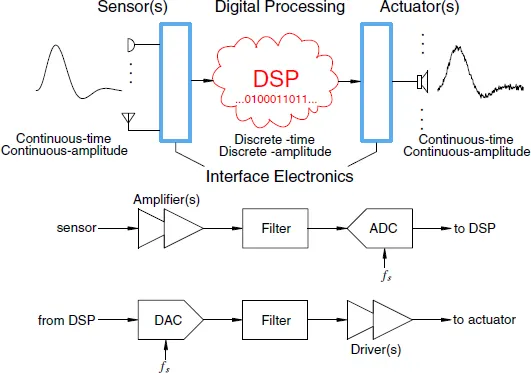
Figure 1.1 illustrates the block diagram of a signal processing system with analog input and output signals, plus a central digital engine. As shown, the analog input signal (usually after some amplification and filtering) enters an analog-to-digital converter (ADC), that transforms the input signal into a digital data stream. This stream is processed by the DSP core, and the resulting digital output signal is reconverted into analog form by a digital-to-analog converter (DAC). The DAC output is usually also filtered and amplified to obtain the final analog output signal.
Figure 1.1 ADCs and DACs interface the real world to the virtual world.
Data converters (both ADCs and DACs) can be classified into two main categories: Nyquist-rate and oversampled converters. In the former category, there exists a one-to-one correspondence between the input and output samples. Each input sample is separately processed, regardless of the earlier input samples; in other words, the converter has no memory. Applying a digital input word containing bits b1, b2, …, bN to a Nyquist-rate DAC ideally results in an analog output
(1.1)
where Vref is the reference voltage, regardless of any previous input word. The accuracy of conversion can be evaluated by comparing the actual value of Vout with the ideal value given by (1.1).
As the name implies, the sampling rate fs of a Nyquist-rate converter can be as low as Nyquist’s criterion requires, i.e., twice the bandwidth B of the input signal. (For practical reasons, the actual rate is usually somewhat higher than this minimum value.)
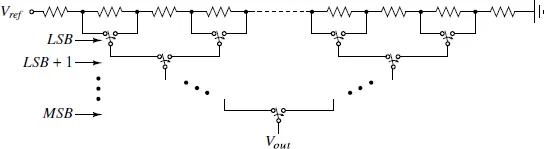
In most cases, the linearity and precision of a Nyquist-rate converter is determined by the matching accuracy of the analog components (resistors, current sources, or capacitors) used in the implementation. For example, in the N-bit resistor-string DAC shown in Figure 1.2, the resistors must have a relative matching error less than 2−N to guarantee an integral nonlinearity (INL)1 less than 0.5 LSB. Similar matching requirements prevail for ADCs and DACs constructed from current sources or switched-capacitor (SC) branches. Practical conditions restrict the matching accuracy to about 0.02%, and hence the effective number of bits (ENOB) to about 12, for such converters.
Figure 1.2 A resistor-string DAC. LSB denotes the least significant bit and MSB the most significant bit of the digital input.
In many applications (e.g., digital audio), higher resolution and linearity are required, even as much as 18 or 20 bits. The only Nyquist-rate converters capable of such accuracy are the integrating or counting ones. These, however, require at least 2N clock periods to convert a single sample, and hence, they are too slow for most signal processing applications.
Oversampling data converters are able to achieve over 20 ENOB resolution at reasonably high conversion speeds by relying on a trade-off. They use sampling rates much higher than the Nyquist rate, typically higher by a factor between 8 and 512, and ge...
Table of contents
Cover
Series Title Page
Title Page
Copyright
Contents
Preface
1 The Magic of Delta-Sigma Modulation
2 Sampling, Oversampling, and Noise-Shaping
3 Second-Order Delta-Sigma Modulation
4 High-Order Delta-Sigma Modulators
5 Multi-Stage and Multi-Quantizer Delta-Sigma Modulators
6 Mismatch-Shaping
7 Circuit Design for Discrete-Time Delta-Sigma ADCs
8 Continuous-Time Delta-Sigma Modulation
9 Nonidealities in Continuous-Time Delta-Sigma Modulators
10 Circuit Design for Continuous-Time Delta-Sigma Modulators
11 Bandpass and Quadrature Delta-Sigma Modulation
12 Incremental Analog-to-Digital Converters
13 Delta-Sigma DACs
14 Interpolation and Decimation Filters
A Spectral Estimation
B The Delta-Sigma Toolbox
C Linear Periodically Time-Varying Systems
Index
IEEE PRESS SERIES ON MICROELECTRONIC SYSTEMS
EULA
Trusted by 375,005 students
Access to over 1.5 million titles for a fair monthly price.
Study more efficiently using our study tools.
Frequently asked questions
Yes, you can cancel anytime from the Subscription tab in your account settings on the Perlego website. Your subscription will stay active until the end of your current billing period. Learn how to cancel your subscription
No, books cannot be downloaded as external files, such as PDFs, for use outside of Perlego. However, you can download books within the Perlego app for offline reading on mobile or tablet. Learn how to download books offline
Perlego offers two plans: Essential and Complete
Essential is ideal for learners and professionals who enjoy exploring a wide range of subjects. Access the Essential Library with 800,000+ trusted titles and best-sellers across business, personal growth, and the humanities. Includes unlimited reading time and Standard Read Aloud voice.
Complete: Perfect for advanced learners and researchers needing full, unrestricted access. Unlock 1.5M+ books across hundreds of subjects, including academic and specialized titles. The Complete Plan also includes advanced features like Premium Read Aloud and Research Assistant.
Both plans are available with monthly, semester, or annual billing cycles.
We are an online textbook subscription service, where you can get access to an entire online library for less than the price of a single book per month. With over 1.5 million books across 990+ topics, we’ve got you covered! Learn about our mission
Look out for the read-aloud symbol on your next book to see if you can listen to it. The read-aloud tool reads text aloud for you, highlighting the text as it is being read. You can pause it, speed it up and slow it down. Learn more about Read Aloud
Yes! You can use the Perlego app on both iOS and Android devices to read anytime, anywhere — even offline. Perfect for commutes or when you’re on the go. Please note we cannot support devices running on iOS 13 and Android 7 or earlier. Learn more about using the app
Yes, you can access Understanding Delta-Sigma Data Converters by Shanthi Pavan,Richard Schreier,Gabor C. Temes in PDF and/or ePUB format, as well as other popular books in Technology & Engineering & Electrical Engineering & Telecommunications. We have over 1.5 million books available in our catalogue for you to explore.