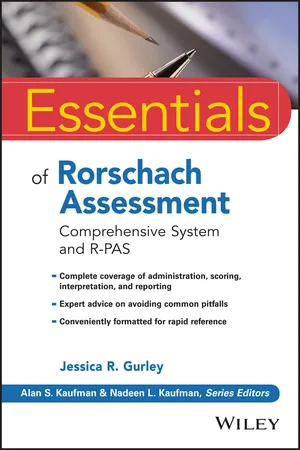
Essentials of Rorschach Assessment provides an invaluable resource for clinicians, offering the only step-by-step guidance toward all aspects of the Rorschach Comprehensive System and Rorschach Performance Assessment System (R-PAS). Beginning with an overview of the tests' history and development, the discussion delves into each test separately before placing the two side by side for direct comparison of administration, coding, and interpretation. The same case study is used for both tests, providing a start-to-finish example of how the Comprehensive System and R-PAS differ, and practical resources including checklists, charts, and sample forms help ease implementation, use, and transition. Thorough explanations break down the jargon and technical language to give clinicians a clearer understanding of both tests without sacrificing precision or depth of information, providing a quick and easy reference for Rorschach personality assessment.
- English
- ePUB (mobile friendly)
- Available on iOS & Android
eBook - ePub
About this book
Information
Chapter One
OVERVIEW AND HISTORY OF THE RORSCHACH TECHNIQUE
Personality can be defined as a person's individual patterns of thinking, behaving, emoting, and interacting with his or her environment in both the short term and the long term. People are often surprised to find out that personality assessment does not focus solely on the assessment of personality traits, such as extraversion or introversion. Instead, personality assessment assesses both personality traits, which are considered to be stable characteristics (e.g., extraversion), and personality states, which are more short lived (e.g., depression, anxiety). In other words, personality assessment encompasses both personality (personality traits) and emotional functioning (personality states).
Many mental health professionals use personality assessment instruments as part of an evaluation of a client's personality and emotional functioning. There are multiple personality assessment instruments that are commercially available from a variety of publishers. Until relatively recently, these instruments were divided into objective measures and projective measures. Objective measures, on the one hand, were considered to be measures such as the Minnesota Multiphasic Personality Inventory, Second Edition (MMPI‐2) (Butcher, Graham, Ben‐Porath, Tellegen, & Dahlstrom, 2001) and the Millon Clinical Multiaxial Inventory, Fourth Edition (MCMI‐IV) (Millon, Grossman, & Millon, 2015). These measures all use forced choice questions and rely on the ability of the clients to self‐report their distress. Projective measures, on the other hand, were considered to be measures that presented clients with an ambiguous stimulus and asked them to use the stimulus to engage in a specific task (e.g., to tell a story about a picture). This category included measures such as the Rorschach (Rorschach, 1921, 1942) and the Thematic Apperception Test (TAT) (Murray, 1943). In theory, individuals would project their unconscious wishes, desires, and so forth onto the ambiguous stimulus and thus their needs would present themselves in their responses.
However, it became clear that this distinction was leading some mental health professionals to believe that the objective measures were superior, as the term objective implied that the objective measures did not rely on subjective factors, such as clinical judgment and client introspection. In reality, however, clients can misrepresent themselves on the objective personality instruments, thereby affecting the interpretive value of the instruments. There is also the issue that clients can interpret questions differently, so the same question may mean different things to different people. As an example, the item “I often feel sad” requires the examinee to determine what sad is for them and what often means. For some, often may be multiple times per week and for others, often could mean once every two weeks. In other words, you could have two people responding to the item in the affirmative, one who feels sad multiple times per week and one who feels sad twice per month. Finally, it is important to note that all personality measures require clinical judgment and skill for interpretation. For these reasons, Meyer and Kurtz (2006) recommended that the mental health fields retire the term objective and start using a more appropriate term, such as self‐report, to describe measures where clients report on their own behaviors, thoughts, and emotions. It is now common practice to refer to the objective measures as self‐report measures.
The use of the terms projective and objective also negatively affected the measures that were classified as projective, as they were seen as being more subjective (Meyer & Kurtz, 2006). Additionally, there was another issue with the terminology, as some of the measures classified as projective did not rely purely on projection. The Rorschach is an excellent example of this. As will be discussed later in this chapter, the Rorschach, when administered using either the Comprehensive System (CS) (Exner, 2003) or the Rorschach Performance Assessment System (R‐PAS) (Meyer, Viglione, Mihura, Erard, & Erdberg, 2011), is actually a problem‐solving task. That is not to say that the Rorschach cannot be used as a projective measure; some clinicians do use it as a purely projective measure and do not use an administration, scoring, and interpretation system. It is also important to note that the stimuli used during the administration of the Rorschach are not actually ambiguous. As will be discussed in Chapters 3 and 6, there are common responses for nine of the ten cards, responses that occur in at least one third of protocols. In other words, the cards pull for some responses. This same pull for certain types of responses can be seen on other projective tests, such as the TAT. For example, one of the TAT cards that an examiner can choose to present is a picture of a man in a graveyard. There is a clear pull for death on this card. Some interpretive guides for the TAT provide a list of common themes that cards may pull for, again indicating that the test is not completely projective (Bellak & Abrams, 1996).
Meyer and Kurtz (2006) suggested a variety of other names for projective tests, including free response measures and performance‐based measures. It is my experience that many in the field have adopted the term performance‐based to describe tests where the examinee is not constrained by having to provide only one or two of a variety of circumscribed responses, such as is the case with self‐report measures (e.g., the MMPI‐2). Instead, performance‐based measures permit examinees to provide any response they wish, allowing for more individualism in the response. Consistent with the recommendation of Meyer and Kurtz (2006), this book will use the term self‐report measures to refer to tests where examinees are directly reporting on their own experiences in a forced choice format (e.g., multiple choice), and the term performance‐based measures to refer to tests where the examinee is not constrained by having to select one of only a few choices and is assessed based on his or her individual performance. Rapid Reference 1.1 outlines the differences between self‐report and performance‐based measures.
Rapid Reference 1.1
Self‐Report Versus Performance‐Based Measures
| Self‐Report Measures | Performance‐Based Measures |
|
|
THE RORSCHACH
There is no “one size fits all” personality assessment instrument. There are a variety of personality assessments commercially available, including highly structured interviews (e.g., the Structured Clinical Interview for DSM‐5 Personality Disorders [SCID‐5‐PD]), self‐report measures (e.g., the MMPI‐2), and performance‐based measures (e.g., CS, R‐PAS). Each instrument has its own strengths and weaknesses. It is important for clinicians using personality instruments to know the strengths, weaknesses, and psychometric information of the instruments they use. This will help the clinician to determine whether the instrument in question is appropriate for the examinee being assessed, given the referral question and the examinee's unique characteristics.
This book focuses on one of the oldest psychological assessment measures still commercially available: the Rorschach. Although many Rorschach systems are available, this book focuses on two administration, scoring, and interpretative systems: the Comprehensive System (CS) (Exner, 2003) and the Rorschach Performance Assessment System (R‐PAS) (Meyer et al., 2011). These systems were chosen because they appeared to be the most commonly used systems in the United States at the time this book was being written. Although this book describes both systems, it is not designed to replace John Exner's three‐volume set on the CS (Exner, 2003; Exner & Erdberg, 2005; Exner & Weiner, 1994) nor the R‐PAS manual (Meyer et al., 2011). Instead, it is designed to provide an overview of both systems, to explain some of the technical language from both systems in simpler terms, and to serve as a resource on both systems. To this end, this book has chapters dedicated to the CS and to R‐PAS, discussing administration, coding (scoring), and interpretation, and presenting a case sample for each system. Another goal of this book is to help clinicians bridge the gap between the CS and R‐PAS. To achieve this goal, an additional chapter focuses on the similarities and differences of the two systems and also their strengths and weaknesses. Finally, this book uses the same sample case for both the CS and R‐PAS, which will also allow the reader to see the similarities and differences between the systems in administration, scoring, and interpretation.
This chapter begins by discussing when the Rorschach can be useful in psychological assessment, including how often it is used. It also discusses referral questions for which the Rorschach may not be an appropriate part of the battery. The remainder of the chapter focuses on the history behind the Rorschach test, beginning with its inception by Hermann Rorschach and progressing through the development of the Comprehensive System and R‐PAS. It also discusses significant factors in the creation of R‐PAS, including the common belief that Exner's estate had decided to hal...
Table of contents
- Cover
- Title Page
- Copyright
- Table of Contents
- Series Preface
- Chapter 1: Overview and History of the Rorschach Technique
- Chapter 2: Comprehensive System Administration
- Chapter 3: Comprehensive System Scoring
- Chapter 4: Comprehensive System Interpretation
- Chapter 5: Comprehensive System Case Sample
- Chapter 6: R‐PAS Administration
- Chapter 7: R‐PAS Coding
- Chapter 8: R‐PAS Interpretation
- Chapter 9: R‐PAS Case Sample
- Chapter 10: Comparison of the CS and R‐PAS
- Appendix: Sample Computerized Score Reports
- References
- Index
- About the Author
- End User License Agreement
Trusted by 375,005 students
Access to over 1.5 million titles for a fair monthly price.
Study more efficiently using our study tools.
Frequently asked questions
Yes, you can cancel anytime from the Subscription tab in your account settings on the Perlego website. Your subscription will stay active until the end of your current billing period. Learn how to cancel your subscription
No, books cannot be downloaded as external files, such as PDFs, for use outside of Perlego. However, you can download books within the Perlego app for offline reading on mobile or tablet. Learn how to download books offline
Perlego offers two plans: Essential and Complete
- Essential is ideal for learners and professionals who enjoy exploring a wide range of subjects. Access the Essential Library with 800,000+ trusted titles and best-sellers across business, personal growth, and the humanities. Includes unlimited reading time and Standard Read Aloud voice.
- Complete: Perfect for advanced learners and researchers needing full, unrestricted access. Unlock 1.5M+ books across hundreds of subjects, including academic and specialized titles. The Complete Plan also includes advanced features like Premium Read Aloud and Research Assistant.
We are an online textbook subscription service, where you can get access to an entire online library for less than the price of a single book per month. With over 1.5 million books across 990+ topics, we’ve got you covered! Learn about our mission
Look out for the read-aloud symbol on your next book to see if you can listen to it. The read-aloud tool reads text aloud for you, highlighting the text as it is being read. You can pause it, speed it up and slow it down. Learn more about Read Aloud
Yes! You can use the Perlego app on both iOS and Android devices to read anytime, anywhere — even offline. Perfect for commutes or when you’re on the go.
Please note we cannot support devices running on iOS 13 and Android 7 or earlier. Learn more about using the app
Please note we cannot support devices running on iOS 13 and Android 7 or earlier. Learn more about using the app
Yes, you can access Essentials of Rorschach Assessment by Jessica R. Gurley in PDF and/or ePUB format, as well as other popular books in Psicologia & Ricerche e metodologie nella psicologia. We have over 1.5 million books available in our catalogue for you to explore.