Filling the gap for an expert text dealing exclusively with the practical aspects of HPLC-MS coupling, this concise, compact, and clear book provides detailed information to enable users to employ the method most efficiently.
Following an overview of the current state of HPLC-MS and its instrumentation, the text goes on to discuss all relevant aspects of method development. A chapter on tips and tricks is followed by user reports on the advantages - and pitfalls - of applying the method in real-life scenarios. The whole is rounded off by a look at future developments by renowned manufacturers.
The dramatically increased demands on the qualitative and quantitative analysis of more complex samples are a huge challenge for modern instrumental analysis. For complex organic samples (e.g., body fluids, natural products or environmental samples), only chromatographic or electrophoretic separations followed by mass spectrometric detection meet these requirements. However, at the moment a tendency can be observed, in which a complex sample preparation and preseparation is replaced by high-resolution mass spectrometer with atmospheric pressure ion sources. However, numerous ion–molecule reactions in the ion source – especially in complex samples due to incomplete separation – are possible because the ionization in typical atmospheric pressure ion sources is nonspecific [1]. Thus, this approach often leads to ion suppression and artifact formation in the ion source, particularly in electrospray ionization (ESI) [2].
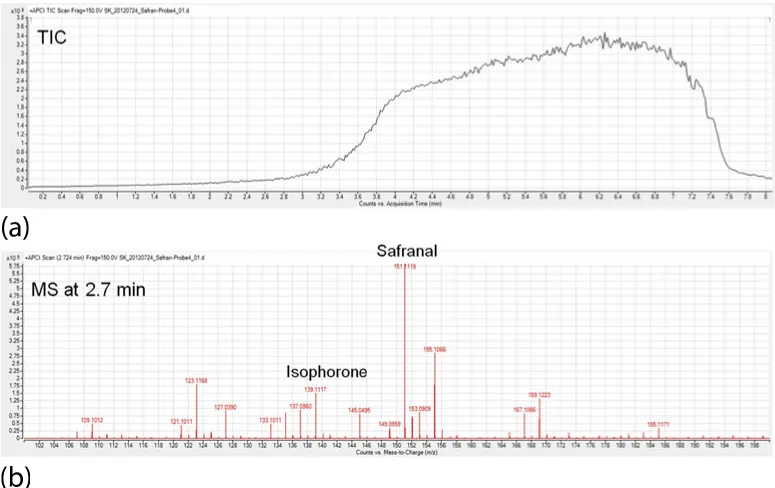
Nevertheless, sources such as ASAP (atmospheric pressure solids analysis probe), DART (direct analysis in real time), and DESI (desorption electrospray ionization) can often be successfully used. In ASAP, a hot nitrogen flow from an ESI or APCI (atmospheric pressure chemical ionization) source is used as a source of energy for evaporation and the only change to an APCI source is the installation of an insertion option to place the sample in the hot gas stream within the ion source [3]. This ion source allows a rapid analysis of volatile and semivolatile compounds and, for example, was used to analyze biological tissue [3], polymer additives [3], fungi and cells [4], and steroids, [3, 5]. ASAP has much in common with DART [6] and DESI [7]. The DART ion source produces a gas stream containing long-lived electronically excited atoms that can interact with the sample and, thus, desorption and subsequent ionization of the sample by Penning ionization [8] or proton transfer from protonated water clusters [6] is realized. The DART source is used for the direct analysis of solid and liquid samples. A great advantage of this source is the possibility to analyze compounds on surfaces such as illegal substances on dollar bills or fungicides on wheat [9]. Unlike ASAP and DART, the great advantage of DESI is that the volatility of the analyte is not a prerequisite for a successful analysis (same as in the classic ESI). DESI is most sensitive for polar and basic compounds and less sensitive for analytes with a low polarity [10]. These useful ion sources have a common drawback. All or almost all substances in the sample are present at the same time in the gas phase during the ionization in the ion source. The analysis of complex samples can therefore lead to ion suppression and artifact formation in the atmospheric pressure ion source due to ion–molecule reactions on the way to the MS inlet. For this reason, some ASAP applications are described in the literature with increasing temperature of the nitrogen gas [5, 11, 12]. DART analyzes with different helium temperatures [13] or with a helium temperature gradient [14] have been described in order to achieve a partial separation of the sample due to the different vapor pressures of the analyte. Related with DART and ASAP, the direct inlet sample APCI (DIP-APCI) from Scientific Instruments Manufacturer GmbH (SIM) was described 2012, which uses a temperature-push rod for direct intake of solid and liquid samples with subsequent chemical ionization at atmospheric pressure [15]. Figure 1.1 shows a DIP-APCI analysis of a saffron sample (solid, spice) without sample preparation with the saffron-specific biomarkers isophorone and safranal. As a detector, an Agilent Technologies 6538 UHD Accurate-Mass Q-TOF was used. The total ion chromatogramm (TIC) of the total analysis and the mass spectrum at the time of 2.7 min are shown in Figure 1.1a,b, respectively. The analysis was started at 40 °C and heated the sample at 1 K/s to a final temperature of 400 °C.
Figure 1.1 Analysis of saffron using direct-inlet probe-APCI with high-resolution QTOF-MS. (a) TIC of the toal analysis. (b) mass spectrum at the time of 2.7 min.
These ion sources may be useful and time saving but for the quantitative and qualitative analysis of complex samples a chromatographic or electrophoretic preseparation makes sense. In addition to the reduction of matrix effects, the comparison of the retention times also allows an analysis of isomers.
1.2 Ionization Methods at Atmospheric Pressure
In the last 10 years, several new ionization methods for atmospheric pressure (AP) mass spectrometers have been developed. Some of these are only available in some working groups. Therefore, only four commercially available ion sources will be presented in detail here.
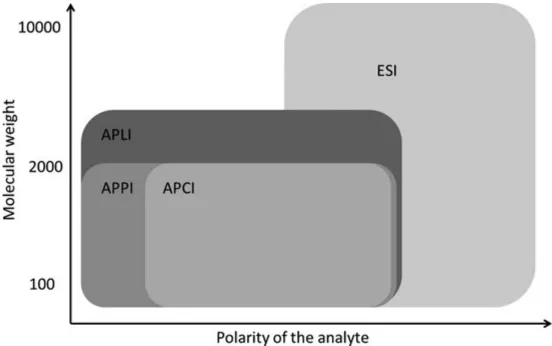
The most common atmospheric pressure ionization (API) is electrospray ionisation (ESI), followed by APCI and APPI (atmospheric pressure photoionization). A significantly lower significance shows the APLI (atmospheric pressure laser ionization). However, this ion source is well suited for the analysis of aromatic compounds and, for example, the gold standard for PAH (polyaromatic hydrocarbons) analysis. This ranking reflects more or less the chemical properties of the analytes, which are determined with API MS: Most analytes from the pharmaceutical and life sciences are polar or even ionic and, thus, are efficiently ionized by ESI (Figure 1.2). However, there is also a considerable interest in API techniques for efficient ionization of less or nonpolar compounds. For the ionization of such substances ESI is less suitable.
Figure 1.2 Polarity range of analytes for ionization with various atmospheric pressure ionization (API) techniques. Note: The extended mass range of APLI against APPI and APCI results from the ionization of nonpolar aromatic analytes in an electrospray Reproduced with kind permission of O. J. Schmitz, T. Benter, Advances in LC-MS Instrumentation: Atmospheric pressure laser ionization, Journal of Chomatography Libary, Vol 72 (2007), Chapter 6, Pages 89-113.
1.2.1 Overview of API Methods
Ionization methods that operate at atmospheric pressure, such as atmospheric pressure chemical ionization (APCI) and electrospray ionization (ESI), have greatly expanded the scope of mass spectrometry [17–20]. These API techniques allow an easy coupling of chromatographic separation systems, such as liquid chromatography (LC), to a mass spectrometer.
There is a fundamental difference between APCI and ESI ionization mechanism. In APCI, ionization of the analyte takes place in the gas phase after evaporation of the solvent. In ESI, the ionization takes place already in the liquid phase. In the ESI process, protonated or deprotonated molecular ions are usually formed from highly polar analytes. Fragmentation is rarely observed. However, for the ionization of less polar substances, APCI is preferably used. APCI is based on the reaction of analytes with primary ions, which are generated by corona discharge. But the ionization of nonpolar analytes is very low with both techniques.
For these classes of substances other methods have been developed, such as the coupling of ESI with an electrochemical cell [21–32], the “coordination ionspray” [32–47] or the “diss...
Table of contents
Cover
Table of Contents
Title
Copyright
Preface
The Structure of HPLC-MS for Practitioners
List of Contributors
Part I: Overview, Pitfalls, Hardware-Requirements
Part II: Tips, Examples, Trends
Part III: User Reports
Part IV: Vendor’s Reports
About the Authors
Index
End User License Agreement
Trusted by 375,005 students
Access to over 1.5 million titles for a fair monthly price.
Study more efficiently using our study tools.
Frequently asked questions
Yes, you can cancel anytime from the Subscription tab in your account settings on the Perlego website. Your subscription will stay active until the end of your current billing period. Learn how to cancel your subscription
No, books cannot be downloaded as external files, such as PDFs, for use outside of Perlego. However, you can download books within the Perlego app for offline reading on mobile or tablet. Learn how to download books offline
Perlego offers two plans: Essential and Complete
Essential is ideal for learners and professionals who enjoy exploring a wide range of subjects. Access the Essential Library with 800,000+ trusted titles and best-sellers across business, personal growth, and the humanities. Includes unlimited reading time and Standard Read Aloud voice.
Complete: Perfect for advanced learners and researchers needing full, unrestricted access. Unlock 1.5M+ books across hundreds of subjects, including academic and specialized titles. The Complete Plan also includes advanced features like Premium Read Aloud and Research Assistant.
Both plans are available with monthly, semester, or annual billing cycles.
We are an online textbook subscription service, where you can get access to an entire online library for less than the price of a single book per month. With over 1.5 million books across 990+ topics, we’ve got you covered! Learn about our mission
Look out for the read-aloud symbol on your next book to see if you can listen to it. The read-aloud tool reads text aloud for you, highlighting the text as it is being read. You can pause it, speed it up and slow it down. Learn more about Read Aloud
Yes! You can use the Perlego app on both iOS and Android devices to read anytime, anywhere — even offline. Perfect for commutes or when you’re on the go. Please note we cannot support devices running on iOS 13 and Android 7 or earlier. Learn more about using the app
Yes, you can access The HPLC-MS Handbook for Practitioners by Stavros Kromidas in PDF and/or ePUB format, as well as other popular books in Sciences physiques & Chimie analytique. We have over 1.5 million books available in our catalogue for you to explore.