- English
- ePUB (mobile friendly)
- Available on iOS & Android
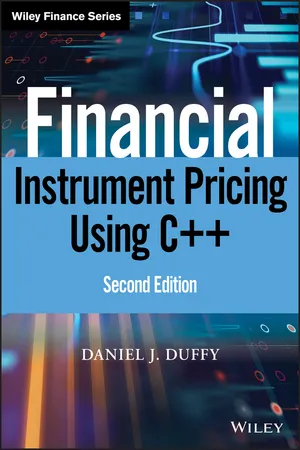
Financial Instrument Pricing Using C++
About this book
An integrated guide to C++ and computational finance
This complete guide to C++ and computational finance is a follow-up and major extension to Daniel J. Duffy's 2004 edition of Financial Instrument Pricing Using C++. Both C++ and computational finance have evolved and changed dramatically in the last ten years and this book documents these improvements. Duffy focuses on these developments and the advantages for the quant developer by:
- Delving into a detailed account of the new C++11 standard and its applicability to computational finance.
- Using de-facto standard libraries, such as Boost and Eigen to improve developer productivity.
- Developing multiparadigm software using the object-oriented, generic, and functional programming styles.
- Designing flexible numerical algorithms: modern numerical methods and multiparadigm design patterns.
- Providing a detailed explanation of the Finite Difference Methods through six chapters, including new developments such as ADE, Method of Lines (MOL), and Uncertain Volatility Models.
- Developing applications, from financial model to algorithmic design and code, through a coherent approach.
- Generating interoperability with Excel add-ins, C#, and C++/CLI.
- Using random number generation in C++11 and Monte Carlo simulation.
Duffy adopted a spiral model approach while writing each chapter of Financial Instrument Pricing Using C++ 2e: analyse a little, design a little, and code a little. Each cycle ends with a working prototype in C++ and shows how a given algorithm or numerical method works. Additionally, each chapter contains non-trivial exercises and projects that discuss improvements and extensions to the material.
This book is for designers and application developers in computational finance, and assumes the reader has some fundamental experience of C++ and derivatives pricing.
HOW TO RECEIVE THE SOURCE CODE
Once you have purchased a copy of the book please send an email to the author dduffyATdatasim.nl requesting your personal and non-transferable copy of the source code. Proof of purchase is needed. The subject of the mail should be "C++ Book Source Code Request".You will receivea reply with a zip file attachment.
Trusted by 375,005 students
Access to over 1 million titles for a fair monthly price.
Study more efficiently using our study tools.
Information
Table of contents
- Cover
- Title page
- Copyright
- Chapter 1 A Tour of C++ and Environs
- Chapter 2 New and Improved C++ Fundamentals
- Chapter 3 Modelling Functions in C++
- Chapter 4 Advanced C++ Template Programming
- Chapter 5 Tuples in C++ and their Applications
- Chapter 6 Type Traits, Advanced Lambdas and Multiparadigm Design in C++
- Chapter 7 Multiparadigm Design in C++
- Chapter 8 C++ Numerics, IEEE 754 and Boost C++ Multiprecision
- Chapter 9 An Introduction to Unified Software Design
- Chapter 10 New Data Types, Containers and Algorithms in C++ and Boost C++ Libraries
- Chapter 11 Lattice Models Fundamental Data Structures and Algorithms
- Chapter 12 Lattice Models Applications to Computational Finance
- Chapter 13 Numerical Linear Algebra: Tridiagonal Systems and Applications
- Chapter 14 Data Visualisation in Excel
- Chapter 15 Univariate Statistical Distributions
- Chapter 16 Bivariate Statistical Distributions and Two-Asset Option Pricing
- Chapter 17 STL Algorithms in Detail
- Chapter 18 STL Algorithms Part II
- Chapter 19 An Introduction to Optimisation and the Solution of Nonlinear Equations
- Chapter 20 The Finite Difference Method for PDEs: Mathematical Background
- Chapter 21 Software Framework for One-Factor Option Models
- Chapter 22 Extending the Software Framework
- Chapter 23 A PDE Software Framework in C++11 for a Class of Path-Dependent Options
- Chapter 24 Ordinary Differential Equations and their Numerical Approximation
- Chapter 25 Advanced Ordinary Differential Equations and Method of Lines
- Chapter 26 Random Number Generation and Distributions
- Chapter 27 Microsoft .Net, C# and C++11 Interoperability
- Chapter 28 C++ Concurrency, Part I Threads
- Chapter 29 C++ Concurrency, Part II Tasks
- Chapter 30 Parallel Patterns Language (PPL)
- Chapter 31 Monte Carlo Simulation, Part I
- Chapter 32 Monte Carlo Simulation, Part II
- Appendix 1 Multiple-Precision Arithmetic
- Appendix 2 Computing Implied Volatility
- References
- Index
- EULA
Frequently asked questions
- Essential is ideal for learners and professionals who enjoy exploring a wide range of subjects. Access the Essential Library with 800,000+ trusted titles and best-sellers across business, personal growth, and the humanities. Includes unlimited reading time and Standard Read Aloud voice.
- Complete: Perfect for advanced learners and researchers needing full, unrestricted access. Unlock 1.4M+ books across hundreds of subjects, including academic and specialized titles. The Complete Plan also includes advanced features like Premium Read Aloud and Research Assistant.
Please note we cannot support devices running on iOS 13 and Android 7 or earlier. Learn more about using the app