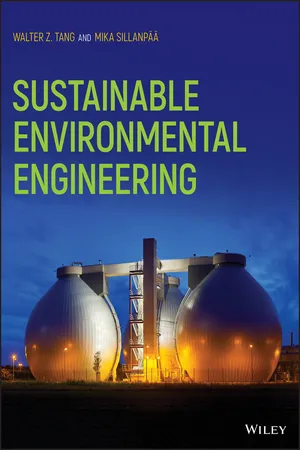
Sustainable Environmental Engineering
eBook - ePub

Sustainable Environmental Engineering

  1. English
  2. ePUB (mobile friendly)
  3. Available on iOS & Android
eBook - ePub

Sustainable Environmental Engineering

About this book

The important resource that explores the twelve design principles of sustainable environmental engineering

Sustainable Environmental Engineering (SEE) is to research, design, and build Environmental Engineering Infrastructure System (EEIS) in harmony with nature using life cycle cost analysis and benefit analysis and life cycle assessment and to protect human health and environments at minimal cost. The foundations of the SEE are the twelve design principles (TDPs) with three specific rules for each principle. The TDPs attempt to transform how environmental engineering could be taught by prioritizing six design hierarchies through six different dimensions. Six design hierarchies are prevention, recovery, separation, treatment, remediation, and optimization. Six dimensions are integrated system, material economy, reliability on spatial scale, resiliency on temporal scale, and cost effectiveness. In addition, the authors, two experts in the field, introduce major computer packages that are useful to solve real environmental engineering design problems. 

The text presents how specific environmental engineering issues could be identified and prioritized under climate change through quantification of air, water, and soil quality indexes. For water pollution control, eight innovative technologies which are critical in the paradigm shift from the conventional environmental engineering design to water resource recovery facility (WRRF) are examined in detail. These new processes include UV disinfection, membrane separation technologies, Anammox, membrane biological reactor, struvite precipitation, Fenton process, photocatalytic oxidation of organic pollutants, as well as green infrastructure. Computer tools are provided to facilitate life cycle cost and benefit analysis of WRRF. This important resource:

•    Includes statistical analysis of engineering design parameters using Statistical Package for the Social Sciences (SPSS)

•    Presents Monte Carlos simulation using Crystal ball to quantify uncertainty and sensitivity of design parameters

•    Contains design methods of new energy, materials, processes, products, and system to achieve energy positive WRRF that are illustrated with Matlab

•    Provides information on life cycle costs in terms of capital and operation for different processes using MatLab

Written for senior or graduates in environmental or chemical engineering, Sustainable Environmental Engineering defines and illustrates the TDPs of SEE. Undergraduate, graduate, and engineers should find the computer codes are useful in their EEIS design. The exercise at the end of each chapter encourages students to identify EEI engineering problems in their own city and find creative solutions by applying the TDPs. For more information, please visit www.tang.fiu.edu.  

Frequently asked questions

Yes, you can cancel anytime from the Subscription tab in your account settings on the Perlego website. Your subscription will stay active until the end of your current billing period. Learn how to cancel your subscription.
At the moment all of our mobile-responsive ePub books are available to download via the app. Most of our PDFs are also available to download and we're working on making the final remaining ones downloadable now. Learn more here.
Perlego offers two plans: Essential and Complete
  • Essential is ideal for learners and professionals who enjoy exploring a wide range of subjects. Access the Essential Library with 800,000+ trusted titles and best-sellers across business, personal growth, and the humanities. Includes unlimited reading time and Standard Read Aloud voice.
  • Complete: Perfect for advanced learners and researchers needing full, unrestricted access. Unlock 1.4M+ books across hundreds of subjects, including academic and specialized titles. The Complete Plan also includes advanced features like Premium Read Aloud and Research Assistant.
Both plans are available with monthly, semester, or annual billing cycles.
We are an online textbook subscription service, where you can get access to an entire online library for less than the price of a single book per month. With over 1 million books across 1000+ topics, we’ve got you covered! Learn more here.
Look out for the read-aloud symbol on your next book to see if you can listen to it. The read-aloud tool reads text aloud for you, highlighting the text as it is being read. You can pause it, speed it up and slow it down. Learn more here.
Yes! You can use the Perlego app on both iOS or Android devices to read anytime, anywhere — even offline. Perfect for commutes or when you’re on the go.
Please note we cannot support devices running on iOS 13 and Android 7 or earlier. Learn more about using the app.
Yes, you can access Sustainable Environmental Engineering by Walter Z. Tang,Mika Sillanpää in PDF and/or ePUB format, as well as other popular books in Technology & Engineering & Environmental Management. We have over one million books available in our catalogue for you to explore.

1
Renewable Resources and Environmental Quality

Sun sustains every life on Earth.

OBJECTIVES

  • To present renewable energy such as solar, biomass, and wind
  • To quantify hydrological, carbon, oxygen, nitrogen and phosphorus cycles
  • To provide unit data on human demand and footprints
  • To quantitatively describe the uncertainty of the carrying capacity of Earth by using SPSS
  • To calculate C, N, P, water, energy, and ecological footprints
  • To define nine planetary boundaries
  • To explain peak oil and phosphorus in terms of mineral depletion
  • To calculate air, water, and soil quality indexes

1.1 Renewable Resources and Energy

Free water and energy have sustained human life on Earth in the past million years because water can be harvested from the sky and energy can be produced from solar, biomass, and wind. Since the Industrial Revolution in 1781, however, nonrenewable fossil energy such as coal, oil, and natural gas has become the major power source for human economic activities. For example, environmental engineering infrastructure system (EEIS) such as centralized water treatment plant (WTP) and wastewater treatment plant (WWTP) are mostly powered by fossil fuels and have become symbols of modern life. Due to the economy of scale, centralized EEIS was designed to fit for all because unit cost of water and wastewater produced decreases with the increasing plant capacity. As EEIS ages, however, maintenance becomes more and more expensive. Under climate change and sea level rise, retrofitting existing WWTP may cost more than building new plants. For example, Miami‐Dade Water and Sewer Department (MD WASD) plans spend $6 billion dollar to increase resiliency of three WWTPs with total average flow rate of 300 MGD in next 20 years which could be much more expensive than building new plants within the same budget.
Currently, the average electricity compositions in the United States contributed by coal, natural gas, nuclear, and renewables are 33, 33, 20, and 14, respectively. Among the other renewable energy sources, wind, biomass, solar, and geothermal energy consist of 4.7, 1.6, 1.0, and 0.4% of the total energy portfolio, respectively. Oil provides almost 100% of transportation energy. Solar energy is the only primary energy continuously arriving on Earth at a rate of 1361 W/m2. Each day, about 174 peta‐watts (1015 W) of sunlight hits the planet Earth. Assuming Earth to be a black body, its mean temperature witho...

Table of contents

  1. Cover
  2. Table of Contents
  3. Preface
  4. 1 Renewable Resources and Environmental Quality
  5. 2 Health Risk Assessment
  6. 3 Twelve Design Principles of Sustainable Environmental Engineering
  7. 4 Integrated and Interconnected Systems
  8. 5 Reliable Systems on a Spatial Scale
  9. 6 Resiliency on Temporal Scale
  10. 7 Efficiency of Renewable Materials
  11. 8 Efficiency of Renewable Energy
  12. 9 Prevention
  13. 10 Recovery
  14. 11 Separation
  15. 12 Treatment
  16. 13 Green Retrofitting and Remediation
  17. 14 Optimization through Modeling and Simulation
  18. 15 Life Cycle Cost and Benefit Analysis
  19. Index
  20. End User License Agreement