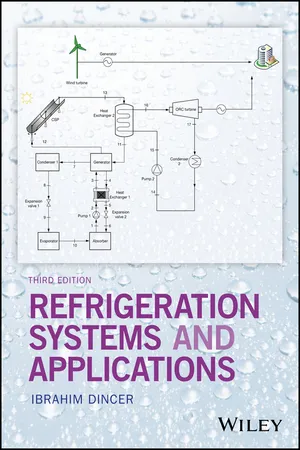
Refrigeration Systems and Applications
eBook - ePub

Refrigeration Systems and Applications

  1. English
  2. ePUB (mobile friendly)
  3. Available on iOS & Android
eBook - ePub

Refrigeration Systems and Applications

About this book

The definitive text/reference for students, researchers and practicing engineers

This book provides comprehensive coverage on refrigeration systems and applications, ranging from the fundamental principles of thermodynamics to food cooling applications for a wide range of sectoral utilizations. Energy and exergy analyses as well as performance assessments through energy and exergy efficiencies and energetic and exergetic coefficients of performance are explored, and numerous analysis techniques, models, correlations and procedures are introduced with examples and case studies. There are specific sections allocated to environmental impact assessment and sustainable development studies. Also featured are discussions of important recent developments in the field, including those stemming from the author's pioneering research.

Refrigeration is a uniquely positioned multi-disciplinary field encompassing mechanical, chemical, industrial and food engineering, as well as chemistry. Its wide-ranging applications mean that the industry plays a key role in national and international economies. And it continues to be an area of active research, much of it focusing on making the technology as environmentally friendly and sustainable as possible without compromising cost efficiency and effectiveness.

This substantially updated and revised edition of the classic text/reference now features two new chapters devoted to renewable-energy-based integrated refrigeration systems and environmental impact/sustainability assessment. All examples and chapter-end problems have been updated as have conversion factors and the thermophysical properties of an array of materials.

  • Provides a solid foundation in the fundamental principles and the practical applications of refrigeration technologies
  • Examines fundamental aspects of thermodynamics, refrigerants, as well as energy and exergy analyses and energy and exergy based performance assessment criteria and approaches
  • Introduces environmental impact assessment methods and sustainability evaluation of refrigeration systems and applications
  • Covers basic and advanced (and hence integrated) refrigeration cycles and systems, as well as a range of novel applications
  • Discusses crucial industrial, technical and operational problems, as well as new performance improvement techniques and tools for better design and analysis
  • Features clear explanations, numerous chapter-end problems and worked-out examples

Refrigeration Systems and Applications, Third Edition is an indispensable working resource for researchers and practitioners in the areas of Refrigeration and Air Conditioning. It is also an ideal textbook for graduate and senior undergraduate students in mechanical, chemical, biochemical, industrial and food engineering disciplines.

Frequently asked questions

Yes, you can cancel anytime from the Subscription tab in your account settings on the Perlego website. Your subscription will stay active until the end of your current billing period. Learn how to cancel your subscription.
No, books cannot be downloaded as external files, such as PDFs, for use outside of Perlego. However, you can download books within the Perlego app for offline reading on mobile or tablet. Learn more here.
Perlego offers two plans: Essential and Complete
  • Essential is ideal for learners and professionals who enjoy exploring a wide range of subjects. Access the Essential Library with 800,000+ trusted titles and best-sellers across business, personal growth, and the humanities. Includes unlimited reading time and Standard Read Aloud voice.
  • Complete: Perfect for advanced learners and researchers needing full, unrestricted access. Unlock 1.4M+ books across hundreds of subjects, including academic and specialized titles. The Complete Plan also includes advanced features like Premium Read Aloud and Research Assistant.
Both plans are available with monthly, semester, or annual billing cycles.
We are an online textbook subscription service, where you can get access to an entire online library for less than the price of a single book per month. With over 1 million books across 1000+ topics, we’ve got you covered! Learn more here.
Look out for the read-aloud symbol on your next book to see if you can listen to it. The read-aloud tool reads text aloud for you, highlighting the text as it is being read. You can pause it, speed it up and slow it down. Learn more here.
Yes! You can use the Perlego app on both iOS or Android devices to read anytime, anywhere — even offline. Perfect for commutes or when you’re on the go.
Please note we cannot support devices running on iOS 13 and Android 7 or earlier. Learn more about using the app.
Yes, you can access Refrigeration Systems and Applications by Ibrahim Dincer in PDF and/or ePUB format, as well as other popular books in Technology & Engineering & Mechanical Engineering. We have over one million books available in our catalogue for you to explore.

Chapter 1
General Aspects of Thermodynamics

1.1 Introduction

Refrigeration has a diverse nature and covers a large number of processes ranging from cooling to air conditioning and from food refrigeration to human comfort. Refrigeration as a whole, therefore, appears complicated due to the fact that thermodynamics, fluid mechanics, and heat transfer are always encountered in every refrigeration process or application. For a good understanding of the operation of refrigeration systems and applications, an extensive knowledge of such topics is indispensable.
When an engineer or an engineering student undertakes the analysis of a refrigeration system and/or its application, he or she should deal with several basic aspects first, depending upon the type of the problem being studied, that may be of thermodynamics, fluid mechanics, or heat transfer. In conjunction with this, there is a need to introduce several definitions and concepts before moving into refrigeration systems and applications in depth. Furthermore, the units are of importance in the analysis of such systems and applications. One should make sure that the units used are consistent to reach the correct result. This means that there are several introductory factors to be taken into consideration to avoid getting lost further on. While the information in some situations is limited, it is desirable that the reader comprehend these processes. Despite assuming that the reader, if he or she is a student, has completed necessary courses in thermodynamics, fluid mechanics, and heat transfer, there is still a need for him or her to review, and for those who are practicing refrigeration engineers, the need is much stronger to understand the physical phenomena and practical aspects, along with a knowledge of the basic laws, principles, governing equations, and related boundary conditions. In addition, this introductory chapter reviews the essentials of such principles, laws, etc., discusses the relationships between the aspects and provides some key examples for better understanding.
This chapter primarily focuses on general aspects of thermodynamics, ranging from dimensions and units to psychrometric processes, and specifically discusses systems of units, thermodynamic systems, thermodynamic laws, pure substances, ideal and real gases, refrigerators and heat pumps, Carmot cycle...

Table of contents

  1. Cover
  2. Title Page
  3. Copyright
  4. Table of Contents
  5. Preface
  6. Acknowledgments
  7. Chapter 1: General Aspects of Thermodynamics
  8. Chapter 2: Refrigerants
  9. Chapter 3: Refrigeration System Components
  10. Chapter 4: Refrigeration Cycles and Systems
  11. Chapter 5: Advanced Refrigeration Cycles and Systems
  12. Chapter 6: Renewable Energy-based Integrated Refrigeration Systems
  13. Chapter 7: Heat Pipes
  14. Chapter 8: Food Refrigeration
  15. Chapter 9: Food Freezing
  16. Chapter 10: Environmental Impact and Sustainability Assessment of Refrigeration Systems
  17. Appendix A: Conversion Factors
  18. Appendix B: Thermophysical Properties
  19. Appendix C: Food Refrigeration Data
  20. Index
  21. End User License Agreement