This book is dedicated to the general study of fluid structure interaction with consideration of uncertainties. The fluid-structure interaction is the study of the behavior of a solid in contact with a fluid, the response can be strongly affected by the action of the fluid. These phenomena are common and are sometimes the cause of the operation of certain systems, or otherwise manifest malfunction. The vibrations affect the integrity of structures and must be predicted to prevent accelerated wear of the system by material fatigue or even its destruction when the vibrations exceed a certain threshold.

eBook - ePub
Fluid-Structure Interactions and Uncertainties
Ansys and Fluent Tools
- English
- ePUB (mobile friendly)
- Available on iOS & Android
eBook - ePub
Fluid-Structure Interactions and Uncertainties
Ansys and Fluent Tools
About this book
Information
1
Fluid–Structure Interaction
1.1. Introduction
Recently, several new problems have been formulated in the area of fluid–structure coupling, for example in the automotive industry with the dynamics of airbag inflation and fluid sloshing inside tanks; in aeronautics with the fluttering phenomenon affecting airplane wings, which involves a coupling between the vibrational dynamics of a structure and the flow of a fluid; and in the transportation industry with studies on noise reduction inside vehicles based on vibroacoustic analysis.
Each and every structure in contact with a fluid is subject to phenomena involving mechanical fluid–structure couplings to some extent. This kind of multiphysics coupling often significantly affects the dynamic behavior of mechanical systems. Taking it into account is one of the major challenges in calculating the dimensions of structures, especially when the objective is to ensure that their design meets the necessary safety requirements.
In this chapter, we will examine problems relating to the interaction of a structure with fluids both at rest and in flow. We will give a description of the motion of the fluid based on vibration theory, considering small vibrations in the structure and fluctuations in the pressure of the fluid around a stable equilibrium state, and we will present the relevant equations in the case of flowing fluids and the corresponding numerical methods for calculating couplings with dynamic structures.
1.2. Fluid–structure interaction problem
The mechanical coupling between the two media acts in both directions at their surface of contact: deformations in the structure resulting from the forces applied by the fluid flow modify the state of the fluid–structure interface; this affects the flow conditions of the fluid, which induces a change in the forces exerted on the structure at the interface, thus bringing the interaction cycle to a close.
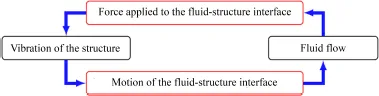
Figure 1.1. Fluid–structure coupling mechanism. For a color version of this figure, see www.iste.co.uk/elhami/interactions.zip
The fluid–structure interaction is described as the exchange of mechanical energy between a fluid and structure. This definition encompasses a wide range of problems. We can classify these problems using two criteria according to the physics of the problem at hand. The first criterion, proposed by Axisa [AXI 01], is based on the nature of the fluid flow. If the flow is negligible or non-existent, we say that the fluid is stagnant. Otherwise, we say that the fluid is flowing. In the first case, the objective is to describe small movements of the fluid and the structure around an equilibrium rest state. In these conditions, we choose to describe the dynamics of the interaction as a function of frequency; the equations describing the behavior of the structure and the fluid are written in terms of the reference (rest) state and generally lead to linear problems. In the second case, the objective is to establish a description of larger scale motion in the fluid and/or the structure. In these conditions, we choose to describe the dynamics of the interaction as a function of time; the equations describing the behavior of the structure and the fluid are written in terms of the current state of the system and generally lead to nonlinear problems.
The second criterion considers the coupling strength, which may be defined as the magnitude of the interactions or exchanges between the two media.
A coupling is said to be strong if there are high levels of exchange between the two media, i.e. the fluid has a significant impact on the structure, and vice versa. A coupling is said to be weak if the effect of one of the media dominates that of the other (Figure 1.2).
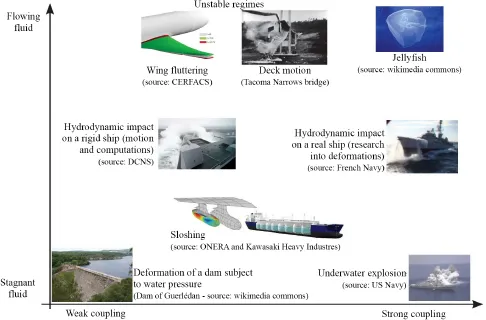
Figure 1.2. Examples of fluid–structure interaction problems [GAU 11]. For a color version of this figure, see www.iste.co.uk/elhami/interactions.zip
Three dimensionless numbers have been suggested to classify these problems [DEL 01]:
- – The mass number MA is defined as the ratio between the density of the fluid ρf and that of the structure ρs: [1.1]
 This describes the significance of the inertial effects of the fluid and the structure. If its value is close to one, the inertial effects of the fluid are comparable to t...
Table of contents
- Cover
- Table of Contents
- Title
- Copyright
- Preface
- 1 Fluid–Structure Interaction
- 2 Fluid–Structure Interaction with Ansys/Fluent
- 3 Vibroacoustics
- 4 Aerodynamics
- 5 Modal Reduction for FSI
- 6 Reliability-based Optimization for FSI
- Bibliography
- Index
- End User License Agreement
Trusted by 375,005 students
Access to over 1.5 million titles for a fair monthly price.
Study more efficiently using our study tools.
Frequently asked questions
Yes, you can cancel anytime from the Subscription tab in your account settings on the Perlego website. Your subscription will stay active until the end of your current billing period. Learn how to cancel your subscription
No, books cannot be downloaded as external files, such as PDFs, for use outside of Perlego. However, you can download books within the Perlego app for offline reading on mobile or tablet. Learn how to download books offline
We are an online textbook subscription service, where you can get access to an entire online library for less than the price of a single book per month. With over 1.5 million books across 990+ topics, we’ve got you covered! Learn about our mission
Look out for the read-aloud symbol on your next book to see if you can listen to it. The read-aloud tool reads text aloud for you, highlighting the text as it is being read. You can pause it, speed it up and slow it down. Learn more about Read Aloud
Yes! You can use the Perlego app on both iOS and Android devices to read anytime, anywhere — even offline. Perfect for commutes or when you’re on the go.
Please note we cannot support devices running on iOS 13 and Android 7 or earlier. Learn more about using the app
Please note we cannot support devices running on iOS 13 and Android 7 or earlier. Learn more about using the app
Yes, you can access Fluid-Structure Interactions and Uncertainties by Abdelkhalak El Hami,Bouchaib Radi in PDF and/or ePUB format, as well as other popular books in Physical Sciences & Mechanics. We have over 1.5 million books available in our catalogue for you to explore.