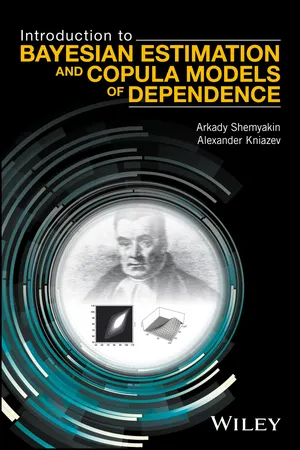
Introduction to Bayesian Estimation and Copula Models of Dependence
eBook - ePub

Introduction to Bayesian Estimation and Copula Models of Dependence

  1. English
  2. ePUB (mobile friendly)
  3. Available on iOS & Android
eBook - ePub

Introduction to Bayesian Estimation and Copula Models of Dependence

About this book

Presents an introduction to Bayesian statistics, presents an emphasis on Bayesian methods (prior and posterior), Bayes estimation, prediction, MCMC, Bayesian regression, and Bayesian analysis of statistical modelsof dependence, and features a focus on copulas for risk management

Introduction to Bayesian Estimation and Copula Models of Dependence emphasizes the applications of Bayesian analysis to copula modeling and equips readers with the tools needed to implement the procedures of Bayesian estimation in copula models of dependence. This book is structured in two parts: the first four chapters serve as a general introduction to Bayesian statistics with a clear emphasis on parametric estimation and the following four chapters stress statistical models of dependence with a focus of copulas.

A review of the main concepts is discussed along with the basics of Bayesian statistics including prior information and experimental data, prior and posterior distributions, with an emphasis on Bayesian parametric estimation. The basic mathematical background of both Markov chains and Monte Carlo integration and simulation is also provided. The authors discuss statistical models of dependence with a focus on copulas and present a brief survey of pre-copula dependence models. The main definitions and notations of copula models are summarized followed by discussions of real-world cases that address particular risk management problems.

In addition, this book includes:

• Practical examples of copulas in use including within the Basel Accord II documents that regulate the world banking system as well as examples of Bayesian methods within current FDA recommendations

• Step-by-step procedures of multivariate data analysis and copula modeling, allowing readers to gain insight for their own applied research and studies

• Separate reference lists within each chapter and end-of-the-chapter exercises within Chapters 2 through 8

• A companion website containing appendices: data files and demo files in MicrosoftĀ® Office ExcelĀ®, basic code in R, and selected exercise solutions

Introduction to Bayesian Estimation and Copula Models of Dependence is a reference and resource for statisticians who need to learn formal Bayesian analysis as well as professionals within analytical and risk management departments of banks and insurance companies who are involved in quantitative analysis and forecasting. This book can also be used as a textbook for upper-undergraduate and graduate-level courses in Bayesian statistics and analysis.

ARKADY SHEMYAKIN, PhD, is Professor in the Department of Mathematics and Director of the Statistics Program at the University of St. Thomas. A member of the American Statistical Association and the International Society for Bayesian Analysis, Dr. Shemyakin's research interests include informationtheory, Bayesian methods of parametric estimation, and copula models in actuarial mathematics, finance, and engineering.

ALEXANDER KNIAZEV, PhD, is Associate Professor and Head of the Department of Mathematics at Astrakhan State University in Russia. Dr. Kniazev's research interests include representation theory of Lie algebras and finite groups, mathematical statistics, econometrics, and financial mathematics.
Frequently asked questions

Yes, you can cancel anytime from the Subscription tab in your account settings on the Perlego website. Your subscription will stay active until the end of your current billing period. Learn how to cancel your subscription.
No, books cannot be downloaded as external files, such as PDFs, for use outside of Perlego. However, you can download books within the Perlego app for offline reading on mobile or tablet. Learn more here.
Perlego offers two plans: Essential and Complete
  • Essential is ideal for learners and professionals who enjoy exploring a wide range of subjects. Access the Essential Library with 800,000+ trusted titles and best-sellers across business, personal growth, and the humanities. Includes unlimited reading time and Standard Read Aloud voice.
  • Complete: Perfect for advanced learners and researchers needing full, unrestricted access. Unlock 1.4M+ books across hundreds of subjects, including academic and specialized titles. The Complete Plan also includes advanced features like Premium Read Aloud and Research Assistant.
Both plans are available with monthly, semester, or annual billing cycles.
We are an online textbook subscription service, where you can get access to an entire online library for less than the price of a single book per month. With over 1 million books across 1000+ topics, we’ve got you covered! Learn more here.
Look out for the read-aloud symbol on your next book to see if you can listen to it. The read-aloud tool reads text aloud for you, highlighting the text as it is being read. You can pause it, speed it up and slow it down. Learn more here.
Yes! You can use the Perlego app on both iOS or Android devices to read anytime, anywhere — even offline. Perfect for commutes or when you’re on the go.
Please note we cannot support devices running on iOS 13 and Android 7 or earlier. Learn more about using the app.
Yes, you can access Introduction to Bayesian Estimation and Copula Models of Dependence by Arkady Shemyakin,Alexander Kniazev in PDF and/or ePUB format, as well as other popular books in Mathematik & Wahrscheinlichkeitsrechnung & Statistiken. We have over one million books available in our catalogue for you to explore.

Information

Part I
Bayesian Estimation

1
Random Variables and Distributions

Chapter 1 is by no means suggested to replace or replicate a standard course in probability. Its purpose is to provide a reference source and remind the readers what topics they might need to review. For a systematic review of probability and introduction to statistics we can recommend excellent texts by DeGroot and Schervish [4], Miller and Miller [10], and Rice [12]. In-depth coverage of probability distributions in the context of loss models is offered by Klugman et al. in [8]. If the reader is interested in a review with a comprehensive software guide, we can recommend Crawley’s handbook in R [3].
Here we will introduce the main concepts and notations used throughout the book. The emphasis is made on the simplicity of explanations, and often in order to avoid technical details we have to sacrifice mathematical rigor and conciseness. We will also introduce a library of distributions for further illustrations. Without a detailed reference to the main facts of probability theory, we need to however emphasize the role played in the sequel by the concept of conditional probability, which becomes our starting point.

1.1 Conditional Probability

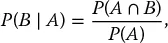
Let A and B be two random events, which could be represented as two subsets of the same sample space S including all possible outcomes of a chance experiment: AāŠ†S and BāŠ†S. Conditional probability of B given A measures the chances of B to happen if A is already known to occur. It can be defined for events A and B such that P(A) > 0 as
(1.1)
numbered Display Equation
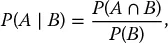
where P(A∩B) = P(B∩A) is the probability of intersection of A and B, the event indicating that both A and B occur. This conditional probability should not be confused with the conditional probability of A given B defined as
(1.2)
numbered Display Equation
which shares the same numerator with P(B∣A), but has a different denominator.
The source of possible confusion is a different choice of the ā€œsample spaceā€ or ā€œreference populationā€ā€”whatever language one prefers to use—in (1.1) and (1.2) corresponding to the denominators in these formulas. In case of (1.1) we consider only such cases that A occurs, so that the sample space or reference population is reduced from S to A, while in (1.2) it changes from S to B.
To illustrate this distinction, we will use a simple example. It fits the purpose of the book, using many illustrations from the fields of insurance and risk management, to begin with an example related to insurance.
In a fictitious country of Endolacia, people drive cars and buy insurance against accidents. Accidents do happen on a regular basis, but not too often. During t...

Table of contents

  1. Cover
  2. Titlepage
  3. Copyright
  4. Dedication
  5. Acknowledgments
  6. Acronyms
  7. Glossary
  8. About the Companion Website
  9. Introduction
  10. Part I: Bayesian Estimation
  11. Part II: Modeling Dependence
  12. Index
  13. EULA