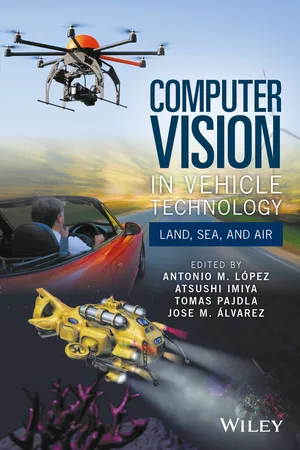
Computer Vision in Vehicle Technology
  1. English
  2. ePUB (mobile friendly)
  3. Available on iOS & Android
eBook - ePub

About this book

A unified view of the use of computer vision technology for different types of vehicles

Computer Vision in Vehicle Technology focuses on computer vision as on-board technology, bringing together fields of research where computer vision is progressively penetrating: the automotive sector, unmanned aerial and underwater vehicles. It also serves as a reference for researchers of current developments and challenges in areas of the application of computer vision, involving vehicles such as advanced driver assistance (pedestrian detection, lane departure warning, traffic sign recognition), autonomous driving and robot navigation (with visual simultaneous localization and mapping) or unmanned aerial vehicles (obstacle avoidance, landscape classification and mapping, fire risk assessment).

The overall role of computer vision for the navigation of different vehicles, as well as technology to address on-board applications, is analysed.

Key features:

  • Presents the latest advances in the field of computer vision and vehicle technologies in a highly informative and understandable way, including the basic mathematics for each problem.
  • Provides a comprehensive summary of the state of the art computer vision techniques in vehicles from the navigation and the addressable applications points of view.
  • Offers a detailed description of the open challenges and business opportunities for the immediate future in the field of vision based vehicle technologies.

This is essential reading for computer vision researchers, as well as engineers working in vehicle technologies, and students of computer vision.
Frequently asked questions

Yes, you can cancel anytime from the Subscription tab in your account settings on the Perlego website. Your subscription will stay active until the end of your current billing period. Learn how to cancel your subscription.
At the moment all of our mobile-responsive ePub books are available to download via the app. Most of our PDFs are also available to download and we're working on making the final remaining ones downloadable now. Learn more here.
Perlego offers two plans: Essential and Complete
  • Essential is ideal for learners and professionals who enjoy exploring a wide range of subjects. Access the Essential Library with 800,000+ trusted titles and best-sellers across business, personal growth, and the humanities. Includes unlimited reading time and Standard Read Aloud voice.
  • Complete: Perfect for advanced learners and researchers needing full, unrestricted access. Unlock 1.4M+ books across hundreds of subjects, including academic and specialized titles. The Complete Plan also includes advanced features like Premium Read Aloud and Research Assistant.
Both plans are available with monthly, semester, or annual billing cycles.
We are an online textbook subscription service, where you can get access to an entire online library for less than the price of a single book per month. With over 1 million books across 1000+ topics, we’ve got you covered! Learn more here.
Look out for the read-aloud symbol on your next book to see if you can listen to it. The read-aloud tool reads text aloud for you, highlighting the text as it is being read. You can pause it, speed it up and slow it down. Learn more here.
Yes! You can use the Perlego app on both iOS or Android devices to read anytime, anywhere — even offline. Perfect for commutes or when you’re on the go.
Please note we cannot support devices running on iOS 13 and Android 7 or earlier. Learn more about using the app.
Yes, you can access Computer Vision in Vehicle Technology by Antonio M. López, Atsushi Imiya, Tomas Pajdla, Jose M. Álvarez, Antonio M. López,Atsushi Imiya,Tomas Pajdla,Jose M. Álvarez in PDF and/or ePUB format, as well as other popular books in Computer Science & Computer Vision & Pattern Recognition. We have over one million books available in our catalogue for you to explore.

Chapter 1
Computer Vision in Vehicles

Reinhard Klette
School of Engineering, Computer and Mathematical Sciences, Auckland University of Technology, Auckland, New Zealand
This chapter is a brief introduction to academic aspects of computer vision in vehicles. It briefly summarizes basic notation and definitions used in computer vision. The chapter discusses a few visual tasks as of relevance for vehicle control and environment understanding.

1.1 Adaptive Computer Vision for Vehicles

Computer vision designs solutions for understanding the real world by using cameras. See Rosenfeld (1969), Horn (1986), Hartley and Zisserman (2003), or Klette (2014) for examples of monographs or textbooks on computer vision.
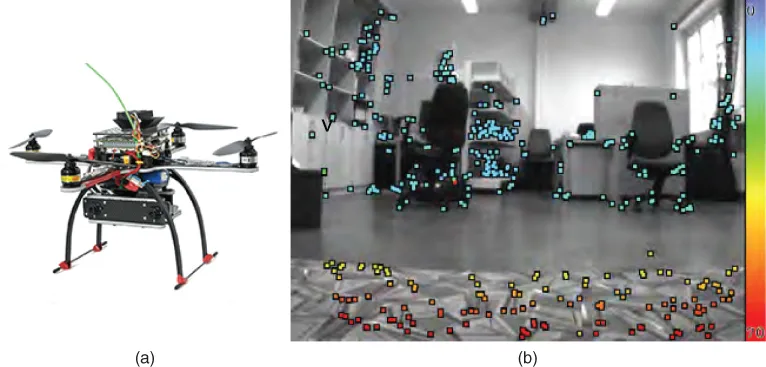
Computer vision operates today in vehicles including cars, trucks, airplanes, unmanned aerial vehicles (UAVs) such as multi-copters (see Figure 1.1 for a quadcopter), satellites, or even autonomous driving rovers on the Moon or Mars.
nfgz001
Figure 1.1 (a) Quadcopter. (b) Corners detected from a flying quadcopter using a modified FAST feature detector.
Courtesy of Konstantin Schauwecker
In our context, the ego-vehicle is that vehicle where the computer vision system operates in; ego-motion describes the ego-vehicle's motion in the real world.

1.1.1 Applications

Computer vision solutions are today in use in manned vehicles for improved safety or comfort, in autonomous vehicles (e.g., robots) for supporting motion or action control, and also for misusing UAVs for killing people remotely. The UAV technology has also good potentials for helping to save lives, to create three-dimensional (3D) models of the environment, and so forth. Underwater robots and unmanned sea-surface vehicles are further important applications of vision-augmented vehicles.

1.1.2 Traffic Safety and Comfort

Traffic safety is a dominant application area for computer vision in vehicles. Currently, about 1.24 million people die annually worldwide due to traffic accidents (WHO 2013), this is, on average, 2.4 people die per minute in traffic accidents. How does this compare to the numbers Western politicians are using for obtaining support for their...

Table of contents

  1. Cover
  2. Title Page
  3. Copyright
  4. Table of Contents
  5. List of Contributors
  6. Preface
  7. Abbreviations and Acronyms
  8. Chapter 1: Computer Vision in Vehicles
  9. Chapter 2: Autonomous Driving
  10. Chapter 3: Computer Vision for MAVs
  11. Chapter 4: Exploring the Seafloor with Underwater Robots
  12. Chapter 5: Vision-Based Advanced Driver Assistance Systems
  13. Chapter 6: Application Challenges from a Bird's-Eye View
  14. Chapter 7: Application Challenges of Underwater Vision
  15. Chapter 8: Closing Notes
  16. References
  17. Index
  18. End User License Agreement