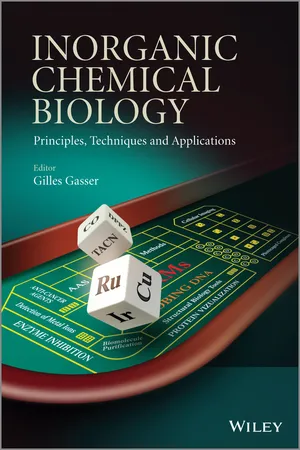
Inorganic Chemical Biology
eBook - ePub

Inorganic Chemical Biology

Principles, Techniques and Applications

  1. English
  2. ePUB (mobile friendly)
  3. Available on iOS & Android
eBook - ePub

Inorganic Chemical Biology

Principles, Techniques and Applications

About this book

Understanding, identifying and influencing the biological systems are the primary objectives of
chemical biology. From this perspective, metal complexes have always been of great assistance
to chemical biologists, for example, in structural identification and purification of essential
biomolecules, for visualizing cellular organelles or to inhibit specific enzymes. This inorganic side
of chemical biology, which continues to receive considerable attention, is referred to as inorganic
chemical biology.

Inorganic Chemical Biology: Principles, Techniques and Applications provides a comprehensive
overview of the current and emerging role of metal complexes in chemical biology. Throughout all
of the chapters there is a strong emphasis on fundamental theoretical chemistry and experiments
that have been carried out in living cells or organisms. Outlooks for the future applications of
metal complexes in chemical biology are also discussed.

Topics covered include:

• Metal complexes as tools for structural biology

• IMAC, AAS, XRF and MS as detection techniques for metals in chemical biology

• Cell and organism imaging and probing DNA using metal and metal carbonyl complexes

• Detection of metal ions, anions and small molecules using metal complexes

• Photo-release of metal ions in living cells

• Metal complexes as enzyme inhibitors and catalysts in living cells

Written by a team of international experts, Inorganic Chemical Biology: Principles, Techniques and
Applications is a must-have for bioinorganic, bioorganometallic and medicinal chemists as well as
chemical biologists working in both academia and industry.
Frequently asked questions

Yes, you can cancel anytime from the Subscription tab in your account settings on the Perlego website. Your subscription will stay active until the end of your current billing period. Learn how to cancel your subscription.
At the moment all of our mobile-responsive ePub books are available to download via the app. Most of our PDFs are also available to download and we're working on making the final remaining ones downloadable now. Learn more here.
Perlego offers two plans: Essential and Complete
  • Essential is ideal for learners and professionals who enjoy exploring a wide range of subjects. Access the Essential Library with 800,000+ trusted titles and best-sellers across business, personal growth, and the humanities. Includes unlimited reading time and Standard Read Aloud voice.
  • Complete: Perfect for advanced learners and researchers needing full, unrestricted access. Unlock 1.4M+ books across hundreds of subjects, including academic and specialized titles. The Complete Plan also includes advanced features like Premium Read Aloud and Research Assistant.
Both plans are available with monthly, semester, or annual billing cycles.
We are an online textbook subscription service, where you can get access to an entire online library for less than the price of a single book per month. With over 1 million books across 1000+ topics, we’ve got you covered! Learn more here.
Look out for the read-aloud symbol on your next book to see if you can listen to it. The read-aloud tool reads text aloud for you, highlighting the text as it is being read. You can pause it, speed it up and slow it down. Learn more here.
Yes! You can use the Perlego app on both iOS or Android devices to read anytime, anywhere — even offline. Perfect for commutes or when you’re on the go.
Please note we cannot support devices running on iOS 13 and Android 7 or earlier. Learn more about using the app.
Yes, you can access Inorganic Chemical Biology by Gilles Gasser in PDF and/or ePUB format, as well as other popular books in Biological Sciences & Biochemistry. We have over one million books available in our catalogue for you to explore.

Information

Publisher
Wiley
Year
2014
Print ISBN
9781118510025
eBook ISBN
9781118684153

Chapter 1
New Applications of Immobilized Metal Ion Affinity Chromatography in Chemical Biology

Rachel Codd, Jiesi Gu, Najwa Ejje and Tulip Lifa
School of Medical Sciences (Pharmacology) and Bosch Institute, The University of Sydney, Australia

1.1 Introduction

Immobilized metal ion affinity chromatography (IMAC) was first introduced as a method for resolving native proteins with surface exposed histidine residues from a complex mixture of human serum [1]. IMAC has since become a routine method used in molecular biology for purifying recombinant proteins with histidine tags engineered at the N- or C-terminus. The success of IMAC for protein purification may have obscured its potential utility in other applications in biomolecular chemistry and chemical biology. Since there exists in nature a multitude of non-protein based low molecular weight compounds that have an inherent affinity towards metal ions, or that have a fundamental requirement for metal ion binding for activity, IMAC could be used to capture these targets from complex mixtures. This highly selective affinity-based separation method could facilitate the discovery of new anti-infective and anticancer compounds from bacteria, fungi, plants, and sponges. A recent body of work highlights new applications of IMAC for the isolation of known drugs and for drug discovery, metabolome profiling, and for preparing metal-specific molecular probes for chemical proteomics-based drug discovery. At its core, IMAC is a method underpinned by the fundamental tenets of coordination chemistry. This chapter will briefly focus on these aspects, before moving on to describe a number of recent innovations in IMAC. The ultimate intent of this chapter is to seed interest in other research groups for expanding the use of IMAC across chemical biology.

1.2 Principles and Traditional Use

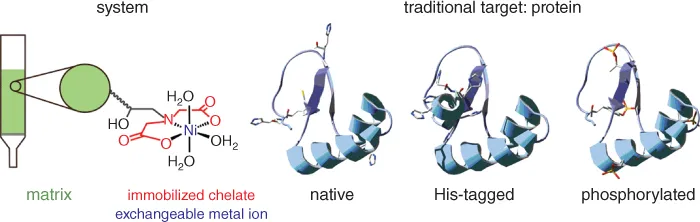
An IMAC system comprises three variable elements (Fig. 1.1): the insoluble matrix (green), the immobilized chelate (depicted as iminodiacetic acid, IDA, red), and the metal ion (commonly Ni(II), blue). Critical to the veracity of IMAC as a separation technique is that the coordination sphere of the immobilized metal–chelate complex is unsaturated, which allows target compounds to reversibly bind to the resin via the formation and dissociation of coordinate bonds. Each element of the IMAC system can be varied independently or in combination, which, together with basic experimental conditions (buffer selection, pH value), will influence the outcome of a separation experiment. This modular type of experimental system allows a high level of control for optimization.
c01f001
Figure 1.1 The elements of an immobilized metal ion affinity chromatography (IMAC) experiment. The system (left-hand side) comprises an insoluble matrix (green) with a covalently bound chelate (iminodiacetic acid, IDA, red) which coordinates in a 1:1 fashion a metal ion (Ni(II), blue) to give a complex with vacant coordination sites available for the reversible binding of targets with metal binding groups. Traditional IMAC targets (right-hand side) include native proteins with surface exposed histidine residues, histidine-tagged proteins, and phosphorylated proteins
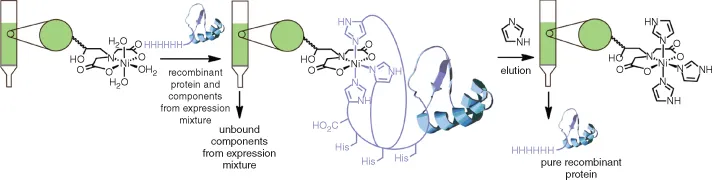
In accord with its original intended use, the majority of IMAC targets are proteins, which even as native molecules can bind to the immobilized metal–chelate complex with variable affinities, as determined by the presence of surface exposed histidine residues and, in some cases, more weakly binding cysteine residues (Fig. 1.1, protein shown at left). Compared with native proteins, recombinant proteins, which feature a hexameric histidine repeat unit (His-tag) engineered at the C- or N-terminus, are higher affinity IMAC targets (Fig. 1.1, protein shown at middle). In this case, the C-terminal histidine residues of the recombinant protein displace the three water ligands in the immobilized Ni(II)–IDA coordination sphere, with the majority of the components in the protein expression mixture not retained on the resin (Fig. 1.2). After washing the resin to remove these unbound components, the coordinate bonds between the Ni(II)–IDA complex and the C-terminal histidine residues are dissociated by competition upon washing the resin with a buffer containing a high concentration of imidazole.
c01f002
Figure 1.2 The traditional use of IMAC for the purification of His-tagged recombinant proteins. The recombinant protein binds to the immobilized coordination complex upon the displacement of water ligands by the histidine residues engineered at the N- or C- (as shown) terminus. The resin is washed to remove unbound components from the expression mixture, and the purified protein is eluted from the resin by competition upon washing with a high concentration of imidazole buffer
Phosphorylated proteins (Fig. 1.1, protein at right) as studied in phosphoproteomics [2–4], are also isolable using an IMAC format, based upon the affinity between Fe(III) and phosphorylated proteins (Fe(III)–phosphoserine, log K ∼ 13 [5]). The IMAC-compatible metal ions most suited for phosphoproteomics include Fe(III), Ga(III), or Zr(IV), with these hard acids having preferential binding affinities towards the hard base phosphate groups. This highlights that the IMAC technique is governed by key principles of coordination chemistry, including the hard and soft acids and bases (HSAB) theory [6], coordination number and geometry preferences, and thermodynamic and kinetic factors.
Because there is a significant market demand for IMAC-based separations, considerable research in the biotechnology sector has focused upon finding new and improved matrices and immobilized chelates. Common matrices include cross-linked agarose, cellulose, and sepharose. These polymers can be prepared with different degrees of cross-linking, branching, and different levels of activation, which affect the concentration of the immobilized chelate in the final matrix. There are seve...

Table of contents

  1. Cover
  2. Title Page
  3. Copyright
  4. About the Editor
  5. List of Contributors
  6. Preface
  7. References
  8. Acknowledgements
  9. Chapter 1: New Applications of Immobilized Metal Ion Affinity Chromatography in Chemical Biology
  10. Chapter 2: Metal Complexes as Tools for Structural Biology
  11. Chapter 3: AAS, XRF, and MS Methods in Chemical Biology of Metal Complexes
  12. Chapter 4: Metal Complexes for Cell and Organism Imaging
  13. Chapter 5: Cellular Imaging with Metal Carbonyl Complexes
  14. Chapter 6: Probing DNA Using Metal Complexes
  15. Chapter 7: Visualization of Proteins and Cells Using Dithiol-reactive Metal Complexes
  16. Chapter 8: Detection of Metal Ions, Anions and Small Molecules Using Metal Complexes
  17. Chapter 9: Photo-release of Metal Ions in Living Cells
  18. Chapter 10: Release of Bioactive Molecules Using Metal Complexes
  19. Chapter 11: Metal Complexes as Enzyme Inhibitors and Catalysts in Living Cells
  20. Chapter 12: Other Applications of Metal Complexes in Chemical Biology
  21. Index
  22. End User License Agreement