Designing Knowledge Organizations
eBook - ePub

Designing Knowledge Organizations

A Pathway to Innovation Leadership

  1. English
  2. ePUB (mobile friendly)
  3. Available on iOS & Android
eBook - ePub

Designing Knowledge Organizations

A Pathway to Innovation Leadership

About this book

A pedagogical approach to the principles and architecture of knowledge management in organizations

This textbook is based on a graduate course taught at Stevens Institute of Technology. It focuses on the design and management of today's complex K organizations. A K organization is any company that generates and applies knowledge. The text takes existing ideas from organizational design and knowledge management to enhance and elevate each through harmonization with concepts from other disciplines. The authors—noted experts in the field—concentrate on both micro- and macro design and their interrelationships at individual, group, work, and organizational levels.

A key feature of the textbook is an incisive discussion of the cultural, practice, and social aspects of knowledge management. The text explores the processes, tools, and infrastructures by which an organization can continuously improve, maintain, and exploit all elements of its knowledge base that are most relevant to achieve its strategic goals. The book seamlessly intertwines the disciplines of organizational design and knowledge management and offers extensive discussions, illustrative examples, student exercises, and visualizations. The following major topics are addressed:

  • Knowledge management, intellectual capital, and knowledge systems
  • Organizational design, behavior, and architecture
  • Organizational strategy, change, and development
  • Leadership and innovation
  • Organizational culture and learning
  • Social networking, communications, and collaboration
  • Strategic human resources; e.g., hiring K workers and performance reviews
  • Knowledge science, thinking, and creativity
  • Philosophy of knowledge and information
  • Information, knowledge, social, strategy, and contract continuums
  • Information management and intelligent systems; e.g., business intelligence, big data, and cognitive systems

Designing Knowledge Organizations takes an interdisciplinary and original approach to assess and synthesize the disciplines of knowledge management and organizational design, drawing upon conceptual underpinnings and practical experiences in these and related areas.
Frequently asked questions

Yes, you can cancel anytime from the Subscription tab in your account settings on the Perlego website. Your subscription will stay active until the end of your current billing period. Learn how to cancel your subscription.
No, books cannot be downloaded as external files, such as PDFs, for use outside of Perlego. However, you can download books within the Perlego app for offline reading on mobile or tablet. Learn more here.
Perlego offers two plans: Essential and Complete
  • Essential is ideal for learners and professionals who enjoy exploring a wide range of subjects. Access the Essential Library with 800,000+ trusted titles and best-sellers across business, personal growth, and the humanities. Includes unlimited reading time and Standard Read Aloud voice.
  • Complete: Perfect for advanced learners and researchers needing full, unrestricted access. Unlock 1.4M+ books across hundreds of subjects, including academic and specialized titles. The Complete Plan also includes advanced features like Premium Read Aloud and Research Assistant.
Both plans are available with monthly, semester, or annual billing cycles.
We are an online textbook subscription service, where you can get access to an entire online library for less than the price of a single book per month. With over 1 million books across 1000+ topics, we’ve got you covered! Learn more here.
Look out for the read-aloud symbol on your next book to see if you can listen to it. The read-aloud tool reads text aloud for you, highlighting the text as it is being read. You can pause it, speed it up and slow it down. Learn more here.
Yes! You can use the Perlego app on both iOS or Android devices to read anytime, anywhere — even offline. Perfect for commutes or when you’re on the go.
Please note we cannot support devices running on iOS 13 and Android 7 or earlier. Learn more about using the app.
Yes, you can access Designing Knowledge Organizations by Joseph Morabito,Ira Sack,Anilkumar Bhate in PDF and/or ePUB format, as well as other popular books in Technology & Engineering & Management. We have over one million books available in our catalogue for you to explore.

Information

1
Understanding Knowledge

Chapter Preview

Introduction

In this chapter, we discuss the new world of people and organizations. There is a revolution—based on new knowledge and technical artifacts—that is turning the world upside‐down. Knowledge and technology are substantially changing the way people think and behave. The young are breaking with old ways and bringing new expectations to their work. They will interact with organizations differently than did their parents.
Organizations are changing too. As with technology and people, the organization finds itself an integral part of a global mind, what we refer to as the new Pangaea. In this chapter, we discuss the economic and social stresses—for people and organizations—the new Pangaea brings. We call attention to the role of culture in the development of knowledge. We ask, can we really separate knowledge from moral behavior or social responsibility? We conclude with a discussion of competence and organization‐level models of intellectual capital (IC). No one really knows where all this will take us, but hopefully we are on a pathway to a better place!

Food for Thought

  1. Can knowledge arise solely from the faculty of the mind?
  2. Do you believe there are cultural or social tendencies in our thinking patterns that may lead to different perspectives on the meaning of knowledge?
  3. Imagine a fully automated world. What would the social order look like, and what would you do about it?
  4. What are some of the positive and negative impacts of globalization and technology on your organization or school?
  5. How do you know what knowledge is most important in your organization or school?

Topic Layout

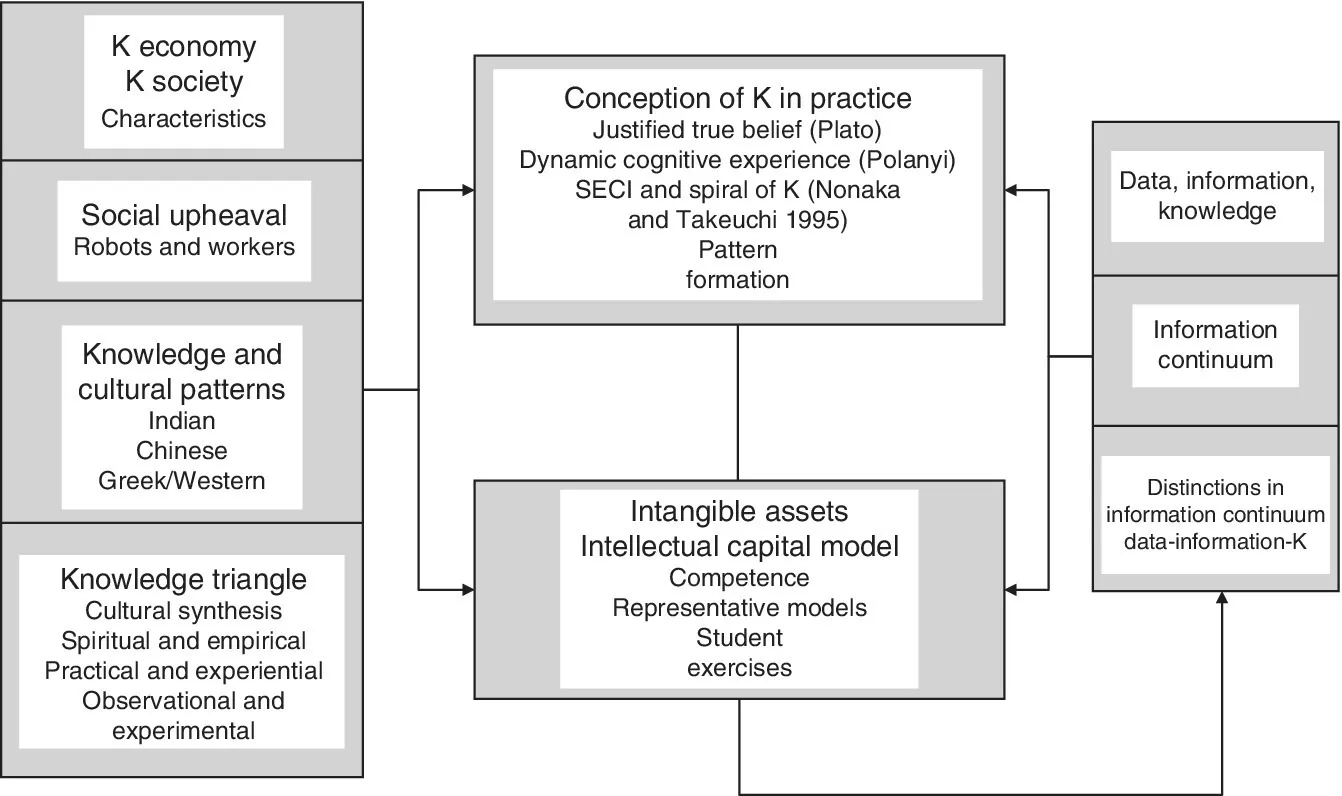
The figure below illustrates the topic layout of Chapter 1. The left section informs the organization on the characteristics of the knowledge economy and its social implications. We discuss the cultural perspectives of knowledge through the prism of Indian, Chinese, and Greek/Western traditions. We also introduce the K‐triangle as a metaphor to represent a cultural synthesis. The right side of the figure shows the artifacts associated with data, information, and knowledge (D‐I‐K). We discuss the information continuum as an artifact that characterizes levels of richness between data, information, and knowledge, as well as their interactions. The center of the figure represents the conceptions of knowledge in practice. We consider popular models, including Plato, Polanyi, and Nonaka, and Takeuchi. We discuss tacit and explicit knowledge. We further characterize how organizations may represent their K assets—intangibles and IC. We conclude with a student exercise on the development of an IC model for their organization.
Image described by surrounding text.

Concept roadmap to Chapter 1.

1.1 The New Pangaea

Once upon a time, say 300 million years ago, there was a single global supercontinent known as Pangaea that was home to all land life. This single land mass promoted a certain mixing and combining of life constrained, of course, by geological formations and weather conditions. Information flow was relatively easy.
In time, earth forces broke apart Pangaea, thereby creating the continents—and this movement continues today. With this separation of land, life too became isolated, and ā€œculturesā€ soon developed. As an example, Charles Darwin observed the many species of finches in the Galapagos Islands—species that arose from isolation caused by the creation of islands in close proximity to one another. Information flow, initially inhibited by geographic isolation, was further inhibited by cultural isolation.
Periods of isolation characterize the history of life and humankind on earth. The many races and languages as well as beliefs and experiences demonstrate what happens when humans are separated from each other. Communication and information flow were also difficult, usually requiring travel by foot or occasionally by water. Conflict followed separation and culturation—and this too continues today. However, something different is happening now. It is the figurative formation of a new type of Pangaea. In this new Pangaea, there is once again a mixing and combining, not in a biological sense, but of human culture, information, and knowledge. Thomas Friedman (2005) calls this movement a ā€œflat worldā€; others simply call it ā€œglobalization.ā€
The ancient landmass of Pangaea serves as a useful starting point for our discussion of knowledge and knowledge management (KM). The history of knowledge is the history of human beings. First, isolation and, now, interaction are the creative forces that give rise to the fabric of human knowledge.

1.2 Characterizing the Knowledge Economy

How do we characterize KM? Despres and Chauvel (2000) have described two ā€œdividesā€ associated with KM. The first asserts that KM is a progression from managing by objectives to managing by (organizational) development, to total quality management, to business process reengineering, and finally to KM. In this perspective, KM is an evolutionary process creating yet another collection of organizational technologies, matrices, and techniques. The subtheme is that managing knowledge is not very different from managing data or information. In effect, the organization’s management practices continue those of the industrial age with certain structural addendums, such as teams.
The second divide, advocated by Peter Drucker (1999) and supported by the authors, is that KM is a harbinger of a new age in both management and economics. The subtheme here is that KM is a global phenomenon, what we characterize as the new Pangaea, with dimensions that extend well beyond the organization into virtually every human endeavor. Its impact will be largely cultural and social, with profound effects on the design and management of organizations. And this takes us back to Drucker’s assertion that the single most important issue for 21st century organizations is the improvement of knowledge worker productivity.
In this new way of thinking, Despres and Chauvel (2000) illustrate both the importance and dilemma that KM presents:
  • KM is ā€œintuitively important but intellectually elusive.ā€
  • ā€œWith rare exceptions, the productivity of a modern corporation or nation lies more in its intellectual and systems capabilities than in its hard assets.ā€
  • ā€œTo define knowledge in a non‐abstract and non‐sweeping way seems to be very difficult. Knowledge easily becomes everything and nothing.ā€
There is a certain theme to these quotes: KM is of overwhelming importance to society yet difficult to grasp. This presents an organizational problem—if knowledge is everything, then in practice, it becomes nothing. And this is our central design challenge: if, indeed, knowledge is everywhere, its design must be based on new and creative concepts so as to avoid becoming nothing.

1.3 A Glimpse into the Knowledge Society

Lester Thurow (2009) has identified several attributes of our knowledge society. Of course, the list is endless and constantly changing, but Thurow (2009) makes two interesting observations. In the first, he asks from where will new ideas come. He answers, ā€œcorporate democracy.ā€ This approach is contrary to the way organizations typically create knowledge. Social networking, for example, extends knowledge transfer beyond the organization’...

Table of contents

  1. Cover
  2. Title Page
  3. Table of Contents
  4. Acknowledgments
  5. Introduction to Knowledge Systems
  6. 1 Understanding Knowledge
  7. 2 Designing Knowledge Systems
  8. 3 Organizations and Systems
  9. 4 Knowledge Work and Technology
  10. 5 Organizations and Knowledge
  11. 6 Social Aspects of Knowledge Management
  12. 7 Strategy and Leadership for Knowledge Management
  13. 8 Knowledge Horizons
  14. Appendix
  15. Index
  16. End User License Agreement