
Nursing and Healthcare Research at a Glance
eBook - ePub

Nursing and Healthcare Research at a Glance

  1. English
  2. ePUB (mobile friendly)
  3. Available on iOS & Android
eBook - ePub

Nursing and Healthcare Research at a Glance

About this book

Nursing and Healthcare Research at a Glance is perfect for nursing and healthcare students, as well as newly qualified practitioners and anyone looking for a refresher or introduction to research.

Covering a broad range of topics gathered under key sections, this essential book combines informative diagrams and images to provide memorable information for students on one page, and accessible, clearly written text on the facing page. It includes information on a range of quantitative and qualitative research methods, the process of gaining ethical permission, conducting research with special groups including children, and successfully conducting reviews of the literature.

Key features include:

  • Clear and informative full colour illustrations throughout
  • An emphasis on need-to-know research information for busy students and healthcare staff
  • A wide range of research methods, currently used in modern healthcare research
  • An impressive line-up of specialist and well-known experts in the field of health and nursing research

This book provides quick access to the principles and reality of research and its implementation within the education and practice environment. It is essential reading for anyone in health service education and service settings with limited time who need to draw on research evidence.
Frequently asked questions

Yes, you can cancel anytime from the Subscription tab in your account settings on the Perlego website. Your subscription will stay active until the end of your current billing period. Learn how to cancel your subscription.
No, books cannot be downloaded as external files, such as PDFs, for use outside of Perlego. However, you can download books within the Perlego app for offline reading on mobile or tablet. Learn more here.
Perlego offers two plans: Essential and Complete
  • Essential is ideal for learners and professionals who enjoy exploring a wide range of subjects. Access the Essential Library with 800,000+ trusted titles and best-sellers across business, personal growth, and the humanities. Includes unlimited reading time and Standard Read Aloud voice.
  • Complete: Perfect for advanced learners and researchers needing full, unrestricted access. Unlock 1.4M+ books across hundreds of subjects, including academic and specialized titles. The Complete Plan also includes advanced features like Premium Read Aloud and Research Assistant.
Both plans are available with monthly, semester, or annual billing cycles.
We are an online textbook subscription service, where you can get access to an entire online library for less than the price of a single book per month. With over 1 million books across 1000+ topics, we’ve got you covered! Learn more here.
Look out for the read-aloud symbol on your next book to see if you can listen to it. The read-aloud tool reads text aloud for you, highlighting the text as it is being read. You can pause it, speed it up and slow it down. Learn more here.
Yes! You can use the Perlego app on both iOS or Android devices to read anytime, anywhere — even offline. Perfect for commutes or when you’re on the go.
Please note we cannot support devices running on iOS 13 and Android 7 or earlier. Learn more about using the app.
Yes, you can access Nursing and Healthcare Research at a Glance by Alan Glasper, Colin Rees, Alan Glasper,Colin Rees in PDF and/or ePUB format, as well as other popular books in Medicine & Nursing. We have over one million books available in our catalogue for you to explore.

Information

Year
2016
Print ISBN
9781118778791
eBook ISBN
9781119267140
Edition
1
Subtopic
Nursing

Part 1 What is healthcare research?

Chapters

  1. 1 The research journey
  2. 2 Types of review and their purpose
  3. 3 Using databases to search the literature
  4. 4 Undertaking a Cochrane systematic review
  5. 5 Undertaking a Joanna Briggs Institute systematic review
  6. 6 Using End Note
  7. 7 Using the PICO framework
  8. 8 Using the SPICE framework
  9. 9 Using grey literature in the quest for evidence
  10. 10 Why does research need evaluating?
  11. 11 Key issues in evaluating research
  12. 12 Critically reviewing a research paper
  13. 13 The hierarchy of evidence
  14. 14 Factors influencing research design
  15. 15 Patient and public involvement in research
  16. 16 Descriptive studies
  17. 17 Action research
  18. 18 Participatory health research
  19. 19 The ethics of healthcare research
  20. 20 Preparing a research proposal
  21. 21 Developing a patient research information pack
  22. 22 Getting the most from supervision
  23. 23 Writing a research report
  24. 24 Implementation of healthcare research
  25. 25 Barriers to research utilisation
  26. 26 Designing service evaluations
  27. 27 Designing audit tools for measuring compliance

1 The research journey

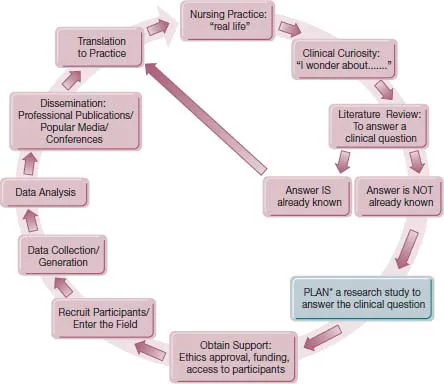
Cyclic diagram shows steps as nursing practice, clinical curiosity, literature review: answer clinical question, if answer not known, plan a research study to answer clinical question, obtain support, recruit participants, data collection and analysis, dissemination, translation to practice, which leads back to nursing practice. If answer is known then go to translation to practice.
Figure 1.1 The steps of the nursing research journey: it begins and ends with nursing practice.
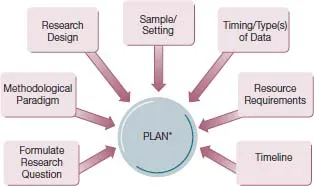
Diagram shows planning formulate research question, methodological paradigm, research design, sample/setting, timing/ type(s) of data, resource requirements, and timeline.
Figure 1.2 Planning: the pivotal step.

Clinical curiosity

The first step in the research journey is to begin to wonder about something. A vibrant research culture will foster this clinical curiosity. If the patient or client’s best interests are truly at the heart of a healthcare organisation, then its employees will always be on the lookout for how things might be done better, for how some vexing recurring problem might finally be solved. The first step of research is to observe, to notice, to look around, to wonder why things are happening the way they are, and to envision how they might be improved (Figure 1.1).

Literature searching

The next step is to see if our curiosity can be immediately satisfied by what is already known in the existing body of research evidence available at our fingertips. This step includes finding the research literature, then appraising it both for quality and for applicability to our own practice context. If there have already been a number of rigorously conducted studies and they concur on the best approach after studying populations that are similar to our own clients, then we can immediately apply that evidence to our own practice without the need to conduct further research. This process of translation of research evidence into the practice setting requires excellent leadership and change management skills, as well as project management. Evidence must be presented, appraised and discussed before any change can, or indeed should, occur.

Planning a research study

However, an exhaustive search of the current body of research evidence may fail to unearth a compelling, congruent body of work. The clinician may still be left wondering how best to care for their client. Once such a gap in the literature has been identified, this gap may justify the expenditure of human and material resources to conduct a study to answer the clinical question. This is where the fun really begins!

Research question

It is vital to carefully delineate exactly what it is that you are trying to discover in any research project, as that research question will drive all the other decisions you will need to make as you devise your research plan (Leedy & Ormrod, 2013) (Figure 1.2).

Methodological paradigm

Once you know your question, you can begin to select the best methodological paradigm to use to frame your research plan (Schneider & Whitehead, 2013). If you are trying to test an intervention for effectiveness, the ‘gold standard’ is to conduct a randomised controlled trial (RCT) in the positivist paradigm, by gathering quantitative data to use in statistical comparisons. However, there are many other types of research questions you may be wondering about, and if you choose the wrong paradigm you are still going to get an answer, but not to your question.

Research design/methods

Once you have chosen the most appropriate and relevant methodological paradigm, you can begin to plan the ‘nuts and bolts’ of your study (Leedy & Ormrod, 2013). Who will be your participants – your sample? Where will you recruit your participants? What kind of data will you collect from them: numbers, words or both kinds of data? Will it come from interviews, chart audits, questionnaires, focus groups, observations, document analysis? Will the data be collected once or a number of times, and how far apart? Who will collect the data and how will they be hired and trained? How much time and money will you need to conduct the study? Are there ethical or legal considerations that you need to address in your research plan?

Obtain support

Ethical approval

Most research requires the oversight and approval of a human research ethics committee (HREC), which evaluates all your carefully considered plans to ensure two things. First, that you are conducting research properly, so that it will have merit and usefulness, and not be trivial and a waste of everyone’s time. Second, that you have included safeguards to ensure that the ethical rights of the participants in your study are maintained. You will need to prepare a participant information sheet and an informed consent form for the HREC to review and approve. The committee will also wish to see any questionnaire you want participants to complete, or the questions you may ask during an interview or focus group, or the kinds of ...

Table of contents

  1. Cover
  2. QR Code
  3. Title page
  4. Copyright
  5. Contributors
  6. Preface
  7. Part 1 What is healthcare research?
  8. Part 2 Quantitative research
  9. Part 3 Qualitative research
  10. Part 4 Research techniques
  11. Part 5 Conducting research with special groups
  12. Part 6 Historical research
  13. Part 7 Educational research
  14. Part 8 Appendices
  15. Index
  16. EULA