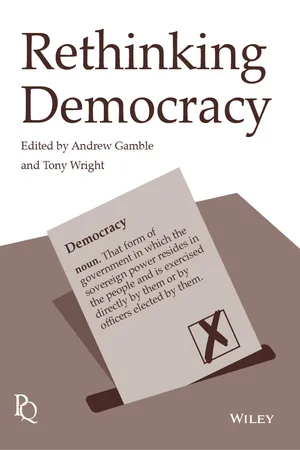
2018 IS THE centenary of the 1918 Act which introduced universal suffrage for all male citizens over twenty-one and all female citizens over thirty. Women had to wait another ten years until 1928 for that anomaly to be corrected, but the fundamental principle of universal suffrage for all citizens had been conceded. This reform marked a decisive stage in the emergence of a full democracy in Britain and seems a good moment for some stocktaking and rethinking. Has democracy delivered what those who fought so hard to establish it hoped for? How far is it an unfinished revolution? The present time is a difficult one for democracies everywhere. The populist surge, from Brexit to Trump, and now Italy, has raised questions about the condition and conduct of representative politics; and democratic politics is under attack on several fronts and in a range of places. There is much to discuss and to rethink about democracy.
This collection of essays is a response to these issues and concerns. We asked our contributors to write pieces which would reflect on one or more aspects of democracy. We did not assign them a particular theme or set of questions but asked them to explore the issues in the way they thought most appropriate. In the tradition of Political Quarterly, we also asked that the essays should not be narrowly academic but written for an informed and non-specialised readership.
They did not disappoint us. The essays collected here explore the problems of democracy from many different perspectives, and although some of the contributors address similar themes, they do so from different angles. Each contributor develops an argument which sheds new insight on the current state of democracy. Some suggest ways it might be improved, some dissect myths that have grown up about how democracy operates, while others analyse the developments which are undermining democracy and could conceivably threaten its survival in the next hundred years. We think our democracies are now so well established that they have become permanent and irreversible, but in politics nothing is guaranteed to last for ever, and what seems solid and impregnable in one era can seem fragile and vulnerable in the next. Democracy is not a finished state. It is a living process and if there is no longer the will or the belief in its value then it may not endure. If we lose the art of active citizenship, we will lose the freedoms and the rights which democracy has bestowed.
This is one of the key themes of Tony Wright’s opening essay, pointing out that democracies can die and when they do, it is norms not institutions which are the key factor. If important aspects of a democratic culture weaken, if the civilised management of disagreement is lost, then the will to sustain the institutions of democracy can decline also. He notes that there has been an explosion of accountability in recent times but governments are accountable for less and less, which means that elected governments are often perceived as no longer delivering for their citizens. But the essay ends on an optimistic note. Representative democracy can be renewed and enriched in ways that were not possible before, including through the new digital media, but it also needs a culture of democratic citizenship, one that is pluralist and encourages civility. Without it, the greatest risk is not that democracies will collapse but that they will steadily deteriorate.
Joni Lovenduski is more pessimistic about the possibilities of renewing representative democracy. All democratic governments notionally support equality for women, but none have achieved it. She argues that the political institutions of representative democracy pre-dated the mobilisation of women, and as a result, women were trapped in the private sphere. The operating institutions of representative democracy have always been unable to accommodate both ascribed and real differences between women and men. Democracy raises expectations of inclusion and equality, but in reality, women have been ignored and have often been absent in both the theory and practice of democracy. One hundred years after the breakthrough in securing votes for women, they are not yet citizens on the same terms as men.
David Runciman asks why democracies are so surprising. In many recent results of elections and referendums, the winners have often been as taken aback as the losers. Part of this is because representative democracies are no longer very representative. The political class has become increasingly divorced from those it represents. The tremors that were an early warning of the later earthquake were ignored. Voting behaviour is driven by tribal loyalties and voting against someone is often more important than voting for someone, which makes differential turnout a very important factor in elections. Some element of surprise is good for democracy and forces the political class to listen, but too many surprises make good government much harder to achieve.
Vernon Bogdanor looks at the history of constitutional reform over the last hundred years and why, after the lively debate before 1914 on Ireland and the suffrage, the constitution was little discussed for fifty years until it became once more a major issue with the return of the old question of Ireland, the new question of Europe, and the eruption of Scottish nationalism. He explores the introduction of the referendum into British constitutional practice, arguing that the 1975 referendum established the precedent that for fundamental decisions, a vote in Parliament is no longer enough. The people also have to be consulted. In the Brexit vote the sovereign people have triumphed over the sovereign Parliament. Brexit is coming about against the wishes of both government and Parliament. The crisis of British representative democracy, he argues, is that the constitutional reforms of the Blair government shared power amongst the elite but did little to transfer power from the elites to the people. What is now needed is a major reform of local government to energise citizens once again. The age of pure representative democracy is coming to an end.
Albert Weale picks up on another aspect of the practice of representative democracy in the UK, the greater difficulty parties currently have in forming majority governments. The electoral system no longer delivers the parliamentary majorities of the past: two of the last three elections have produced a hung Parliament. Weale argues that there are good reasons why this is not likely to change and that this makes it urgent to find fair and open ways to make possible political negotiations among different groups in order to achieve strong and effective governments. He supports the principle of double majorities, seeing it as desirable that governments should command a majority both in Parliament and in the electorate. The coalition government of 2010–15 satisfied that principle, while the May government does not.
Alan Finlayson reflects on the nature of political communications in contemporary democracies and the impact of digital media, a theme which is also the focus of several other essays in this collection. Finlayson considers digital media and the digital public sphere, noting the anxieties which have arisen around fake news, irrationality, and hate speech. He argues that rather than just bemoaning these things, we need to develop new strategies to combat them. He discusses the effectiveness of some of the right-wing bloggers, noting that nothing similar exists on the left. What is required are new forms of egalitarian self-education, and new ways of communicating political messages, using the new styles of the digital media.
Martin Moore also analyses the impact of digital media, looking in particular at election campaigns as communication campaigns. He notes that there have always been exaggerated fears and hopes around the political effects of every major change in communication, but he accepts that some of the changes introduced by digital media do pose real challenges to established democratic principles and protections, such as safeguarding the secrecy of the vote and shielding voters from undue influence. He uses the recent revelations about Cambridge Analytica to pinpoint the dangers and what might be done about it.
Helen Margetts looks at a different angle of digital media and democracy. She examines the evidence of the impact of digital media on political behaviour, noting that up to now this has been hard to research because researchers cannot access the data which the big platforms hold. This means we actually know very little about the relationship between social media and democracy, but that has not prevented many people speculating as to what that relationship is, and reaching sometimes apocalyptic conclusions. Margetts focuses on what we do know, such as the way the new digital platforms have transformed the costs and benefits of every kind of political participation, which has both good and bad effects. She seeks to dispel some of the myths which have gathered around social media and argues that these new media platforms need to be accepted as part of the democratic system, and that although many political institutions have not yet adjusted, eventually they will. To speed up the process, we need to separate fact from myth and analyse in much greater depth the scale and scope of the democratic pathologies such as fake news with which digital media have become associated.
Almost every piece in this collection touches on populism and the final two chapters make it their main focus. Colin Crouch contrasts two concepts of democracy, liberal and populist, and relates them to his thesis of postdemocracy which he first advanced more than ten years ago in 2005. Postdemocracy was the process by which democracies were being hollowed out and the political class divided from the mass of citizens, leading to feelings of anger and resentment. Crouch identified xenophobic populism as one possible response to the increasing detachment of the political class, but he did not think back then that it would become the dominant one. He analyses the consequences of xenophobic populism in the vote for Brexit and the vote for Trump.
Gerry Stoker takes up the theme of the politics of resentment and shows how rooted it is in the geographical, educational and generational divides of modern Britain. Reinforcing some of the arguments of Wright and Bogdanor, he argues that the right democratic response to the politics of resentment is not to condemn it but to understand it, and to mobilise a new politics of place and identity to counter it. One of the implications is that liberal democracies, if they are to survive and contain and even roll back the populist insurgencies which are currently besieging them, need to pay much more attention to democratic accountability exercised locally. Citizens need to regain a stake in their local communities and influence over the decisions that most immediately affect them.
Andrew Gamble’s concluding chapter surveys the progress and the setbacks to democracy in Britain over the last hundred years and identifies some of the things which need to change if democracy and the public domain which supports it is to be preserved and extended in the future.
The editors would like to thank the contributors and also the Political Quarterly Editorial Board for their assistance in the writing of this book. Special thanks also go to Emma Anderson for production, Clara Dekker for the copyediting and Anya Pearson for organising events around the book.
2.
Democracy and Its Discontents
TONY WRIGHT
‘THAT’S DEMOCRACY.’ This is the claim routinely heard as political opponents exchange verbal blows, with each side asserting their occupancy of the democratic high ground. In Britain, it is the contested claim between those who see the EU referendum as the definitive expression of popular democracy and those who regard it as a threat to its representative version. In the battle for control inside the Labour party, an assertion of the democratic primacy of an activist membership collides with a more pluralist conception of democracy. In Catalonia, the assertion of democratic rights by the separatists is met by the assertion of democratic rights by other Spaniards. In the United States, the democratic authority of a rogue president rubs up against the kind of checks-and-balances democracy of the Founding Fathers. In Russia, Putin wins an election and claims democratic legitimacy. Such examples could be endlessly multiplied. All kinds of regimes, including many oppressive ones, have wanted to call themselves democracies. If everybody can make the claim of ‘that’s democracy’ to support their position, it suggests that democracy is both potent and promiscuous.
It also means that any discussion of it can easily become muddled. Consider, for example, the latest version of the Economist Intelligence Unit’s annual Democracy Index, an audit of the state of democracy in every country in the world. In its most recent report, the United Kingdom’s democratic score has improved from the previous year, largely on the basis of the high turnout in the 2016 referendum on the EU. In one sense this makes sense, as electoral participation is an important measure of democracy. Yet does it mean that the quality of democracy in Britain has improved? This seems unlikely. It would be difficult to claim that the referendum campaign produced a more informed electorate. For example, an Ipsos Mori survey shortly before the referendum found that Leave voters overestimated the number of EU immigrants by a factor of four (and Remain voters by a factor of two). As for the turnout boost produced by non-voters voting, the political science evidence on non-voters is that ‘however ignorant voters tend to be, non-voters—adult citizens who are eligible to vote but choose to abstain —tend to be worse’.1
None of this diminishes the significance (or validity) of the result, but it does illustrate some of the difficulties about the discussion of democracy. These difficulties were already there in the origins of the democratic idea in the city states of ancient Greece. Democracy combined ‘demos’ (the people) with ‘kratos’ (control), but who were the people and what were they controlling? The different answers to this question meant that ‘there was no such thing as ancient Greek democracy—no one single thing, that is’.2 Citizenship excluded women and slaves, but even beyond this exclusion the ‘demos’ might mean people in a broad sense or the rule of the many poor. It was this latter sense, with its association of mob rule and the prospect of the propertyless expropriating the propertied, that was to identify democracy as a bad word for much of its history. How a bad word became not merely a good word but the defining source of political authority in the modern world is a remarkable story.
The reinvention of democracy took the idea of the people ruling themselves and put it into the idea of people ruling through their representatives. Not only did this overcome the problem of scale (the face-to-face direct democracy of Athens was only possible because of a citizen body numbered in the thousands), but also mitigated the problem of majoritarian tyranny that so exercised the minds of such nineteenth-century figures as T...