The aim of this new book series (Diatoms: Biology and Applications) is to provide a comprehensive and reliable source of information on diatom biology and applications. The first book of the series, Diatoms Fundamentals & Applications, is wide ranging, starting with the contributions of amateurs and the beauty of diatoms, to details of how their shells are made, how they bend light to their advantage and ours, and major aspects of their biochemistry (photosynthesis and iron metabolism). The book then delves into the ecology of diatoms living in a wide range of habitats, and look at those few that can kill or harm us. The book concludes with a wide range of applications of diatoms, in forensics, manufacturing, medicine, biofuel and agriculture. The contributors are leading international experts on diatoms. This book is for a wide audience researchers, academics, students, and teachers of biology and related disciplines, written to both act as an introduction to diatoms and to present some of the most advanced research on them.
eBook - ePub
Diatoms
Fundamentals and Applications
- English
- ePUB (mobile friendly)
- Available on iOS & Android
eBook - ePub
About this book
Information
Chapter 1
A Memorial to Frithjof Sterrenburg: The Importance of the Amateur Diatomist
Janice L. Pappas
Department of Mathematics, University of Michigan, Ann Arbor, USA
Corresponding author: [email protected]
Abstract
Frithjof A.S. Sterrenburg was an amateur diatomist who became an expert in taxonomy, nomenclature, microscopy, and photomicrography. He is best known for his work on Gyrosigma Hassall and Pleurosigma W. Smith but contributed in many areas of diatom research. Because of who he was and the nature of his interactions with the diatom community, he has had and will continue to have a lasting impact. His contributions to diatom research have influenced our understanding and usage of diatom taxonomy and nomenclature and how taxonomy informs ecological, biostratigraphic and other biological studies. His affable yet incisive character enabled him to be a teacher and mentor to professionals and amateurs and to be respected and appreciated internationally.
Keywords: Diatoms, Gyrosigma, Pleurosigma, microscopy, amateur diatomists, photomicrography, museum collections, taxonomy, valve morphogenesis, constructal morphology
1.1 Introduction
Throughout science, amateurs have contributed to the body of knowledge in many disciplines. Amateurs dedicate themselves to the pursuit of knowledge concerning their specific interests, and when it comes to diatoms, this is no exception. During the 1800s, diatom research was conducted by hobbyists who had occupations in very different fields (Bahls 2015; Gordon et al. 2009). For example, Friedrich Traugott Kützing was a pharmacist and school teacher who became a diatomist. He discovered that diatoms were composed of silica and had two parts to their shells, one was “primary” and the other “secondary,” and was aided in publishing his findings by C.G. Ehrenburg, the preeminent zoologist and diatomist of the time (Werner 1977). Some amateurs formed microscopical societies or clubs as enthusiasts pursuing their common interest in the microscopic world (e.g., The Quekett Microscopical Club). In the post-Victorian world, diatom research has become professionalized, and currently, individuals can find professional mentors for formalized training to become a diatom researcher as one’s occupation.
Having said this, modern amateur or citizen scientists are still making contributions to diatom research. Because so few individuals are formally trained, credentialed, paid, and have a career specifically in diatom research, and because diatom research is at a stage where the enormity of necessary work involves potentially hundreds of thousands of species, amateurs have a vital role to play. Amateurs who engage in this role seriously soon realize that contributing requires associating oneself with professionals, especially concerning technical matters in taxonomy, nomenclature, microscopy, and photomicrography.
The quintessential example of the modern amateur diatomist was Frithjof Sterrenburg (Figure 1.1). He died on March, 11, 2016 and left his mark on diatom research. He had passion and dedication to diatom research that earned him recognition and respect from professionals internationally. Frithjof’s work in diatom taxonomy and nomenclature as well as microscopy and photomicrography has benefited professional and amateur diatomists alike, and his contributions have continued to be influential in the way diatom researchers engage in and pursue their studies. No matter how one perceives what it means to be an amateur, Frithjof transcended the notion because of who he was and how he lived his life.
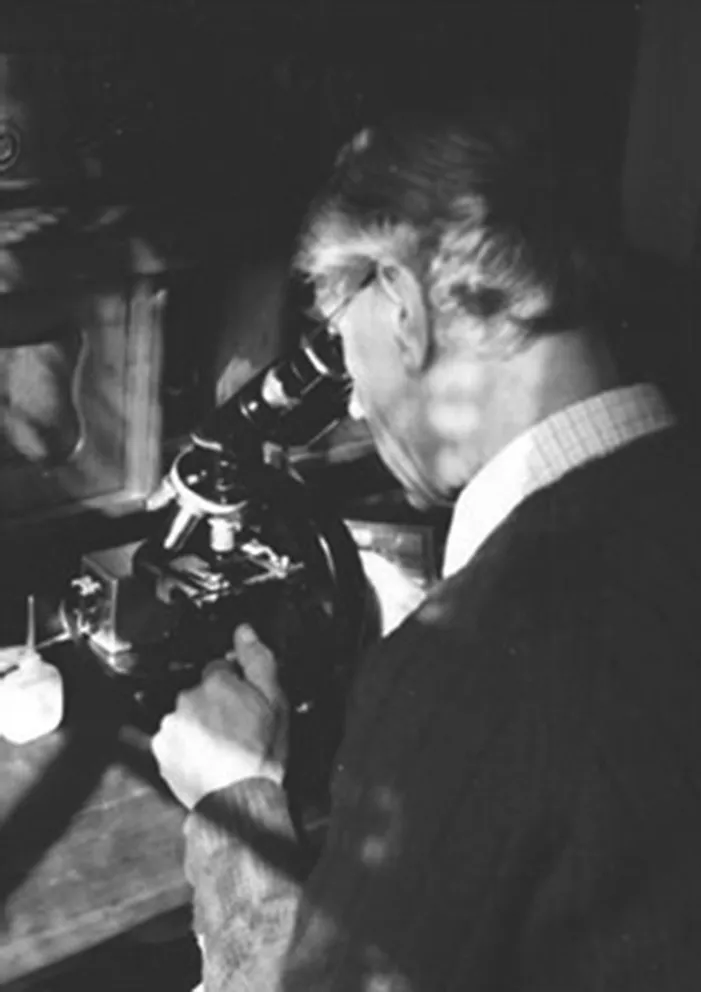
Figure 1.1 Frithjof A. S. Sterrenburg at his microscope.
(courtesy of H. van Dam)
Historically, amateur diatomists were unpaid and typically worked in various occupations (Bahls 2015; Werner 1977). A prime example was Astrid Cleve-Euler. She was the first female to be awarded a doctorate in science at Uppsala University, Sweden in the late 19th century. Yet, throughout her life, she was never employed as a scientist despite her contributions to chemistry, botany, geology, and diatom research (Swedish Natural History Museum). Even van Leeuwenhoek (17th to 18th century) who was a tradesman and politician did not get paid to study the microscopic world (Pedrotti accessed on 2016; Sterrenburg 1982).
Other dedicated amateurs engaged in diatom research. Pleurosigma angulatum, originally named Navicula angulata by John Thomas Quekett (Sterrenburg 1990a), an amateur diatomist who was a microscopist and histologist, was typified by the Reverend William Smith, an amateur turned academic who was a prominent diatom researcher in the Victorian era (Werner 1977). As a common leisure activity, diatoms were mounted in various configurations, slides were either purchased or prepared by the individual, and mounts were viewed with microscopes situated in Victorian parlors (Lynk accessed on 2016). Diatom mounters such as Johann Diedrich Möller (originator of the art of diatom mounting) (Walker 2009) and dentist William Gatrell (Stevenson 2009) were much in demand to produce intricate arrangements for viewing. The advent of the microscope and its common usage paved the way for such activities and induced the proliferation of amateur diatomists interested in the natural history of these eye-catching, exquisite microorganisms.
Frithjof was a throwback, in a sense, to this ilk of diatom researcher. Yet, he developed his own style and went beyond amateurs such as surgeon and physician John Redmayne (Stevenson 2013) and teacher John Albert Long (Walker 2012). Like Quekett, Redmayne and Long plied their trade as amateur diatomists in the late 19th and early 20th century. They bought and sold diatom samples as well as made mounts and relied on popular publications such as Hardwicke’s Science Gossip for the latest information on diatoms (e.g., Taylor 1885). In Hardwicke’s volume XXI from 1885, an article on Jacques-Joseph Brun’s publication, “The Diatoms of the Alps and the Jura,” was presented in which Brun, a pharmacologist and diatomist (JStor Global Plants accessed on 2016), talked about the deposition of diatoms over time and the formation of Kieselgühr (Taylor 1885). His taxonomic work like that of his contemporaries on fossil diatoms provided the impetus for the commencement of Adolph Schmidt’s Atlas in 1874 (Schmidt et al. 1874–1959) that was continued with contributions from others until 1959—including Friedrich Hustedt, a teacher turned professional diatomist who has had a great influence on diatom research (Alfred Wegener Institute 2015). Frithjof’s trajectory into diatom research was more along the lines of Smith, Brun, and Hustedt. Like these predecessors, Frithjof progressed from amateur to expert, garnering respect for his expertise. Frithjof elevated his contributions to the level of scientific peer-review rather than being only presentable in popular publications, and like many of his predecessors, he has had a lasting impact on diatom research.
1.2 Background and Interests
Frithjof A. S. Sterrenburg was born in 1934. Originally, he studied medicine at Amsterdam University. His autodidactic nature conflicted with a formalized education approach, and inevitably, he would venture out on his own. He was well-read and able to learn various subjects at many levels of difficulty and did so as a life-long endeavor. For Frithjof, life and learning was an adventure.
Frithjof showed a propensity for immersing himself in a wide range of learning experiences, and some of his emerging talents were expressed in such divergent fields as music (e.g., Sterrenburg 1967) and astronomy. In his youth, Frithjof played trumpet (Figure 1.2), saxophone, clarinet, and piano in big-band style orchestras, and he also arrange...
Table of contents
- Cover
- Title Page
- Copyright
- Dedication to Lawrence Bogorad
- Foreword
- Introduction to Diatoms: Fundamentals and Applications
- Chapter 1: A Memorial to Frithjof Sterrenburg: The Importance of the Amateur Diatomist
- Chapter 2: Alex Altenbach – In Memoriam of a Friend
- Chapter 3: The Beauty of Diatoms
- Chapter 4: Current Diatom Research in China
- Chapter 5: Cellular Mechanisms of Diatom Valve Morphogenesis
- Chapter 6: Application of Focused Ion Beam Technique in Taxonomy-Oriented Research on Ultrastructure of Diatoms
- Chapter 7: On Light and Diatoms: A Photonics and Photobiology Review
- Chapter 8: Photosynthesis in Diatoms
- Chapter 9: Iron in Diatoms
- Chapter 10: Diatom Symbioses with Other Photoautotroph
- Chapter 11: Diatom Sexual Reproduction and Life Cycles
- Chapter 12: Ecophysiology, Cell Biology and Ultrastructure of a Benthic Diatom Isolated in the Arctic
- Chapter 13: Ecology of Freshwater Diatoms – Current Trends and Applications
- Chapter 14: Diatoms from Hot Springs of the Kamchatka Peninsula (Russia)
- Chapter 15: Biodiversity of High Mountain Lakes in Europe with Special Regards to Rila Mountains (Bulgaria) and Tatra Mountains (Poland)
- Chapter 16: Diatoms of the Southern Part of the Russian Far East
- Chapter 17: Toxic and Harmful Marine Diatoms
- Chapter 18: Diatoms in Forensics: A Molecular Approach to Diatom Testing in Forensic Science
- Chapter 19: Diatomite in Use: Nature, Modifications, Commercial Applications and Prospective Trends
- Chapter 20: Diatom Silica for Biomedical Applications
- Chapter 21: Diafuel™ (Diatom Biofuel) vs Electric Vehicles, a Basic Comparison: A High Potential Renewable Energy Source to Make India Energy Independent
- Chapter 22: Bubble Farming: Scalable Microcosms for Diatom Biofuel and the Next Green Revolution
- Index
- End User License Agreement
Trusted by 375,005 students
Access to over 1.5 million titles for a fair monthly price.
Study more efficiently using our study tools.
Frequently asked questions
Yes, you can cancel anytime from the Subscription tab in your account settings on the Perlego website. Your subscription will stay active until the end of your current billing period. Learn how to cancel your subscription
No, books cannot be downloaded as external files, such as PDFs, for use outside of Perlego. However, you can download books within the Perlego app for offline reading on mobile or tablet. Learn how to download books offline
Perlego offers two plans: Essential and Complete
- Essential is ideal for learners and professionals who enjoy exploring a wide range of subjects. Access the Essential Library with 800,000+ trusted titles and best-sellers across business, personal growth, and the humanities. Includes unlimited reading time and Standard Read Aloud voice.
- Complete: Perfect for advanced learners and researchers needing full, unrestricted access. Unlock 1.5M+ books across hundreds of subjects, including academic and specialized titles. The Complete Plan also includes advanced features like Premium Read Aloud and Research Assistant.
We are an online textbook subscription service, where you can get access to an entire online library for less than the price of a single book per month. With over 1.5 million books across 990+ topics, we’ve got you covered! Learn about our mission
Look out for the read-aloud symbol on your next book to see if you can listen to it. The read-aloud tool reads text aloud for you, highlighting the text as it is being read. You can pause it, speed it up and slow it down. Learn more about Read Aloud
Yes! You can use the Perlego app on both iOS and Android devices to read anytime, anywhere — even offline. Perfect for commutes or when you’re on the go.
Please note we cannot support devices running on iOS 13 and Android 7 or earlier. Learn more about using the app
Please note we cannot support devices running on iOS 13 and Android 7 or earlier. Learn more about using the app
Yes, you can access Diatoms by Joseph Seckbach, Richard Gordon, Joseph Seckbach,Richard Gordon in PDF and/or ePUB format, as well as other popular books in Biological Sciences & Biology. We have over 1.5 million books available in our catalogue for you to explore.