E-Enabled Operations Management
eBook - ePub

E-Enabled Operations Management

  1. English
  2. ePUB (mobile friendly)
  3. Available on iOS & Android
eBook - ePub

E-Enabled Operations Management

About this book

Although the theory of operations management has been presented in many textbooks published in the last two decades, the subject of e-enabled operations management is rather short of easily accessible literature.  The approach to operations management described in this book is unusual with respect to what is found in standard textbooks. Information and Communication Technologies (ICT) impact the ways firms are organised and managed, and as a consequence change the practical means used to conduct business operations.

The features of this book are threefold.

System approach to business modelling: Business activities, controlling functions and associated information systems are described within a coherent analytical system framework allowing a clear understanding of the various current control and costing concepts.  Operations costing is not usually included in textbooks as part of operations management, but it should be. Cost targeting has become an integral part of good practice of business management.

Validity of models: Apparently simple models are analyzed in depth. Students must be fully aware of the assumptions made when models are formulated and of their conditions of validity. Applying a model implies automatically that assumptions of a sort are taken for granted.

Logistics, procurement and quality management: These three business functions are critical key success factors for managing e-enabled supply chains from suppliers to customers. That is why their main tools are introduced in this document.
Frequently asked questions

Yes, you can cancel anytime from the Subscription tab in your account settings on the Perlego website. Your subscription will stay active until the end of your current billing period. Learn how to cancel your subscription.
No, books cannot be downloaded as external files, such as PDFs, for use outside of Perlego. However, you can download books within the Perlego app for offline reading on mobile or tablet. Learn more here.
Perlego offers two plans: Essential and Complete
  • Essential is ideal for learners and professionals who enjoy exploring a wide range of subjects. Access the Essential Library with 800,000+ trusted titles and best-sellers across business, personal growth, and the humanities. Includes unlimited reading time and Standard Read Aloud voice.
  • Complete: Perfect for advanced learners and researchers needing full, unrestricted access. Unlock 1.4M+ books across hundreds of subjects, including academic and specialized titles. The Complete Plan also includes advanced features like Premium Read Aloud and Research Assistant.
Both plans are available with monthly, semester, or annual billing cycles.
We are an online textbook subscription service, where you can get access to an entire online library for less than the price of a single book per month. With over 1 million books across 1000+ topics, we’ve got you covered! Learn more here.
Look out for the read-aloud symbol on your next book to see if you can listen to it. The read-aloud tool reads text aloud for you, highlighting the text as it is being read. You can pause it, speed it up and slow it down. Learn more here.
Yes! You can use the Perlego app on both iOS or Android devices to read anytime, anywhere — even offline. Perfect for commutes or when you’re on the go.
Please note we cannot support devices running on iOS 13 and Android 7 or earlier. Learn more about using the app.
Yes, you can access E-Enabled Operations Management by Jean-Pierre Briffaut in PDF and/or ePUB format, as well as other popular books in Technology & Engineering & Industrial Engineering. We have over one million books available in our catalogue for you to explore.

PART 1
Modeling of Business Structures

1
System Approach to Business Operations and Information Engineering

1.1. System approach to conduct business operations

1.1.1. General considerations

The system approach is instrumental in tackling complexity in the managerial as well as technical worlds. The system concept is a modeling tool based on interacting entities. Its purpose is to understand complex structures by (de)composing them into entities having specific functions and interacting with each other.
The “composition” approach is implemented when designing a real or virtual object. The “decomposition” approach is implemented when analyzing some existing part of the world.
In both approaches, systems are constructed with a view to identifying certain function capabilities perceived by the users to be desirable. Examples of function-based systems include: defending the country, transmitting messages, transporting people and goods, manufacturing goods, exchanging products and services, etc.
In general, users are known not to be able to articulate all their requirements and expectations. Therefore, at the planning stage, there always exists a considerable uncertainty about many aspects of the system to be built, or, in other words, the system behavior. That explains why prototypes have to be built for checking whether the users’ requirements are adequately fulfilled.
Systems do not exist in isolation. Each operates within a definite environment. But the ways a system interacts with its environment may prove to be of a wide variety. In other words, how and when some types of interaction take place have to be ascribed to uncertain or random events. As a result in certain circumstances, the system behavior can run out of control. These circumstances refer to events or sequences of events which have not been taken into account at the design stage of the system.

1.1.2. System description

  1. Describing a system implies:
  2. – describing its constituent entities as attributes;
  3. – describing the inter-entity relationships;
  4. – describing the relationships between entities and the environment.
  5. Each entity can be a system in itself.
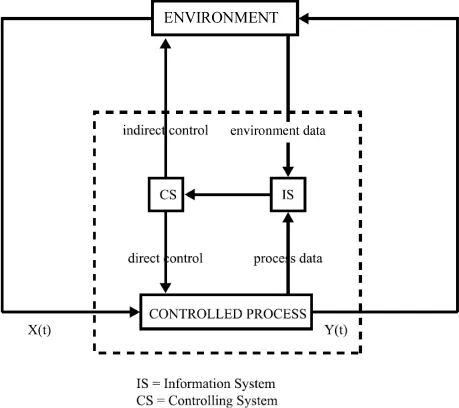
When a business unit is described as a system, the purpose is to control its business operations. Three entities have to be identified, i.e. the controlled system, the controlling system and the information system (IS). The controlled system, often called the transformation system, because it converts inputs into outputs, is modeled generally as a process. The relationships between these three entities are shown in Figure 1.1.
It is noteworthy to elaborate on Figure 1.1 for understanding the features of the system approach to business description. What is meant by direct and indirect control? Direct control refers to the direct action on the controlled process to maintain or change its state. Indirect control resorts to some entity external to the system for influencing the state of the controlled process by means of inputs.
Let us take an example to explain how the messages exchanged between the entities involved are articulated and how their contents trigger decisions. The controlled process is assumed to be a manufacturing process made of storage and production activities. A message coming from the market place (environment data) is captured and processed by the IS. The message content says that a market slump is forecast. It is directed to the production scheduler in an appropriate format (control data). As a consequence, the scheduler decides to reduce the production level by releasing orders to the manufacturing shops (direct control) on the basis of inventory levels (process data) and to send orders to suppliers to decrease the number of deliveries (indirect control).
c01f001
Figure 1.1. Relationships between the various entities of a business unit within the framework of a system approach
  1. Describing any business organization as a system means:
  2. – identifying and modeling the system to be controlled (WHAT);
  1. – identifying decision-making functions (WHO) and defining management rules (HOW);
  2. – producing the IS requirement.

1.2. Information engineering

1.2.1. Information as a resource

  1. Central to any human activity is the process of decision-making, i.e.:
  2. – defining a goal;
  3. – identifying a number of alternative actions which may lead to the goal;
  4. – evaluating the consequences of each action;
  5. – selecting the action which is most likely to lead to the desired goal.
The decision maker, in general, faces uncertain...

Table of contents

  1. Cover
  2. Table of Contents
  3. Title
  4. Copyright
  5. Preface
  6. PART 1: Modeling of Business Structures
  7. PART 2: Managerial Concepts and Software Packages in Perspective
  8. PART 3: Beyond ERP Packages: the E-Enabled Enterprise
  9. PART 4: Critical Business Functions for E-Enabled Operations Management
  10. PART 5: Case Studies
  11. Index
  12. End User License Agreement