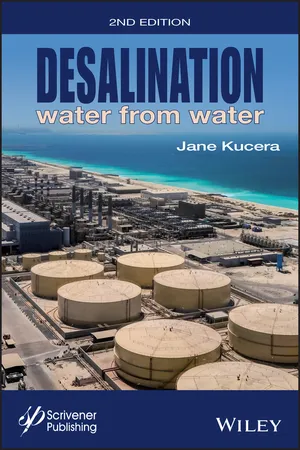
Desalination
eBook - ePub

Desalination

Water from Water

  1. English
  2. ePUB (mobile friendly)
  3. Available on iOS & Android
eBook - ePub

Desalination

Water from Water

About this book

This all-new revised edition of a modern classic is the most comprehensive and up-to-date coverage of the "green" process of desalination in industrial and municipal applications, covering all of the processes and equipment necessary to design, operate, and troubleshoot desalination systems. This is becoming increasingly more important for not only our world's industries, but our world's populations, as pure water becomes more and more scarce.

"Blue is the new green." This is an all-new revised edition of a modern classic on one of the most important subjects in engineering: Water. Featuring a total revision of the initial volume, this is the most comprehensive and up-to-date coverage of the process of desalination in industrial and municipal applications, a technology that is becoming increasingly more important as more and more companies choose to "go green." This book covers all of the processes and equipment necessary to design, operate, and troubleshoot desalination systems, from the fundamental principles of desalination technology and membranes to the much more advanced engineering principles necessary for designing a desalination system. Earlier chapters cover the basic principles, the economics of desalination, basic terms and definitions, and essential equipment.

The book then goes into the thermal processes involved in desalination, such as various methods of evaporation, distillation, recompression, and multistage flash. Following that is an exhaustive discussion of the membrane processes involved in desalination, such as reverse osmosis, forward osmosis, and electrodialysis. Finally, the book concludes with a chapter on the future of these technologies and their place in industry and how they can be of use to society.

This book is a must-have for anyone working in water, for engineers, technicians, scientists working in research and development, and operators. It is also useful as a textbook for graduate classes studying industrial water applications.

Frequently asked questions

Yes, you can cancel anytime from the Subscription tab in your account settings on the Perlego website. Your subscription will stay active until the end of your current billing period. Learn how to cancel your subscription.
No, books cannot be downloaded as external files, such as PDFs, for use outside of Perlego. However, you can download books within the Perlego app for offline reading on mobile or tablet. Learn more here.
Perlego offers two plans: Essential and Complete
  • Essential is ideal for learners and professionals who enjoy exploring a wide range of subjects. Access the Essential Library with 800,000+ trusted titles and best-sellers across business, personal growth, and the humanities. Includes unlimited reading time and Standard Read Aloud voice.
  • Complete: Perfect for advanced learners and researchers needing full, unrestricted access. Unlock 1.4M+ books across hundreds of subjects, including academic and specialized titles. The Complete Plan also includes advanced features like Premium Read Aloud and Research Assistant.
Both plans are available with monthly, semester, or annual billing cycles.
We are an online textbook subscription service, where you can get access to an entire online library for less than the price of a single book per month. With over 1 million books across 1000+ topics, we’ve got you covered! Learn more here.
Look out for the read-aloud symbol on your next book to see if you can listen to it. The read-aloud tool reads text aloud for you, highlighting the text as it is being read. You can pause it, speed it up and slow it down. Learn more here.
Yes! You can use the Perlego app on both iOS or Android devices to read anytime, anywhere — even offline. Perfect for commutes or when you’re on the go.
Please note we cannot support devices running on iOS 13 and Android 7 or earlier. Learn more about using the app.
Yes, you can access Desalination by Jane Kucera in PDF and/or ePUB format, as well as other popular books in Physical Sciences & Organic Chemistry. We have over one million books available in our catalogue for you to explore.

Information

Chapter 1
Introduction to Desalination

Jane Kucera
Nalco Water/an Ecolab Company
Corresponding author: Jane Kucera ([email protected])

Abstract

The availability of fresh water on the planet is finite, and natural fresh water makes up only about 0.5% entire water supply on Earth. This limited supply, coupled with the growing population of the Earth and the growing industrialization of many developing countries, is driving global fresh water stress and scarcity to the point where more fresh water must be found to meet future needs. Methods to “find” more fresh water include conservation and reduce/reuse/recycle of existing fresh water sources, moving fresh water from water-rich regions to water-poor regions, and “creating” fresh water from other sources, such as oceans and wastewater, using desalination. Of these methods, desalination has proven to be a very viable technique to meet current and future fresh water needs in many areas around the world.
This introductory chapter discusses the history of, and drivers for desalination, and also provides a framework for the detailed discussions about various desalination technologies and opportunities to use renewable energy sources to power the desalination technologies that are presented in this book.
Keywords: Desalination, water scarcity, thermal desalination, membrane desalination, reverse osmosis, renewable energy sources

1.1 Introduction

Desalination: from the root word desalt meaning to “remove salt from” [1]. By convention, the term desalination is defined as the “process of removing dissolved solids, such as salts and minerals, from water” [2]. Other terms that are sometimes used interchangeably with desalination are desalting and desalinization, although these terms have alternate meanings; desalting is conventionally used to mean removing salt from other more valuable products such as food, pharmaceuticals, and oil, while desalinization is used to mean removing salt from soil, such as by leaching [2].
The first practical use of desalination goes back to the sixteenth and seventeenth centuries, when sailors such as Sir Richard Hawkins reported that their men generated fresh water from seawater using shipboard distillation during their voyages [3]. The early twentieth century saw the first desalination facilities developed on the Island of Curaçao and in the Arabian Peninsula [3]. The research into and application of desalination gained momentum in the mid-twentieth century, and the last 30 years has witnessed exponential growth in the construction of desalination facilities.
One could ask the question, “Why desalination?” Desalination has become necessary for several reasons, the most compelling of which may be: 1) the increased demand for fresh water by population growth in arid climates and other geographies with limited access to high-quality, low-salinity water, and 2) the per capital increase in demand for fresh water due to industrialization and urbanization that out paces availability of high-quality water. Research and development over the last 50 years into desalination has resulted in advanced techniques that have made desalination more efficient and cost-effective. Desalination is, and will be in the future, a viable and even necessary technique for generating fresh water from water of relatively low quality. Thus, the title of this book, Desalination: Water from Water.
In this chapter, and in this entire book, we make the case for desalination as one of the major tools for meet...

Table of contents

  1. Cover
  2. Preface
  3. Chapter 1: Introduction to Desalination
  4. Chapter 2: Thermal Desalination Processes
  5. Chapter 3: Basic Terms and Definitions
  6. Chapter 4: Nanofiltration – Theory and Application
  7. Chapter 5: Forward Osmosis
  8. Chapter 6: Electrodialysis Desalination
  9. Chapter 7: Continuous Electrodeionization
  10. Chapter 8: Membrane Distillation: Now and Future
  11. Chapter 9: Humidification-Dehumidification Desalination
  12. Chapter 10: Freezing-Melting Desalination Processes
  13. Chapter 11: Ion Exchange in Desalination
  14. Chapter 12: Electrosorption of Heavy Metals with Capacitive Deionization: Water Reuse, Desalination and Resources Recovery
  15. Chapter 13: Solar Desalination
  16. Chapter 14: Wind Energy Powered Desalination Systems
  17. Chapter 15: Geothermal Desalination
  18. Chapter 16: Future Expectations
  19. List of Contributors
  20. Index
  21. End User License Agreement