- Emphasises the use of several approaches including CBT, psychodynamic and systemic and family treatments, and consideration of the wider picture of addictions
- As well as the theories, gives a clear overview of the application of these models
- Reflects the very latest developments in the role played by psychological perspectives and interventions in the recovery agenda for problem drug and alcohol users
eBook - ePub
Addiction
Psychology and Treatment
- English
- ePUB (mobile friendly)
- Available on iOS & Android
eBook - ePub
Addiction
Psychology and Treatment
About this book
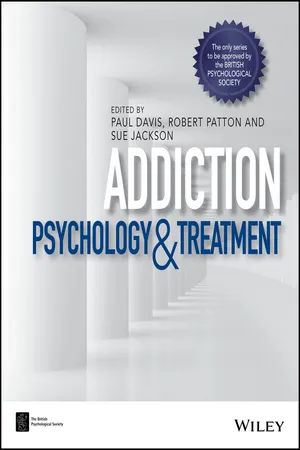
Addiction: Psychology and Treatment brings together leading psychologists to provide a comprehensive overview of the psychology of addictions and their treatment across specialities and types of services.
Information
Part 1
Understanding the Psychology and Treatment of Addictions
1
Addiction: A Comprehensive Approach

JAMIE BROWN AND ROBERT WEST
Cancer Research UK Health Behaviour Research Centre, University College London, UK
CHAPTER OUTLINE
- 1.1 INTRODUCTION
- 1.2 EXISTING THEORIES
- 1.3 THE HUMAN MOTIVATIONAL SYSTEM
- 1.4 INTERNAL AND EXTERNAL SOURCES OF INFLUENCE
- 1.5 THE DYNAMICS OF THE SYSTEM
- 1.6 CHANGING DISPOSITIONS
- 1.7 TESTING THE THEORY
- SUGGESTIONS FOR FURTHER READING
- REFERENCES
1.1 INTRODUCTION
‘Addiction’ is a social construct which can be usefully defined as a chronic condition in which there is a repeated powerful motivation to engage in a rewarding behaviour, acquired as a result of engaging in that behaviour, that has significant potential for unintended harm. From this perspective, a broad conception of motivation is at the heart of addiction and requires any theory of addiction to be based on a comprehensive theory of motivation. This approach understands addiction can be driven by many different factors – physiological, psychological, environmental and social – and that it is not useful to focus on one particular factor to the exclusion of all others. PRIME theory aims to provide a conceptual framework within which the major insights provided by more specific theories of choice, self-control, habits, emotions and drives can be integrated.
PRIME theory describes the motivational system as the set of brain processes that energize and direct our actions. The system can be usefully divided into five interacting but distinct sub-systems: (1) response execution; (2) impulses/inhibition; (3) motives (wants and needs); (4) evaluations (beliefs about what is good or bad); and (5) plans (self-conscious intentions). The response execution system co-ordinates what is happening at any given moment. The proximal influences on this are the impulses and inhibitions to perform particular responses. Motives can influence behaviour only through impulses and inhibitions, evaluations can do so only through motives, and plans must operate on either motives or evaluations. These can also each be influenced by the immediate internal or external environment. Important internal sources of influence include identity, self-control, drives and emotional states.
A core proposition is that all the subsystems compete with one another and we simply act in response to the strongest influence at any given moment. In terms of deliberate action, this means that from one moment to the next we will always act in pursuit of what we most want or need at that moment. These motives vary according to the current strength of evaluations and plans, but also in response to the internal and external environment. For example, if an intention or belief is not currently generating a sufficiently strong motive for performing (or inhibiting) a particular action, then the system may produce an apparently contradictory action in response to a strong internal drive or external stimulus. The operation of this dynamic, complex system is inherently unstable – reflecting the variety in patterns of addictive behaviour – and requires constant balancing to avoid heading into maladaptive ‘chreods’. The motivational system can be changed over time by a range of processes including habituation, associative learning, imitation and explicit memory.
This chapter provide a brief background to the origins of PRIME theory, before describing in more detail the proposed structure of the motivational system, important internal and external sources of influence, the dynamics of the system, and how motivational dispositions change over time. The chapter will finish by summarizing addiction research that has been inspired and informed by PRIME theory.
1.2 EXISTING THEORIES
There is no shortage of theories about addiction. The book Theory of Addiction (West & Brown, 2013), in which PRIME theory was first proposed, was originally intended to provide a convenient overview of available theories. During the course of the research for the book, however, it became apparent that theories of addiction tend to focus on one aspect of addiction or rely upon just one level of explanation. In a problem as manifestly complex as addiction, these approaches are unable to provide a sufficiently coherent and nuanced account of the phenomenon. Existing theories span a range of approaches from those that emphasize choice to those that focus on neuropharmacology. We now summarize some important categories of addiction theory and explain in each case why we believe more comprehensive theories are required. For a fuller account, see Chapters 3–7 in West and Brown (2013).
1.2.1 Choice Theories
Examples of theories that focus on addiction as the exercise of choice based on desires are Becker’s Rational Addiction Theory (Becker & Murphy, 1988) and Skog’s Unstable Preference Theory (Skog, 2000; 2003). Others focus on addicts’ ‘expectancies’ (for a review, see Jones, Corbin & Fromme, 2001). Slovic et al. (2002; 2007) have developed a theory of judgement relating feelings to analytical judgements (an ‘affect heuristic’) and applied this to smoking. There are theories that focus on attentional, or other cognitive, biases (e.g. McCusker, 2001; Mogg, Field & Bradley, 2005; Field & Cox, 2008). A raft of theories argue that the behaviour of addiction can be understood in terms of concepts derived from economic theory, such as temporal discounting (e.g. Bickel, DeGrandpre & Higgins, 1995; Bickel, Miller Kowal, Lindquist & Pitcock, 2007).
A synthesis of these theories describes an individual who chooses in some sense to engage or not engage in the behaviour. The choice involves a cost-benefit analysis: the costs are weighed against the benefits of the behaviour which change over time and the appreciation of which changes over time. The costs and benefits, and indeed aspects of the analysis, may involve mental representations to which one does not have full conscious access. The choice does not need to be rational; it can be influenced by pharmacological and non-pharmacological factors, including one’s sense of self and what one wants to be, and possibly by biases in attention to and memory for stimuli related to the addictive behaviour. In this view, the idea that addictive behaviour is driven by a damagingly powerful and repeated motivation is an illusion based on a failure to appreciate that the expressed desire to stop doing something at one time does not reflect the preferences operating at a later time after the attempt at restraint has begun.
An important problem with this view is that it does not accord with the experience of many addicts. At the point where they find themselves about to relapse back to their old ways, they frequently report feeling compulsion that is distinct from simple desire. It is not even that it is a ‘strong desire’; it is an urge that is often accompanied by a sincere attempt to resist. Successful restraint does not simply depend upon on analysis leading to a decision to refrain; the implementation of the choice requires self-control and expends mental effort. By focusing on the choice, the approach neglects the panoply of observational and research evidence for the importance of a failure of impulse control in the development and maintenance of addiction.
1.2.2 Compulsion and Self-Control Theories
The so-called ‘disease model’ of addiction takes the view that addiction involves powerful and overpowering compulsions that are experienced as ‘cravings’ (e.g. Jellinek, 1960; Gelkopf, Levitt & Bleich, 2002). Examples of theories concerning the failure of impulse control include those that focus on either the dysfunction of inhibitory brain circuitry (Lubman, Yucel & Pantelis, 2004; Dalley, Everitt & Robbins, 2011), or the dysfunction of the prefrontal cortex (Goldstein & Volkow, 2011). A cognitive model of craving has also been proposed (Tiffany & Drobes, 1991). A more general view of addiction as a failure of self-regulation has been proposed by Baumeister (Baumeister et al., 1994; Baumeister & Vohs, 2007; Vohs & Baumeister, 2011). Self-regulation extends beyond impulse control, or the adequate functioning of basic associated mechanisms; instead, it recognizes that failure to self-regulate may also involve a lack of reflective strategies, skills and capacity for self-control. Other examples of theories emphasizing the role of self-regulation in addiction are cognitive control theory (Miller & Cohen, 2001), executive dysfunction theory (Hester & Garavan, 2004; Fernández-Serrano, Pérez-García, Perales & Verdejo-García, 2010; Madoz-Gurpide, Blasco-Fontecilla, Baca-Garcia & Ochoa-Mangado, 2011), and self-determination theory (Deci, Eghrari, Patrick & Leone, 1994; Ryan & Deci, 2000; Deci & Ryan, 2012).
By incorporating theorizing about compulsion and self-control into ideas about choice, many important aspects of addiction are explicable. An addict may be someone for whom the desire to engage in an activity is abnormally strong, or the ability to resist the desire is abnormally weak, or some combination of both. Invoking both avoids the philosophical problem of addicts having ‘no choice’, which is implied by relying only on regulatory failure, and can explain a great deal about addiction. However, a model relying on choice (even if it acknowledges failures in self-control can sometimes be undermined), still has anomalies. A reliance on choice means that behaviour is still fundamentally centred on analyses of costs and benefits (however irrational), whereas, in reality, sometimes behaviour is simply not related to such analysis; instead it is habitual or automatic (i.e., the behaviour itself is automatic, ...
Table of contents
- Cover
- BPS Textbooks in Psychology
- Title Page
- Copyright
- List of Contributors
- Foreword
- Preface
- Notes on Contributors
- Part 1: Understanding the Psychology and Treatment of Addictions
- Part 2: Clinical Applications of Addiction Psychology
- Index
- EULA
Trusted by 375,005 students
Access to over 1.5 million titles for a fair monthly price.
Study more efficiently using our study tools.
Frequently asked questions
Yes, you can cancel anytime from the Subscription tab in your account settings on the Perlego website. Your subscription will stay active until the end of your current billing period. Learn how to cancel your subscription
No, books cannot be downloaded as external files, such as PDFs, for use outside of Perlego. However, you can download books within the Perlego app for offline reading on mobile or tablet. Learn how to download books offline
Perlego offers two plans: Essential and Complete
- Essential is ideal for learners and professionals who enjoy exploring a wide range of subjects. Access the Essential Library with 800,000+ trusted titles and best-sellers across business, personal growth, and the humanities. Includes unlimited reading time and Standard Read Aloud voice.
- Complete: Perfect for advanced learners and researchers needing full, unrestricted access. Unlock 1.5M+ books across hundreds of subjects, including academic and specialized titles. The Complete Plan also includes advanced features like Premium Read Aloud and Research Assistant.
We are an online textbook subscription service, where you can get access to an entire online library for less than the price of a single book per month. With over 1.5 million books across 990+ topics, we’ve got you covered! Learn about our mission
Look out for the read-aloud symbol on your next book to see if you can listen to it. The read-aloud tool reads text aloud for you, highlighting the text as it is being read. You can pause it, speed it up and slow it down. Learn more about Read Aloud
Yes! You can use the Perlego app on both iOS and Android devices to read anytime, anywhere — even offline. Perfect for commutes or when you’re on the go.
Please note we cannot support devices running on iOS 13 and Android 7 or earlier. Learn more about using the app
Please note we cannot support devices running on iOS 13 and Android 7 or earlier. Learn more about using the app
Yes, you can access Addiction by Paul Davis, Robert Patton, Sue Jackson, Paul Davis,Robert Patton,Sue Jackson in PDF and/or ePUB format, as well as other popular books in Psychology & Clinical Psychology. We have over 1.5 million books available in our catalogue for you to explore.