Wiley Revenue Recognition
eBook - ePub

Wiley Revenue Recognition

Understanding and Implementing the New Standard

  1. English
  2. ePUB (mobile friendly)
  3. Available on iOS & Android
eBook - ePub

Wiley Revenue Recognition

Understanding and Implementing the New Standard

About this book

Everything you need to understand and implement the new converged FASB-IASB revenue recognition standard

Wiley Revenue Recognition provides an overview of the new revenue recognition standard and instructs financial statement preparers step-by-step through the new model, providing numerous, helpful application examples along the way. Readers will grasp the many new disclosures that will be required through the use of detailed explanations and useful samples, while electronic tools will be available to aid the preparer in implementing the standards and making the proper disclosures.

The Financial Accounting Standards Board (FASB) and the International Accounting Standards Board (IASB) are in the final stages of a decade-long project to clarify and converge revenue recognition standards. This new principles-based standard—which will affect the business practices of virtually every company worldwide—is designed to serve as one model applied consistently across most industries. This book guides professionals through the new standard.

  • Offers a full explanation of over forty topics superseded by the new standard
  • Includes digital ancillaries featuring measurement tools and GAAP and IFRS Disclosure Checklists
  • Provides all the tools needed to implement the new revenue recognition standard
  • Covers how the structure of contracts will be affected

Wiley Revenue Recognition is a trusted, authoritative guide to the new FASB-IASB revenue recognition standard for CPAs and financial professionals worldwide.
Frequently asked questions

Yes, you can cancel anytime from the Subscription tab in your account settings on the Perlego website. Your subscription will stay active until the end of your current billing period. Learn how to cancel your subscription.
No, books cannot be downloaded as external files, such as PDFs, for use outside of Perlego. However, you can download books within the Perlego app for offline reading on mobile or tablet. Learn more here.
Perlego offers two plans: Essential and Complete
  • Essential is ideal for learners and professionals who enjoy exploring a wide range of subjects. Access the Essential Library with 800,000+ trusted titles and best-sellers across business, personal growth, and the humanities. Includes unlimited reading time and Standard Read Aloud voice.
  • Complete: Perfect for advanced learners and researchers needing full, unrestricted access. Unlock 1.4M+ books across hundreds of subjects, including academic and specialized titles. The Complete Plan also includes advanced features like Premium Read Aloud and Research Assistant.
Both plans are available with monthly, semester, or annual billing cycles.
We are an online textbook subscription service, where you can get access to an entire online library for less than the price of a single book per month. With over 1 million books across 1000+ topics, we’ve got you covered! Learn more here.
Look out for the read-aloud symbol on your next book to see if you can listen to it. The read-aloud tool reads text aloud for you, highlighting the text as it is being read. You can pause it, speed it up and slow it down. Learn more here.
Yes! You can use the Perlego app on both iOS or Android devices to read anytime, anywhere — even offline. Perfect for commutes or when you’re on the go.
Please note we cannot support devices running on iOS 13 and Android 7 or earlier. Learn more about using the app.
Yes, you can access Wiley Revenue Recognition by Joanne M. Flood in PDF and/or ePUB format, as well as other popular books in Business & Corporate Finance. We have over one million books available in our catalogue for you to explore.

Information

Publisher
Wiley
Year
2017
Print ISBN
9781118776858
eBook ISBN
9781119351689
Edition
1

1
Step 1—Identify the Contract with the Customer1

  1. Overview
  2. Assessing Whether Contracts are Within the Scope of the Standard
    1. Enforceable Rights and Obligations
    2. The Five Contract Criteria
      1. The Contract has Approval and Commitment of the Parties
    3. Example 1.1: Oral Contract
    4. Example 1.2: Product Delivered, but No Written Contract Exists
    5. Example 1.3: Contract Extension
    6. Example 1.4: Meeting the Termination Criteria
      1. Rights of the Parties are Identifiable
      2. Payment Terms are Identifiable
      3. The Contract has Commercial Substance
      4. Collectibility of Consideration is Probable
  3. Collectibility Threshold
    1. Comparison with Legacy Guidance
    2. Differences between IFRS and U.S. GAAP
    3. Assessing Collectibility
      1. Judgment
      2. Timing of Assessment
      3. Collectibility = Intent and Ability to Pay
      4. Consider Only Transaction Price
      5. Basis of Assessment May Be Less than Total Consideration
    4. Example 1.5: Assessing Collectibility—Implied Price Concession
    5. Example 1.6: Assessing Collectibility—Meeting the Collectibility Threshold
  4. Contract Recognition
  5. Arrangements where Contract Criteria are not Met
    1. Example 1.7: No Contract Exists—Accounting for Consideration Received
    2. Reassessment
  6. The Portfolio Approach and Combining Contracts
    1. A Practical Expedient
    2. Combination of Contracts Required
    3. Assessing Collectibility of a Portfolio of Contracts
  7. Identifying the Customer
    1. Collaborative Arrangements
    2. Example 1.8: Collaborative Arrangement
    3. Arrangements with Multiple Parties

Overview

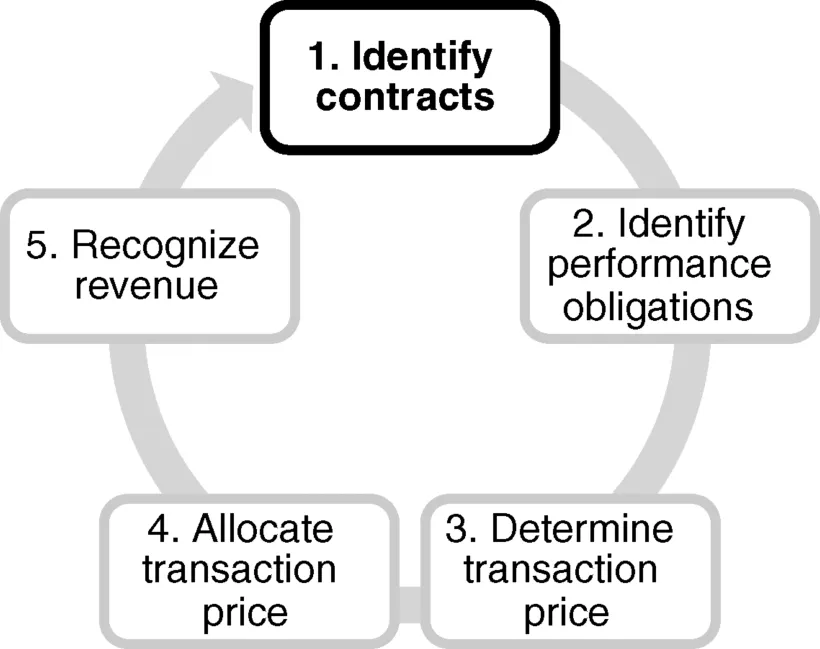
For the most part, guidance for Step 1 in applying the revenue recognition model is straightforward. However, the new guidance for contract modifications might be an aspect of this guidance that is somewhat trickier. Contract modifications are explored in detail in Chapter 6.
Figure depicting the five steps of the revenue recognition model that are arranged in the clockwise manner. It starts from identify contracts, identify performance obligations, determine transaction price, allocate transaction price, and recognize revenue. In this figure, first step: identify contracts is highlighted, and other steps are appeared faded.
Contract: Agreement between two or more parties that creates enforceable rights and obligations.
(ASC 606-10-20; IFRS 15 Appendix A)
Note: The IASB has, in effect, two definitions of contract. The revenue standard emphasizes legal enforceability, whereas IAS 32, Financial Instruments: Presentation, stops short of requiring legal enforceability. (IAS 32.13) The IASB decided not to amend IAS 32 because of concerns over creating unintended consequences in accounting for financial instruments.
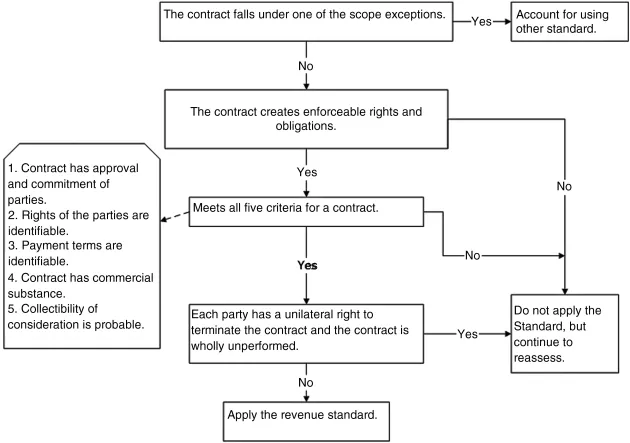
Exhibit depicting a block diagram for the overview of Step 1 of the revenue recognition model–identify the contracts.
Exhibit 1.1 Overview of Step 1 of the revenue recognition model—identify the contracts
To apply the revenue standard, entities should first determine whether a contract is specifically excluded from the guidance in the Standard. Scope exceptions are detailed in the Executive Summary chapter. The Executive Summary chapter includes a list of transactions excluded from the Standard and a related example regarding nonmonetary exchanges. After determining that a contract is not specifically excluded, entities must identify the contracts that meet the criteria in Step 1 of the revenue recognition model. If the entity determines that a contract does not meet the criteria for Step 1, the contract does not exist for the purposes of the Standard and the entity does not apply Steps 2 through 5. A contract as articulated in the Standard must exist before an entity can recognize revenue from a customer.

Assessing Whether Contracts are Within the Scope of the Standard

To be within the scope of the revenue standard, and in accordance with the definition of contracts in the Standard, the agreement must not fall under one of the scope exceptions listed in the Executive Summary chapter and must
  • create enforceable rights and obligations, and
  • meet the five criteria listed in the Standard.

Enforceable Rights and Obligations

The enforceability of the contract
  • is a matter of law
  • varies across legal jurisdictions, industries, and entities
  • may vary within an entity
  • may depend on the class of customer or nature of goods or services.
Determining whether an arrangement has created enforceable rights is a matter of law, and evaluating the legal enforceability of the contract can be particularly challenging. This is particularly true if multiple jurisdictions are involved. Entities also need to consider whether, in order to comply with jurisdictional or trade regulation, a written contract is required. Significant judgment may be involved for some cases, and qualified legal counsel may need to be consulted.
The Boards clarified that even though the contract must be legally enforceable to be within the scope of the guidance, the performance obligations within the contract may not be legally enforceable, but may be based on the valid expectations of the customer.

The Five Contract Criteria

The Standard lists five criteria that are assessed at contract inception and that must be met for agreements to be considered contracts subject to the guidance of the Standard.
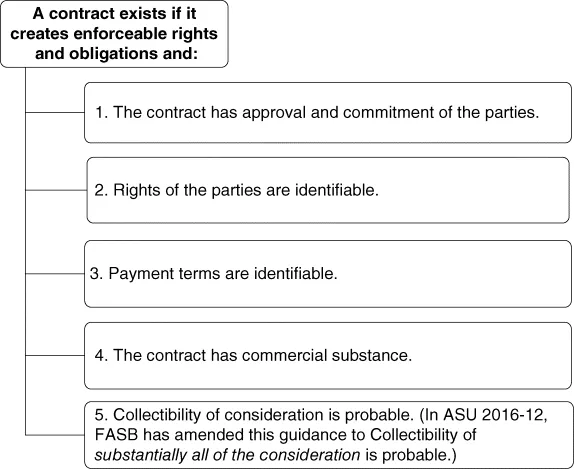
Exhibit depicting a block diagram for the five contract criteria.
Exhibit 1.2 The five contract criteria (ASC 606-10-25-1; IFRS 15.9)
The five criteria, shown in Exhibit 1.2, are essentially a financial accounting definition of a contract. The entity needs to exercise judgment when applying the criteria. The entity must also be aware that the parties may enter into amendments or side agreements that change the substance of the contract. So, it is important to understand the entire contract, including the amendments and side agreements.
A contract that has enforceable rights and obligations between two or more parties is within the scope of the revenue standard when all five of the above criteria are met. The criteria are discussed in more detail below.

The Contract has Approval and Commitment of the Parties

The approval of the parties can be
  1. written,
  2. oral, or
  3. implied by the entity's customary business practice.
This criterion is included because if not approved, a contract may not be legally enforceable. The Standard focuses on the enforceability of the contract rather than its form (oral, written, or implied). An entity may take into consideration its past business practices whe...

Table of contents

  1. Cover
  2. Title Page
  3. Copyright
  4. Executive Summary
  5. Chapter 1: Step 1—Identify the Contract with the Customer
  6. Chapter 2: Step 2—Identify the Performance Obligations
  7. Chapter 3: Step 3—Determine the Transaction Price
  8. Chapter 4: Step 4—Allocate the Transaction Price
  9. Chapter 5: Step 5—Recognize Revenue When (or as) The Entity Satisfies a Performance Obligation
  10. Chapter 6: Other Issues
  11. Chapter 7: Contract Costs
  12. Chapter 8: Presentation and Disclosure
  13. Chapter 9: Implementation Issues
  14. About the Companion Website
  15. Index
  16. End User License Agreement