Triaxial Testing of Soils explains how to carry out triaxial tests to demonstrate the effects of soil behaviour on engineering designs. An authoritative and comprehensive manual, it reflects current best practice and instrumentation.References are made throughout to easily accessible articles in the literature and the book?s focus is on how to obtain high quality experimental results.
The purpose of performing triaxial tests is to determine the mechanical properties of the soil. It is assumed that the soil specimens to be tested are homogeneous and representative of the material in the field, and that the desired soil properties can in fact be obtained from the triaxial tests, either directly or by interpretation through some theory.
The mechanical properties most often sought from triaxial tests are stress–strain relations, volume change or pore pressure behavior, and shear strength of the soil. Included in the stress–strain behavior are also the compressibility and the value of the coefficient of earth pressure at rest, K0. Other properties that may be obtained from the triaxial tests, which include time as a component, are the permeability, the coefficient of consolidation, and properties relating to time dependent behavior such as rate effects, creep, and stress relaxation.
It is important that the natural soil deposit or the fill from which soil samples have been taken in the field are sufficiently uniform that the soil samples possess the properties which are appropriate and representative of the soil mass in the field. It is therefore paramount that the geology at the site is well-known and understood. Even then, samples from uniform deposits may not “contain” properties that are representative of the field deposit. This may happen either (a) due to the change in effective stress state which is always associated with the sampling process or (b) due to mechanical disturbance from sampling, transportation, or handling in the laboratory. The stress–strain and strength properties of very sensitive clays which have been disturbed cannot be regenerated in the laboratory or otherwise obtained by interpretation of tests performed on inadequate specimens. The effects of sampling will briefly be discussed below in connection with choice of consolidation pressure in the triaxial test. The topic of sampling is otherwise outside the scope of the present treatment.
1.2 Concept of testing
The concept to be pursued in testing of soils is to simulate as closely as possible the process that goes on in the field. Because there is a large number of variables (e.g., density, water content, degree of saturation, overconsolidation ratio, loading conditions, stress paths) that influence the resulting soil behavior, the simplest and most direct way of obtaining information pertinent to the field conditions is to duplicate these as closely as possible.
However, because of limitations in equipment and because of practical limitations on the amount of testing that can be performed for each project, it is essential that:
The true field loading conditions (including the drainage conditions) are known.
The laboratory equipment can reproduce these conditions to a required degree of accuracy.
A reasonable estimate can be made of the significance of the differences between the field loading conditions and those that can be produced in the laboratory equipment.
It is clear that the triaxial test in many respects is incapable of simulating several important aspects of field loading conditions. For example, the effects of the intermediate principal stress, the effects of rotation of principal stresses, and the effects of partial drainage during loading in the field cannot be investigated on the basis of the triaxial test. The effects of such conditions require studies involving other types of equipment or analyses of boundary value problems, either by closed form solutions or solutions obtained by numerical techniques.
To provide some background for evaluation of the results of triaxial tests, other types of laboratory shear tests and typical results from such tests are presented in Chapter 11. The relations between the different types of tests are reviewed, and their advantages and limitations are discussed.
1.3 The triaxial test
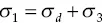
The triaxial test is most often performed on a cylindrical specimen, as shown in Fig. 1.1(a). Principal stresses are applied to the specimen, as indicated in Fig. 1.1(b). First a confining pressure, σ3, is applied to the specimen. This pressure acts all around and therefore on all planes in the specimen. Then an additional stress difference, σd, is applied in the axial direction. The stress applied externally to the specimen in the axial direction is
(1.1 )
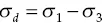
and therefore
(1.2 )
In the general case, three principal stresses, σ1, σ2 and σ3 may act on a soil element in the field. However, only two different principal stresses can be applied to the specimen in the conventional triaxial test. The intermediate principal stress, σ2, can only have values as follows:
(1.3 )
(1.4 )
The condition of triaxial extension can be achieved by applying negative stress differences to the specimen. This merely produces a reduction in compression in the extension direction, but no tension occurs in the specimen. The ...
Table of contents
Cover
Title Page
Table of Contents
Preface
About the Author
1 Principles of Triaxial Testing
2 Computations and Presentation of Test Results
3 Triaxial Equipment
4 Instrumentation, Measurements, and Control
5 Preparation of Triaxial Specimens
6 Specimen Saturation
7 Testing Stage I
8 Testing Stage II
9 Corrections to Measurements
10 Special Tests and Test Considerations
11 Tests with Three Unequal Principal Stresses
Appendix A: Manufacturing of Latex Rubber Membranes
Appendix B: Design of Diaphragm Load Cells
References
Index
End User License Agreement
Trusted by 375,005 students
Access to over 1.5 million titles for a fair monthly price.
Study more efficiently using our study tools.
Frequently asked questions
Yes, you can cancel anytime from the Subscription tab in your account settings on the Perlego website. Your subscription will stay active until the end of your current billing period. Learn how to cancel your subscription
No, books cannot be downloaded as external files, such as PDFs, for use outside of Perlego. However, you can download books within the Perlego app for offline reading on mobile or tablet. Learn how to download books offline
Perlego offers two plans: Essential and Complete
Essential is ideal for learners and professionals who enjoy exploring a wide range of subjects. Access the Essential Library with 800,000+ trusted titles and best-sellers across business, personal growth, and the humanities. Includes unlimited reading time and Standard Read Aloud voice.
Complete: Perfect for advanced learners and researchers needing full, unrestricted access. Unlock 1.5M+ books across hundreds of subjects, including academic and specialized titles. The Complete Plan also includes advanced features like Premium Read Aloud and Research Assistant.
Both plans are available with monthly, semester, or annual billing cycles.
We are an online textbook subscription service, where you can get access to an entire online library for less than the price of a single book per month. With over 1.5 million books across 990+ topics, we’ve got you covered! Learn about our mission
Look out for the read-aloud symbol on your next book to see if you can listen to it. The read-aloud tool reads text aloud for you, highlighting the text as it is being read. You can pause it, speed it up and slow it down. Learn more about Read Aloud
Yes! You can use the Perlego app on both iOS and Android devices to read anytime, anywhere — even offline. Perfect for commutes or when you’re on the go. Please note we cannot support devices running on iOS 13 and Android 7 or earlier. Learn more about using the app
Yes, you can access Triaxial Testing of Soils by Poul V. Lade in PDF and/or ePUB format, as well as other popular books in Technology & Engineering & Civil Engineering. We have over 1.5 million books available in our catalogue for you to explore.