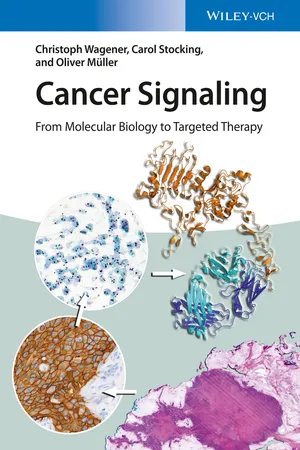
Cancer, which has become the second-most prevalent health issue globally, is essentially a malfunction of cell signaling. Understanding how the intricate signaling networks of cells and tissues allow cancer to thrive - and how they can be turned into potent weapons against it - is the key to managing cancer in the clinic and improving the outcome of cancer therapies. In their ground-breaking textbook, the authors provide a compelling story of how cancer works on the molecular level, and how targeted therapies using kinase inhibitors and other modulators of signaling pathways can contain and eventually cure it.
The first part of the book gives an introduction into the cell and molecular biology of cancer, focusing on the key mechanisms of cancer formation. The second part of the book introduces the main signaling transduction mechanisms responsible for carcinogenesis and compares their function in healthy versus cancer cells. In contrast to the complexity of its topic, the text is easy to read. 32 specially prepared teaching videos on key concepts and pathways in cancer signaling are available online for users of the print edition and have been integrated into the text in the enhanced e-book edition.
eBook - ePub
Cancer Signaling
From Molecular Biology to Targeted Therapy
- English
- ePUB (mobile friendly)
- Available on iOS & Android
eBook - ePub
Cancer Signaling
From Molecular Biology to Targeted Therapy
About this book
Information
Chapter 1
General Aspects of Signal Transduction and Cancer Therapy
- 1.1 General Principles of Signal Transduction
- 1.1.1 Biological Signals have to be Processed
- 1.1.2 What is a Signal Transduction Pathway?
- 1.1.3 Mechanisms of Direct Signal Transduction
- 1.1.4 The Interactome Gives Insight into the Signaling Network
- 1.1.5 Protein Domains for Protein–Protein Interaction and Signal Transduction
- 1.1.6 Functions of Mutated Proteins in Tumor Cells
- 1.2 Drugs against Cancer
- 1.2.1 Terms and Definitions
- 1.2.2 The Steps from a Normal Cell to a Tumor
- 1.2.3 Interference Levels of Therapeutic Drugs
- 1.2.4 Drugs Attacking the Whole Cell
- 1.2.4.1 DNA Alkylating Drugs
- 1.2.5 Process-Blocking Drugs
- 1.2.5.1 Drugs Blocking Synthesis of DNA and RNA
- 1.2.5.2 Drugs Blocking the Synthesis of DNA and RNA Precursor Molecules
- 1.2.5.3 Drugs Blocking Dynamics of Microtubules
- 1.2.6 Innovative Molecule-Interfering Drugs
- 1.2.7 Fast-Dividing Normal Cells and Slowly Dividing Tumor Cells: Side Effects and Relapse
- 1.2.8 Drug Resistance
- 1.2.8.1 Drugs Circumventing Resistance
- 1.3 Outlook
- References
Summary
This chapter should serve as an introduction into the field of intracellular signal transduction. The biological role of signal transduction pathways will be presented together with the mechanisms and the protein domains that are responsible for the direct transduction of signals between molecules. In the second part, we define and describe the major groups of anticancer drugs and their effects on different levels in a simplified model of tumorigenesis. We give examples of important classical drugs and explain their mode of action. Finally, the major mechanisms of drug resistance are described and compounds and approaches that can be used to prevent or circumvent this problem are mentioned.
1.1 General Principles of Signal Transduction
(Video: General aspects of signal transduction – enhanced ebook and closed website: signal_transduction_ebook.mp4)
1.1.1 Biological Signals have to be Processed
Levels of biological communication include communication between whole organisms, communication between organs within an organism, and communication between single cells. Mechanisms for intercellular communication are based on the transfer of signals between cells through direct contacts, by electrical signals, ions, small molecules, or macromolecules. Once a signal has reached a cell, the cell has to “decide” whether and how to react. For this reason, the cell has to process the incoming signal. Most signals are processed by intracellular signal transduction pathways. A signal transduction pathway is a biochemical cascade that connects the incoming signal with the cellular response. Such a pathway fulfills two major functions. First, it modulates the intensity of the originally extracellular signal. It can amplify, weaken, or extinguish the signal. Secondly, the pathway converts the signal into a form that allows and also prepares the cellular response. Examples for potential responses are proliferation, migration, differentiation, and apoptosis. It has to be noted that a signal can be transferred not only by the presence of a molecule but also by its absence. For example, normal cells react to the absence of growth factors by activation of signal transduction pathways that activate apoptosis.
1.1.2 What is a Signal Transduction Pathway?
A signal transduction pathway consists of factors, receptors, adapter proteins, enzymes, second messengers, and transcription factors, which together form a hierarchical sequence of signaling events. Most frequently, the signal transfer from one molecule to another is performed by direct contact and subsequent covalent or noncovalent modification resulting in conformational change of at least one of the interacting partners.
A typical pathway begins with the binding of an extracellular ligand to a membrane-bound receptor. The receptor transports the signal through the plasma membrane into the cell by altering the activity of molecules on the cytosolic side (Figure 1.1). The signal is transferred through the cytoplasm via macromolecules or small molecules. In most pathways, only one or a few enzymes are necessary at this level due to their ability to amplify a signal by several orders of magnitude. Finally, the signal reaches the cell nucleus, where the activity of a transcription factor is altered. As a consequence, this factor promotes or inhibits the expression of distinct genes. The transcribed mRNA is translated and the resulting proteins mediate the biological answer to the original signal.
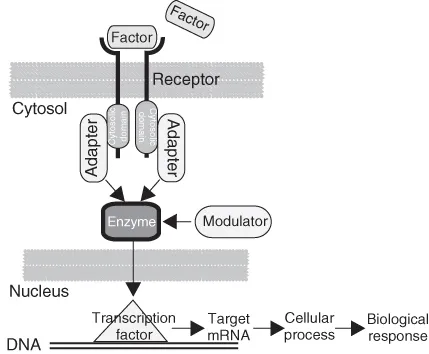
Figure 1.1 Simplified version of a general signal transduction pathway. A signal in the form of an extracellular factor binds to a membrane-bound receptor. The receptor transfers the signal through the membrane onto its cytosolic domain, which transfers the signal to an adapter protein. The adapter transfers the signal to a cytosolic protein, which is frequently an enzyme, for example, a kinase. The activity of this enzyme might be altered by a modulator. The enzyme regulates a nuclear transcription factor, which regulates the expression of target genes. The activities of the translated gene products mediate a cellular process such as proliferation or migration, which results in the biological response to the original signal. (Wagener and Müller, 2009), with permission.
In this book, we describe the different pathways in the same way as this “master pathway,” namely as direct and straight cascades. In this manner, we aim to clearly illustrate their important properties, their biological effects, as well as the potential sites and mechanisms of drugs interfering with them. We are aware that this approach reflects a highly simplified view, which is far from the in vivo processes in a living cell. Actually, every real signaling pathway consists of multifaceted parallel or antiparallel cascades, manifold branches,...
Table of contents
- Cover
- Title Page
- Copyright
- Table of Contents
- Dedication
- Preface
- Acknowledgments
- List of Abbreviations
- About the Companion Website
- Chapter 1: General Aspects of Signal Transduction and Cancer Therapy
- Chapter 2: Tumor Cell Heterogeneity and Resistance to Targeted Therapy
- Chapter 3: Cell Cycle of Tumor Cells
- Chapter 4: Cell Aging and Cell Death
- Chapter 5: Growth Factors and Receptor Tyrosine Kinases
- Chapter 6: The Philadelphia Chromosome and BCR-ABL1
- Chapter 7: MAPK Signaling
- Chapter 8: PI3K-AKT-mTOR Signaling
- Chapter 9: Hypoxia-Inducible Factor (HIF)
- Chapter 10: NF-κB Pathways
- Chapter 11: Wnt Signaling
- Chapter 12: Notch Signaling
- Chapter 13: Hedgehog Signaling
- Chapter 14: TGFβ Signaling
- Index
- End User License Agreement
Trusted by 375,005 students
Access to over 1.5 million titles for a fair monthly price.
Study more efficiently using our study tools.
Frequently asked questions
Yes, you can cancel anytime from the Subscription tab in your account settings on the Perlego website. Your subscription will stay active until the end of your current billing period. Learn how to cancel your subscription
No, books cannot be downloaded as external files, such as PDFs, for use outside of Perlego. However, you can download books within the Perlego app for offline reading on mobile or tablet. Learn how to download books offline
Perlego offers two plans: Essential and Complete
- Essential is ideal for learners and professionals who enjoy exploring a wide range of subjects. Access the Essential Library with 800,000+ trusted titles and best-sellers across business, personal growth, and the humanities. Includes unlimited reading time and Standard Read Aloud voice.
- Complete: Perfect for advanced learners and researchers needing full, unrestricted access. Unlock 1.5M+ books across hundreds of subjects, including academic and specialized titles. The Complete Plan also includes advanced features like Premium Read Aloud and Research Assistant.
We are an online textbook subscription service, where you can get access to an entire online library for less than the price of a single book per month. With over 1.5 million books across 990+ topics, we’ve got you covered! Learn about our mission
Look out for the read-aloud symbol on your next book to see if you can listen to it. The read-aloud tool reads text aloud for you, highlighting the text as it is being read. You can pause it, speed it up and slow it down. Learn more about Read Aloud
Yes! You can use the Perlego app on both iOS and Android devices to read anytime, anywhere — even offline. Perfect for commutes or when you’re on the go.
Please note we cannot support devices running on iOS 13 and Android 7 or earlier. Learn more about using the app
Please note we cannot support devices running on iOS 13 and Android 7 or earlier. Learn more about using the app
Yes, you can access Cancer Signaling by Christoph Wagener,Carol Stocking,Oliver Müller in PDF and/or ePUB format, as well as other popular books in Scienze biologiche & Biologia cellulare. We have over 1.5 million books available in our catalogue for you to explore.