Ligand Design in Metal Chemistry
eBook - ePub

Ligand Design in Metal Chemistry

Reactivity and Catalysis

  1. English
  2. ePUB (mobile friendly)
  3. Available on iOS & Android
eBook - ePub

Ligand Design in Metal Chemistry

Reactivity and Catalysis

About this book

The design of ancillary ligands used to modify the structural and reactivity properties of metal complexes has evolved into a rapidly expanding sub-discipline in inorganic and organometallic chemistry. Ancillary ligand design has figured directly in the discovery of new bonding motifs and stoichiometric reactivity, as well as in the development of new catalytic protocols that have had widespread positive impact on chemical synthesis on benchtop and industrial scales.

Ligand Design in Metal Chemistry presents a collection of cutting-edge contributions from leaders in the field of ligand design, encompassing a broad spectrum of ancillary ligand classes and reactivity applications. Topics covered include:

  • Key concepts in ligand design
  • Redox non-innocent ligands
  • Ligands for selective alkene metathesis
  • Ligands in cross-coupling
  • Ligand design in polymerization
  • Ligand design in modern lanthanide chemistry
  • Cooperative metal-ligand reactivity
  • P,N Ligands for enantioselective hydrogenation
  • Spiro-cyclic ligands in asymmetric catalysis

This book will be a valuable reference for academic researchers and industry practitioners working in the field of ligand design, as well as those who work in the many areas in which the impact of ancillary ligand design has proven significant, for example synthetic organic chemistry, catalysis, medicinal chemistry,  polymer science and materials chemistry.
Frequently asked questions

Yes, you can cancel anytime from the Subscription tab in your account settings on the Perlego website. Your subscription will stay active until the end of your current billing period. Learn how to cancel your subscription.
No, books cannot be downloaded as external files, such as PDFs, for use outside of Perlego. However, you can download books within the Perlego app for offline reading on mobile or tablet. Learn more here.
Perlego offers two plans: Essential and Complete
  • Essential is ideal for learners and professionals who enjoy exploring a wide range of subjects. Access the Essential Library with 800,000+ trusted titles and best-sellers across business, personal growth, and the humanities. Includes unlimited reading time and Standard Read Aloud voice.
  • Complete: Perfect for advanced learners and researchers needing full, unrestricted access. Unlock 1.4M+ books across hundreds of subjects, including academic and specialized titles. The Complete Plan also includes advanced features like Premium Read Aloud and Research Assistant.
Both plans are available with monthly, semester, or annual billing cycles.
We are an online textbook subscription service, where you can get access to an entire online library for less than the price of a single book per month. With over 1 million books across 1000+ topics, we’ve got you covered! Learn more here.
Look out for the read-aloud symbol on your next book to see if you can listen to it. The read-aloud tool reads text aloud for you, highlighting the text as it is being read. You can pause it, speed it up and slow it down. Learn more here.
Yes! You can use the Perlego app on both iOS or Android devices to read anytime, anywhere — even offline. Perfect for commutes or when you’re on the go.
Please note we cannot support devices running on iOS 13 and Android 7 or earlier. Learn more about using the app.
Yes, you can access Ligand Design in Metal Chemistry by Mark Stradiotto, Rylan J. Lundgren, Mark Stradiotto,Rylan J. Lundgren in PDF and/or ePUB format, as well as other popular books in Ciencias físicas & Química inorgánica. We have over one million books available in our catalogue for you to explore.

Information

Publisher
Wiley
Year
2016
Print ISBN
9781118839836
eBook ISBN
9781118839812

1
Key Concepts in Ligand Design: An Introduction

Rylan J. Lundgren1 and Mark Stradiotto2
1 Department of Chemistry, University of Alberta, Edmonton, Alberta, Canada T6G 2G2
2 Department of Chemistry, Dalhousie University, 6274 Coburg Road, PO Box 15000, Halifax, Nova Scotia, Canada B3H 4R2

1.1 Introduction

Organic or main‐group molecules and ions that bind to metal centers to generate coordination complexes are referred to as ligands. Metal–ligand bonding interactions that arise upon coordination of a ligand to a metal serve both to modulate the electronic properties of the metal, and to influence the steric environment of the metal coordination sphere, thereby allowing for some control over the structure and reactivity of metal complexes. Thus, the fields of transition metal and organometallic chemistry, as well as homogeneous metal catalysis, have been greatly enriched by the design and study of new ligand motifs. An understanding of how ligands influence the structural and reactivity properties of metal species has allowed for the discovery of new and improved metal‐catalyzed reactions that are exploited widely in the synthesis of a broad spectrum of molecules (e.g., pharmaceuticals) and materials (e.g., polymers). Moreover, such an understanding has enabled chemists to isolate and interrogate reactive intermediates of relevance to important biological or industrial processes, and to uncover fundamentally new modes of bonding between metal centers and organic or main‐group compounds. This chapter is meant to serve as a brief overview of what the authors believe are some of the important basic concepts when considering how ligands can alter the behavior of soluble metal complexes with respect to chemical reactivity and catalysis. General overviews of ligand structure, bonding, and nomenclature can be found in most introductory inorganic or organometallic textbooks, as can historical aspects of the importance of ligands in the development of these fields. We direct the reader to such resources for a more thorough treatment of the subject.[1]

1.2 Covalent bond classification and elementary bonding concepts

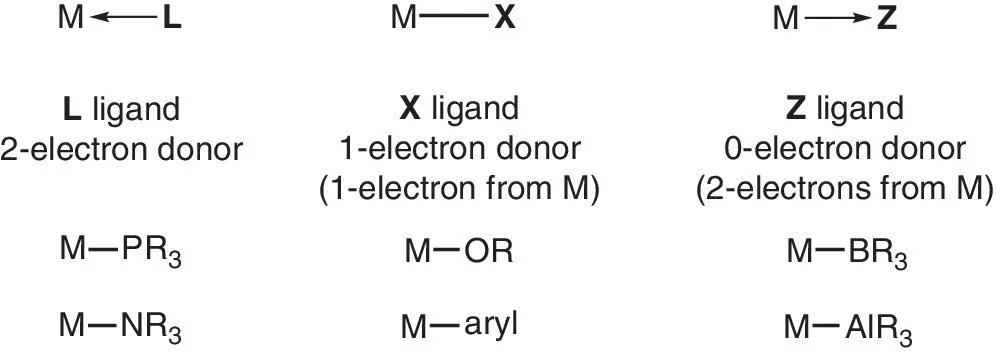
In most simple cases, ligands act as Lewis bases, donating electron density to Lewis acidic metal centers. A prevailing method to classify the number and type of interactions between a metal and ligand, the Covalent Bond Classification, has been formulated by Green and Parkin (Figure 1).[2] Using this formalism, neutral two electron donor fragments are described as L‐type ligands. The metal–ligand bond can be considered a dative interaction, whereby the valence of the metal is not changed upon ligand coordination. For simplicity, formal atom charges on the donor (ligand) and acceptor (metal) atom are invariably not depicted in chemical structures featuring such L‐type interactions. Examples of L‐type ligands include many classical Lewis bases, such as amines and phosphines. Single electron donors (or alternatively described, anionic two electron donors), such as halides, alkoxides, or carbon‐based aryl or alkyl groups, are described as X‐type ligands. The metal–ligand bond can be considered a covalent bond whereby one electron comes from both the metal and the ligand, raising the valence of the metal by one upon ligand coordination. Certain molecules can bind to metals in a fashion such that they accept, rather than donate, two electrons and are classified as Z‐type ligands. This type of dative interaction formally increases the valence state of the metal by two. The most common Z‐type ligands feature B or Al acceptor atoms.
Illustration of the classification and examples of L, X, and Z ligands according to the covalent bond classification method.
Figure 1 Classification and examples of L, X, and Z ligands according to the Covalent Bond Classification method
Ligands can bind to metals via one or more points of attachment, and/or can engage simultaneously in multiple bonding interactions with a metal center, via combinations of L‐, X‐ and Z‐type interactions. The type and strength of the metal–ligand bonding involved will depend on the metal and oxidation state, among other factors. Prototypical examples of such bonding scenarios include arene–metal structures, where the three double bonds of the aromatic act as electron pair donors (an L3‐type ligand), as well as the cyclopentadienyl group, an L2X‐type ligand (Figure 2a). Simultaneous LX‐type bonding can also arise to generate formal M ═ L double bonds, as is prevalent in many amide and alkoxide complexes (Figure 2b). The classification of these ligands as X‐type or LX‐type ligands is usually evidenced by the crystallographically determined bond angles about the donor atom, in addition to...

Table of contents

  1. Cover
  2. Title Page
  3. Table of Contents
  4. List of Contributors
  5. Foreword: Stephen L. Buchwald
  6. Foreword: David Milstein
  7. Preface
  8. 1 Key Concepts in Ligand Design: An Introduction
  9. 2 Catalyst Structure and Cis–Trans Selectivity in Ruthenium‐based Olefin Metathesis
  10. 3 Ligands for Iridium‐catalyzed Asymmetric Hydrogenation of Challenging Substrates
  11. 4 Spiro Ligands for Asymmetric Catalysis
  12. 5 Application of Sterically Demanding Phosphine Ligands in Palladium‐Catalyzed Cross‐Coupling leading to C(sp2)─E Bond Formation (E = NH2, OH, and F)
  13. 6 Pd‐N‐Heterocyclic Carbene Complexes in Cross‐Coupling Applications
  14. 7 Redox Non‐innocent Ligands: Reactivity and Catalysis
  15. 8 Ligands for Iron‐based Homogeneous Catalysts for the Asymmetric Hydrogenation of Ketones and Imines
  16. 9 Ambiphilic Ligands: Unusual Coordination and Reactivity Arising from Lewis Acid Moieties
  17. 10 Ligand Design in Enantioselective Ring‐opening Polymerization of Lactide
  18. 11 Modern Applications of Trispyrazolylborate Ligands in Coinage Metal Catalysis
  19. 12 Ligand Design in Modern Lanthanide Chemistry
  20. 13 Tight Bite Angle N,O‐Chelates. Amidates, Ureates and Beyond
  21. Index
  22. End User License Agreement