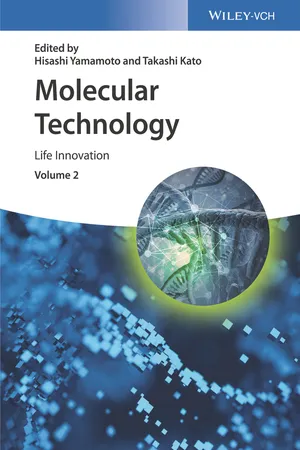
Edited by foremost leaders in chemical research together with a number of distinguished international authors, Volume 2 presents the most important and promising recent chemical developments in life sciences, neatly summarized in one book.
Interdisciplinary and application-oriented, this ready reference focuses on methods and processes with a high practical aspect, covering new trends in drug delivery, in-vivo analysis, structure formation and much more.
Of great interest to chemists and life scientists in academia and industry.
eBook - ePub
Molecular Technology, Volume 2
Life Innovation
- English
- ePUB (mobile friendly)
- Available on iOS & Android
eBook - ePub
Molecular Technology, Volume 2
Life Innovation
About this book
Information
1
Control of DNA Packaging by Block Catiomers for Systemic Gene Delivery System
Kensuke Osada1,2
1National Institutes for Quantum and Radiological Science and Technology (QST), National Institute of Radiological Sciences (NIRS), Department of Molecular Imaging and Theranostics, 4‐9‐1 Anagawa, Inage‐ku, Chiba, 263‐8555, Japan
2PRESTO, Japan Science and Technology Agency, 4‐1‐8 Honcho, Kawaguchi, Saitama, 332‐0012, Japan
1.1 Introduction
DNA undergoes large volume transition from extended coil to compact state by polyion complexation with polycations for minimizing the contact surface area of the charge‐neutralized polyplex from water [1–3]. The transition called DNA condensation is the essential mechanism of genomic DNA packaging and is the important process in preparing a nonviral gene delivery system [4–8]. The self‐assembly formed from pDNA and block catiomers has been gaining attention as a potential systemic gene delivery system, in which the pDNA is condensed into a core by complexed with cationic block and the neutral blocks surround it as a shell to form a 100‐nm‐sized core–shell‐structured polyplex micelle [9–12]. Polyplex micelles, launched from our group [13, 14], had been developed by the encouragement of the precedent development of polymeric micelles for drug delivery, which are currently under investigation of clinical trials [15, 16]. Originated from the firstly prepared polyplex micelles from PEG‐b‐P(Lys) [13, 17, 18], a variety of block catiomers or graft catiomers have been elaborated in order to improve the transfection efficiency by modulating parameters of their degree of polymerization (DP), grafting density for the case of graft catiomers, and varying mixing ratio with pDNA as described elsewhere in details [10, 17, 19, 20]. By these efforts, gene transfection efficiency has been remarkably promoted and a feasible formulation had proceeded to human clinical trial with local application [21, 22].
Nonetheless, development of polyplex micelles for systemic application has yet to be reached the level of clinical trial in spite of the structural analogy with polymeric micelles for drug delivery. This is mainly ascribed to the limited bioavailability of pDNA in active form at the final targeted nucleus; particularly, its instability in bloodstream precludes the secure delivery. To this end, the key issue that should be addressed is the packaging of pDNA into polyplex micelles because it regulates the basic character of polyplex micelles such as size, surface potential, stability, shape, and PEG crowding and thereby their biological performances such as blood circulation capacity, protection from nuclease attack, efficiencies of extravasation and migration into tissue, cellular entry efficiency, and transcription efficiency, all of which affect the ultimate gene expression efficiency. For achieving proper packaging, it is imperative to know the character of pDNA as a molecule and the principle mechanism of polyplex micelle formation so as to freely handle the structure. Moreover, it is necessary to know the suitable structure and the required functionalities to accommodate each step of delivery process. These processes should clearly point out the demanding issues for entirely managing the systemic gene delivery, which ultimately lead to a proper molecular design in structure and functionality to prepare polyplex micelles for achieving systemic gene therapy.
In this context, this review first focuses on the packaging of pDNA by block catiomers as the primal subject. Then, the required property and functionality for managing each of the delivery process are focused from intravenous (IV) injection to the last process of transcription. Finally, rational design criteria of block catiomers for systemic gene delivery are outlined.
1.2 Packaging of pDNA by Block Catiomers
It is important to first recognize the molecular character of pDNA for the sake of elucidating the mechanism of pDNA packaging. pDNA is a large molecule comprising typically a few kbp, which correspond to millions in molecular weight and a few micrometers in contour length, and has supercoiled closed circular form. DNA behaves as a semiflexible chain in solution with persistence length of 50 nm. Then, it is complexed with a large number of block catiomers for compensating the negative charges of pDNA, e.g. 200 block catiomers are required to compensate negative charges of pDNA of 5000 bp when block catiomers with 50 positive charges in their cationic segment are used. The formed polyplex micelles consist of single pDNA, wherein the concept of CAC is not defined as opposed to the polymeric micelles prepared from amphiphilic block copolymers, which are formed by association of multimolecules. Note that the single pDNA packaging is ensured as long as conducting the complexation at a diluted condition, which allows the accomplishment of the PEG shell formation before the collision of complexed pDNA to associate with neighboring complexed pDNA molecule due to translational motion. Otherwise, the secondary association occurs when the polyplex collision takes place faster than the formation of PEG shell, which is evidenced in the network‐like complex formation by conducting the complexation exceeding the overlapping concentration of pDNA strands [23]. Polyplex micelles are characterized as approximately 100 nm particles by dynamic light scattering (DLS) and neutral zeta‐potential value due to the charge‐shielding effect by the PEG shell. When considering packaging of pDNA into polyplex micelles with respect to the aforementioned character of pDNA, several fundamental questions should rise: how the long pDNA changes its conformation within the characteristic topology and how DNA accommodates its stiffness. To these questions, transmission electron microscopic (TEM) or AFM observations revealed that pDNA undergoes a variety of packaging to form structural polymorphism [24–31] such as rod shape, doughnut‐like shape (toroid), and globular shape (Figure 1.1). This is actually intriguing with respect to the driving force of the DNA condensation because globular shape is the most expected shape for minimizing the surface area. The next section deals with the subject of pDNA p...
Table of contents
- Cover
- Table of Contents
- Foreword by Dr Hamaguchi
- Foreword by Dr Noyori
- Preface
- Chapter 1: Control of DNA Packaging by Block Catiomers for Systemic Gene Delivery System
- Chapter 2: Manipulation of Molecular Architecture with DNA
- Chapter 3: Chemical Assembly Lines for Skeletally Diverse Indole Alkaloids
- Chapter 4: Molecular Technology for Injured Brain Regeneration
- Chapter 5: Engineering the Ribosomal Translation System to Introduce Non‐proteinogenic Amino Acids into Peptides
- Chapter 6: Development of Functional Nanoparticles and Their Systems Capable of Accumulating to Tumors
- Chapter 7: Glycan Molecular Technology for Highly Selective In Vivo Recognition
- Chapter 8: Molecular Technology Toward Expansion of Nucleic Acid Functionality
- Chapter 9: Molecular Technology for Membrane Functionalization
- Chapter 10: Molecular Technology for Degradable Synthetic Hydrogels for Biomaterials
- Chapter 11: Molecular Technology for Epigenetics Toward Drug Discovery
- Chapter 12: Molecular Technology for Highly Efficient Gene Silencing: DNA/RNA Heteroduplex Oligonucleotides
- Chapter 13: Molecular Technology for Highly Sensitive Biomolecular Analysis: Hyperpolarized NMR/MRI Probes
- Chapter 14: Molecular Technologies in Life Innovation: Novel Molecular Technologies for Labeling and Functional Control of Proteins Under Live Cell Conditions
- Chapter 15: Molecular Technologies for Pseudo‐natural Peptide Synthesis and Discovery of Bioactive Compounds Against Undruggable Targets
- Index
- End User License Agreement
Trusted by 375,005 students
Access to over 1.5 million titles for a fair monthly price.
Study more efficiently using our study tools.
Frequently asked questions
Yes, you can cancel anytime from the Subscription tab in your account settings on the Perlego website. Your subscription will stay active until the end of your current billing period. Learn how to cancel your subscription
No, books cannot be downloaded as external files, such as PDFs, for use outside of Perlego. However, you can download books within the Perlego app for offline reading on mobile or tablet. Learn how to download books offline
Perlego offers two plans: Essential and Complete
- Essential is ideal for learners and professionals who enjoy exploring a wide range of subjects. Access the Essential Library with 800,000+ trusted titles and best-sellers across business, personal growth, and the humanities. Includes unlimited reading time and Standard Read Aloud voice.
- Complete: Perfect for advanced learners and researchers needing full, unrestricted access. Unlock 1.5M+ books across hundreds of subjects, including academic and specialized titles. The Complete Plan also includes advanced features like Premium Read Aloud and Research Assistant.
We are an online textbook subscription service, where you can get access to an entire online library for less than the price of a single book per month. With over 1.5 million books across 990+ topics, we’ve got you covered! Learn about our mission
Look out for the read-aloud symbol on your next book to see if you can listen to it. The read-aloud tool reads text aloud for you, highlighting the text as it is being read. You can pause it, speed it up and slow it down. Learn more about Read Aloud
Yes! You can use the Perlego app on both iOS and Android devices to read anytime, anywhere — even offline. Perfect for commutes or when you’re on the go.
Please note we cannot support devices running on iOS 13 and Android 7 or earlier. Learn more about using the app
Please note we cannot support devices running on iOS 13 and Android 7 or earlier. Learn more about using the app
Yes, you can access Molecular Technology, Volume 2 by Hisashi Yamamoto, Takashi Kato, Hisashi Yamamoto,Takashi Kato in PDF and/or ePUB format, as well as other popular books in Biological Sciences & Biochemistry. We have over 1.5 million books available in our catalogue for you to explore.