- Includes three new chapters on Russia, Brazil, and India and a revised chapter on the Middle East written by regional media experts
- Features comprehensive coverage of the growing impact of social media on how news is being reported and received
- Charts the media revolutions occurring throughout the world and examines their effects both locally and globally
- Surveys the latest developments in new media and forecasts future developments
- English
- ePUB (mobile friendly)
- Available on iOS & Android
eBook - ePub
About this book
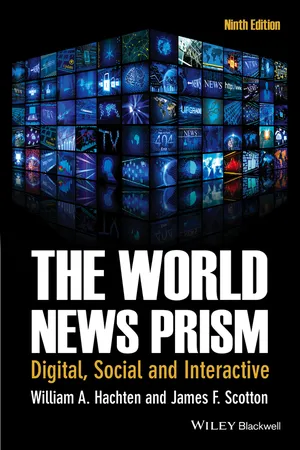
Now available in a fully revised and updated ninth edition, World News Prism provides in-depth analysis of the changing role of transnational news media in the 21st-century.
Information
1
Information for a Global System
The rapid integration of the world's economy, loosely called globalization, has been facilitated by an information revolution driven by communication technologies that provide a nervous system for our world today. Globalization is a broad and inexact term for a wide array of worldwide changes in politics, economics, trade, finance, lifestyles, and cultures. To its critics, globalization is trendy and controversial; they see the world becoming a consumer colony of the United States, led by Coke, McDonald's, Nike, and the vast pop-culture output of Hollywood. How people feel about globalization often depends a lot on where they live and what they do. With just a visit to a mall, one is struck by the plethora of products and services from many distant lands. In the past thirty years, much of the world's economy has become increasingly integrated; direct foreign investment has grown three times as fast as total domestic investment. But globalization is more than buying and selling; some see it as a profound interchange of cultures – a communication revolution that is dissolving our sense of boundaries, our national identities, and how we perceive the world. Deregulation of telecommunications systems and computerization have been called the parents of globalization. Three technologies in particular – computers, satellites, and digitalization – have converged to produce a global communications network that covers the Earth as completely as the atmosphere. Today's era of globalization is characterized by falling telecommunications costs, thanks to microchips, satellites, fiber optics, and the Internet. The popular culture of the West – movies, television shows, music CDs, video- and audio- cassettes, books, magazines, newspapers – has been increasingly flowing about the world. It can be argued that the world is beginning to share a popular culture, based only in part on that of the West. Critics differ about what happens when cultures meet. Rather than fight, cultures often blend. Frederick Tipson noted, “More like a thin but sticky coating than a powerful acid, this cosmopolitan culture of communication networks and the information media seems to overlay rather than supplant the cultures it interacts with.”1 When cultures receive outside influences, it is said, they ignore some and adopt others, and soon begin to transform them. An example can be something called bhangra pop in India – music that sounds like Jamaican reggae but is played on Indian instruments and then amplified.
Critics of this global media market castigate globalization for several reasons: the centralization of media power, and heavy commercialism, which is linked to declines in public broadcasting and public service standards for media performance. Media are seen as a threat to democracy because of lessened public participation and concern with public affairs. Press critics have other concerns about these corporate giants. The news media, they argue, risk becoming submerged and neglected inside vast entertainment conglomerates that are primarily concerned with entertainment profits.
Most of these criticisms are leveled at Western media, and these critics neglect to consider how globalization has spurred the growth of media and their audiences in the developing non-Western nations.
Others see globalization in more positive terms. It is argued that many millions more people than ever before now have access to news and information, especially in such countries as China and India and much of Southeast Asia. Globalization means that multitudes now have many newfound choices: how they will spend their leisure time; what they will watch or read; what to buy with newly acquired personal income from rapidly rising standards of living. Anthropologist James Watson wrote, “The lives of Chinese villagers I know are infinitely better off now than they were 30 years ago. China has become more open because of the demands of ordinary people. They want to become part of the world – I would say that globalism is the major force for democracy in China. People want refrigerators, stereos, CD players.”2
Journalist Thomas Friedman wrote that globalization is essentially about change, which is a reality and not a choice: “Thanks to the combination of computers and cheap telecommunications, people can now offer and trade services globally – from medical advice to software writing to data processing – services that could never be traded before. And why not? A three-minute call (in 1996 dollars) between New York and London cost $300 in 1930. Today it is almost free through the Internet.”3
The primacy of the issue of globalization reminds us of the extent to which most of us now think and act globally – as a matter of course. In his book The World Is Flat: A Brief History of the 21st Century, Friedman expands his earlier views and sees dramatic changes in the forces for global leveling from the fall of the Berlin Wall, which eliminated the ideological divide in the world, to the rise of the Internet and technological changes that have led to new economic models of production and collaboration, including outsourcing and offshore manufacturing. Now nations such as China and India, as well as others in South Asia, have prospered in dramatic ways. The integration of some 3 billion people into the global economy is of major importance. Just one facet of this global flattening is that the media of communications have become increasingly pervasive in these rapidly modernizing places. Literally many millions are now, through the Internet, cellphones, satellite television, and publications, “in touch” with the greater world. But while the new technologies are closing gaps between parts of India and China and the advanced industrial nations, the gaps between those countries and Africa have been widened. The world's nations may not have a level playing field, but the world is changing in critical ways. And for many millions in those nations considered to be “developing,” their standards of living have improved rapidly.
Perhaps one of the most significant photographs of modern times was taken during the Apollo 11 mission to the moon. The astronauts photographed the earthrise as seen from the moon, and there was our planet, like a big, cloudy, blue, agate marble. The widely reprinted picture illuminated the fragility and cosmic insignificance of our spaceship Earth.
That stunning image coincided with the worldwide concern about ecology, climate change, and global pollution; even more, it made it easy to grasp why many scientists already treated that cloudy, blue marble as a complete biological system, in which change in one part will inevitably affect other parts.
Certainly in the years since, concerned persons around the world have become more aware of our global interdependence. Although some experts disagree, an important trend of our times is that the world is becoming a single, rudimentary community. Today's world must grapple with an agenda of urgent and complex problems, most of them interrelated: overpopulation; poverty; famine; depletion of natural resources (especially energy); pollution of the biosphere; regional political disputes; continuing arms buildup, including the nuclear threat; global warming, and the widening gap between rich and poor nations, which seems exacerbated by economic integration. Recent events have pushed terrorism high on the agenda. Terrorist acts are somber reminders of how much hate and anger divide our diverse societies.
These and other global crises ebb and flow on the world's news agendas, but they are truly international in scope; the amelioration – much less solution – of any of them requires cooperation and goodwill among nations. To achieve that, there first must be information and understanding of these challenges, for these are crises of interdependence. No one nation or even combination of nations can deal effectively with such global concerns as international monetary crises, pollution of the air and oceans, population control, terrorism, regional warfare, and widespread famine and food shortages, yet the blinders of nationalism and modern tribalism continue to influence political leaders everywhere to react to international problems with narrow and parochial responses. The news media in all nations will reflect the national views and prejudices of their own societies on these pressing global concerns. It's not necessary that all nations agree on how to respond – and here is where the news media come in – but there should be general agreement about what the problems are.
Westerners and some leaders of developing countries are becoming aware that population growth is putting intolerable pressures on the Earth's land, water, and energy resources as well as its economies.
The world's population in 2008 was 6.8 billion, with 37 percent of its population living in China and India. The US Census Bureau has projected that in 2025 India will surpass China. The other most populous countries are, in order, the United States, Indonesia, Brazil, Pakistan, Bangladesh, Nigeria, Russia, and Japan.4 By the end of this century another 3 billion people are expected to be added.
Africa is currently gripped by one of the greatest population explosions ever recorded. Over the past sixty years Africa's population has quadrupled to 1 billion people, an epic baby boom that threatens to trap a generation of children in poverty and strangle economic progress on the world's poorest continent. With low rates of contraception and high social pressures to have large families, African women bear 5.3 children each on average, compared with 2.1 in the United States. By 2050, Africa's population will reach 2 billion.5 Nigeria's population alone, in a quarter-century, at the rate it is growing, will reach 300 million people (about the population of the present-day United States) living in a country the size of Arizona and New Mexico.
Scientists and development experts have been racing to increase food production by 50 percent in the next two decades to feed this growing population. The global number of hungry people increased to 1.02 billion in 2009, or nearly one in seven, according to the UN Food and Agriculture Organization. A central problem is whether food can be grown in the developing world where the hungry can actually get it at prices they can afford to pay. Poverty and difficult growing conditions plague the places that need new food production most – in sub-Saharan Africa and South Asia.6 Finally, global warming makes this more difficult.
Paradoxically, even with greatly enhanced capability of involvement in world affairs, comparatively few people are well informed or even care much about what happens beyond their borders. Many who follow the news on television or other media have only a superficial knowledge of events such as a cancellation of an election in Nigeria or a stock-market crash in Indonesia. But for those comparative few who do follow public affairs closely (and they are found in every nation), perceptions of the world are being formed and reshaped by this revolution in long-distance instant communications.
Our ability, or lack of it, to use the fruits of this technological revolution is directly related to our success or failure to act decisively and in concert as a world community. International experts worry whether the world can organize itself and deal effectively with what have been called the seven major interrelated world problems: mass poverty, population, food, climate change, energy, military expenditure, and the world monetary system. To organize, though, we must communicate, since communication is the neural system of any organization. The extent of its ability to communicate determines the boundaries of any community – be it a primitive tribe in Papua New Guinea or a global society – and only expanded and more effective ...
Table of contents
- Cover
- Title Page
- Copyright
- Dedication
- Notes on Contributors
- Preface to the Ninth Edition
- Introduction: Fall and Rise of the Media
- Chapter 1: Information for a Global System
- Chapter 2: Game Changers: Twitters, Videos, Blogs
- Chapter 3: Global Media Under Stress
- Chapter 4: Impact of Great Events
- Chapter 5: English: The Language of the World
- Chapter 6: Brazil: Latin America's Communication Leader
- Chapter 7: Russian Media: Struggling Against New Controls
- Chapter 8: India: Liberalization Spurs Phenomenal Media Growth
- Chapter 9: China: A New Media Face But Tighter Control
- Chapter 10: Africa: The Mobile Continent
- Chapter 11: The Middle East: Media in the Midst of Turmoil
- Chapter 12: Reporters Abroad: Paid, Free, and Harassed
- Chapter 13: Reporting War
- Chapter 14: Public Diplomacy and Propaganda
- Chapter 15: Conclusions and Outlook
- Selected Bibliography
- Index
- EULA
Trusted by 375,005 students
Access to over 1.5 million titles for a fair monthly price.
Study more efficiently using our study tools.
Frequently asked questions
Yes, you can cancel anytime from the Subscription tab in your account settings on the Perlego website. Your subscription will stay active until the end of your current billing period. Learn how to cancel your subscription
No, books cannot be downloaded as external files, such as PDFs, for use outside of Perlego. However, you can download books within the Perlego app for offline reading on mobile or tablet. Learn how to download books offline
Perlego offers two plans: Essential and Complete
- Essential is ideal for learners and professionals who enjoy exploring a wide range of subjects. Access the Essential Library with 800,000+ trusted titles and best-sellers across business, personal growth, and the humanities. Includes unlimited reading time and Standard Read Aloud voice.
- Complete: Perfect for advanced learners and researchers needing full, unrestricted access. Unlock 1.5M+ books across hundreds of subjects, including academic and specialized titles. The Complete Plan also includes advanced features like Premium Read Aloud and Research Assistant.
We are an online textbook subscription service, where you can get access to an entire online library for less than the price of a single book per month. With over 1.5 million books across 990+ topics, we’ve got you covered! Learn about our mission
Look out for the read-aloud symbol on your next book to see if you can listen to it. The read-aloud tool reads text aloud for you, highlighting the text as it is being read. You can pause it, speed it up and slow it down. Learn more about Read Aloud
Yes! You can use the Perlego app on both iOS and Android devices to read anytime, anywhere — even offline. Perfect for commutes or when you’re on the go.
Please note we cannot support devices running on iOS 13 and Android 7 or earlier. Learn more about using the app
Please note we cannot support devices running on iOS 13 and Android 7 or earlier. Learn more about using the app
Yes, you can access The World News Prism by William A. Hachten,James F. Scotton in PDF and/or ePUB format, as well as other popular books in Languages & Linguistics & Communication Studies. We have over 1.5 million books available in our catalogue for you to explore.