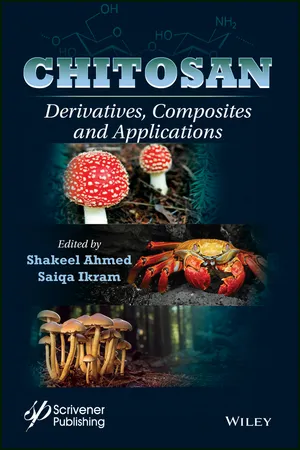
Chitosan
eBook - ePub

Chitosan

Derivatives, Composites and Applications

  1. English
  2. ePUB (mobile friendly)
  3. Available on iOS & Android
eBook - ePub

Chitosan

Derivatives, Composites and Applications

About this book

Unique book presenting the latest advancements and applications of chitosan-based hydrogels and composite materials in biotechnology, environmental studies, food, medicine, water treatments, drug delivery.

This book delves deeply in to the preparation, characterization and multiple applications of chitin and chitosan. The 17 chapters written by leading experts is an excellent reference source and state-of-the-art review for researchers and scientists using chitosan or biopolymers in their respective areas.

This book is divided into following sections:

  • Production and derivatives of chitosan
  • Chitosan in the textile and food industries
  • Chitosan in biomedical applications
  • Chitosan in agriculture and water treatment

The book is practical and readers will be able to see descriptions of chitosan production methods as well as techniques that can be used to estimate and modify their physical and chemical properties. It provides a full description not only of the traditional and recent developments in the applications of chitosan in the fields of biotechnology, environmental studies, food, medicine, water treatments, drug delivery, but it includes all of the therapeutic usages as well.

Frequently asked questions

Yes, you can cancel anytime from the Subscription tab in your account settings on the Perlego website. Your subscription will stay active until the end of your current billing period. Learn how to cancel your subscription.
No, books cannot be downloaded as external files, such as PDFs, for use outside of Perlego. However, you can download books within the Perlego app for offline reading on mobile or tablet. Learn more here.
Perlego offers two plans: Essential and Complete
  • Essential is ideal for learners and professionals who enjoy exploring a wide range of subjects. Access the Essential Library with 800,000+ trusted titles and best-sellers across business, personal growth, and the humanities. Includes unlimited reading time and Standard Read Aloud voice.
  • Complete: Perfect for advanced learners and researchers needing full, unrestricted access. Unlock 1.4M+ books across hundreds of subjects, including academic and specialized titles. The Complete Plan also includes advanced features like Premium Read Aloud and Research Assistant.
Both plans are available with monthly, semester, or annual billing cycles.
We are an online textbook subscription service, where you can get access to an entire online library for less than the price of a single book per month. With over 1 million books across 1000+ topics, we’ve got you covered! Learn more here.
Look out for the read-aloud symbol on your next book to see if you can listen to it. The read-aloud tool reads text aloud for you, highlighting the text as it is being read. You can pause it, speed it up and slow it down. Learn more here.
Yes! You can use the Perlego app on both iOS or Android devices to read anytime, anywhere — even offline. Perfect for commutes or when you’re on the go.
Please note we cannot support devices running on iOS 13 and Android 7 or earlier. Learn more about using the app.
Yes, you can access Chitosan by Shakeel Ahmed, Saiqa Ikram, Shakeel Ahmed,Saiqa Ikram in PDF and/or ePUB format, as well as other popular books in Technology & Engineering & Chemical & Biochemical Engineering. We have over one million books available in our catalogue for you to explore.

Section I
PRODUCTION AND DERIVATIVES OF CHITOSAN

Chapter 1
Chitin and Chitosan: History, Composition and Properties

Annu1*, Shakeel Ahmed1,2 and Saiqa Ikram1*
1Bio/Polymers Research Laboratory, Department of Chemistry, Jamia Millia Islamia (A Central University), New Delhi, India
2Department of Textile Technology, Indian Institute of Technology Delhi, New Delhi, India
*Corresponding authors: [email protected]; [email protected]

Abstract

Chitin and chitosan are most abundant naturally occurring polymers, ranked second after cellulose. Chitin is generally extracted from natural sources viz. terrestrial organisms, marine organisms, microorganisms like fungi and enzymatically from crustaceans shell waste materials. On the other hand, chitosan is obtained from the deacetylation of the former, chitin.
Nowadays, chitin and chitosan are commercially manufactured from biowastes obtained from aquatic organisms. But due to the seasonal and capricious availability of raw materials, terrestrial crustaceans and mushrooms are the alternative source for their production. Structurally, chitin and chitosan are N-acetyl-D-glucosamine units and D-glucosamine units, respectively, with only difference in hydroxyl group of cellulose. Both the biopolymers are biodegradable and possess many beneficial properties such as biocompatibility, antimicrobian, hemostatic, anti-inflammatory, antioxidant, mucoadhesion, analgesic, non-toxicity, adsorption enhancing, antihypertensive, anticholesterolemic, anticancer, and antidiabetic. Due to having such respectable properties chitin, chitosan, and their corresponding derivatives are greatly exploiting by the scientists and also getting tremendously better results in medical and engineering fields.
Keywords: Chitin, chitosan, history, structure, properties, solubility, viscosity, biomedical, anticancer

1.1 Chitin

1.1.1 History

French scientist Prof. Henri Braconnot for the very first time discovered chitin in 1811 in mushroom. After that Odier found the same compound in the cuticles of insects in 1823 and called it “Chitin” from the Greek word meaning tunic, covering or envelope [1].
This was how it begins the research in a new direction of polymers present in our nature. Gradually as the time passed away in 1859, Prof. C. Rouget coined another noval biopolymer, actually derived from previous chitin, and it was known as “Chitosan.” In 1878, Ledderhose revealed that the chitin consists of glucosamine and acetic acid. Thereafter, in 1930s and 1940s, both former and latter attract considerable attention as evidenced by about 50 patents. Chitin is the most abundant naturally occurring polymer, ranked second after cellulose and also most abundant naturally occurring polysaccharide possesses amino acid and sugars. Chemically, chitin is composed of N-acetyl-D-glucosamine units with β-(1-4) glycosidic linkage [2].

1.1.2 Sources of Chitin

Chitin is generally produced from natural sources viz. terrestrial organisms, marine organisms, microorganisms like fungi and enzymatically from crustaceans shell waste materials. On the other hand, chitosan is obtained from the deacetylation of the former, chitin. Nowadays, chitin and chitosan are commercially manufactured from biowastes obtained from aquatic organisms. But due to the seasonal and capricious availability of raw materials terrestrial crustaceans and mushrooms are the alternative source for their production [2]. The industrial manufacturing of synthetic polymers was restricted by the time because of the inadequate facilities as well as the cutthroat competition in synthetic polymers. Therefore, again the shellfish shells, crustaceans and shrimps revitalized the interest in late 1970s (Global industry analysis since 2004). Various sources for extraction and production of chitin can be categorized as follows:
  1. Terrestrial organisms
  2. Marine or Aquatic organisms
  3. Microorganisms (e.g., Fungi)

1.1.2.1 Terrestrial Organisms

From commercial point of view, these organisms are mainly used for the extraction of chitin, due to their easy availability and processability. Terrestrial species ge...

Table of contents

  1. Cover
  2. Title page
  3. Copyright page
  4. Preface
  5. Section I: Production and Derivatives of Chitosan
  6. Section II: Chitosan in Textile and Food Industry
  7. Section III: Chitosan in Biomedical Applications
  8. Section IV: Chitosan in Agriculture and Water Treatment
  9. Index
  10. End User License Agreement