![]()
Chapter 1
Biomedical Applications for Thermoplastic Starch
Antonio José Felix de Carvalho1* and Eliane Trovatti1,2
1São Carlos School of Engineering, University of São Paulo, Brazil
2São Carlos Institute of Chemistry, University of São Paulo, São Carlos, Brazil
Abstract
Thermoplastic starch (TPS) emerged recently as a new polymeric material based on biodegradable and renewable resources. Since its beginning in the 1990s, several researchers described the use of TPS for biomedical applications, which increased recently due to new TPS-based materials such as blends with other polymers, composites and nanocomposites. Its non-toxic, resorbable and biodegradable characteristics make TPS a key material for biomedical applications, allowing its use in implantable materials, opening a new field of research. In this chapter we introduce TPS and we describe the most recent research on its applications and new developments in biomedical and pharmaceutical areas.
Keywords: Thermoplastic starch, processing, biomedical in vivo tests, scaffolds, resorbable material
1.1 Starch as Source of Materials in the Polymer Industry
Thermoplastic starch (TPS) emerged as new class of biodegradable materials in the 1990s and quickly become one of the most studied polymer system in the field of biodegradable materials derived from renewable resources [1–9]. One reason for this interest is the fact that starch is one of the few natural polymers that can be used directly as a thermoplastic material without any chemical modification [9], with possible uses in package and in food and biomedical industries. In this chapter we describe the approach for TPS preparation, as well as its blends, some methods for chemical modification of starch and the most advanced materials prepared from starch for application in pharmaceutical and biomedical fields.
1.2 Starch in Plastic Materials and Thermoplastic Starch
The use of starch in compositions in the plastic industry is not new. Since the 1960s starch has been used in its native form as granule or gelatinized in compositions with other polymers such as rubber [10, 11], polyvinyl chloride (PVC) [10, 12] and in low-density polyehylene (LDPE) as filler [13]. However, further investigations into these processes were not undertaken due to several problems such as the need of drying and poor adhesion of the hydrophilic starch granules to the high hydrophobic polymer matrix.
Relative success in producing films by casting a dispersion of gelatinized starch and poly(ethylene-co-acrylic acid) (EAA) was described by Otey and co-workers [10, 14–16]. However, the high costs involved limited its application in high extension. Other attempts to use starch were also described by the same research group. The main examples consisted of blends of starch and poly(ethylene-co-acrylic acid), which after drying were processed by extrusion-blowing. This blends where plasticized with sorbitol, glycerol, urea, starch-based polyols [17]. These materials where partially biodegradable, which also limited its application.
The fundamentals of TPS preparation have long become well-known because starch gelatinization leads to the same kind of material. The process can be divided into two conditions, in excess of water, and in low water concentrations.
When native starch is heated above a characteristic temperature (known as the gelatinization temperature), in excess of water or of another solvent such as liquid ammonia, formamide, dimethyl sulfoxide and others, it undergoes an irreversible order-disorder transition known as gelatinization or destructuration [9]. The process involves two steps: hydration limited by the diffusion of the solvent through the granule, and melting of the starch crystallites [18, 19]. The phenomenon is characterized either by a large excess of water in a single endotherm peak observed by DTA or DSC, corresponding to the gelatinization temperature; or by an endotherm event, at a higher temperature, in which the maximum temperature depends on the water concentration attributed to the melting of the starch crystallites. When water concentration is intermediate between the gelatinization and the melting, two endothermic transitions are observed. The same final results can be obtained when TPS is produced in limited amounts of water or in the presence of a high boiling point hydroxyl compounds.
Thermoplastic starch behaves as a conventional thermoplastic and may be repeatedly softened and hardened, so that it becomes amenable to moulding/shaping by the action of heat and shear forces. This behaviour allows TPS processing with commonly techniques used in the plastic industry — a very attractive feature, since a low additional investment is required to achieve effective industrial use [1, 20, 21]. The temperature for TPS processing depends on the proportions of starch/plasticizer and, in general, it is between 120 °C and 160 °C. Expanded materials can be obtained when water is used alone or in combination with starch to produce TPS.
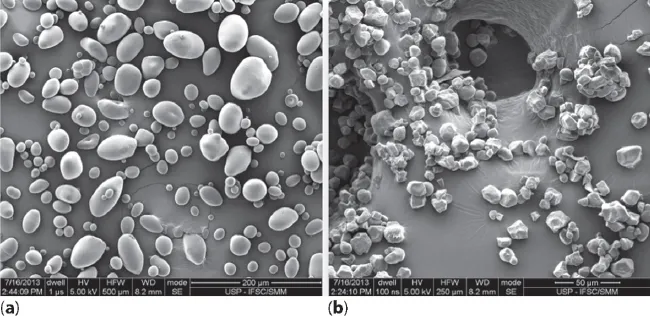
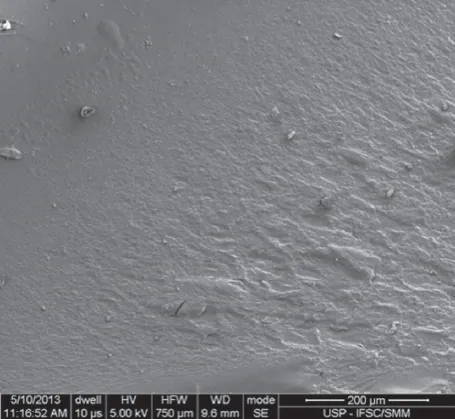
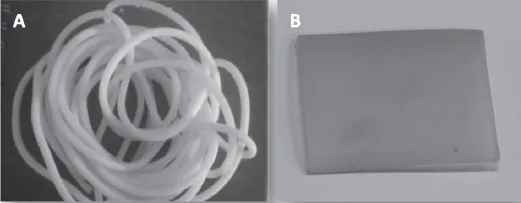
Starch granules structure is completely destroyed when it is plasticized to produce TPS. The scanning electron microscopy (SEM) images in Figure 1.1 shows the morphology of native starch granules from two different food sources, potato (a) and regular corn starch (b). Figure 1.2 shows the smooth surface of a TPS film evidencing the complete granules disruption. TPS is processed conventionally by extrusion in wires, strips or in pellets. Figure 1.3 shows samples of extruded TPS in strips and wires before pellet cutting.
The choices of plasticizer type and concentration are of fundamental importance not only for the processing conditions, but also for the final properties of the material. These can vary from a rigid and fragile material, to a soft and rubbery material at room temperature [22]. The most common plasticizer for starch is glycerol [8, 9] however other such as urea [3], fructose [23], xylitol, sorbitol, maltitol [8, 22, 24], glycols (EG, TEG, PG, PEG) [9], ethanolamine [25] and formamide [26] have also been used. In essence, the plasticizer is any substance capable of forming stable hydrogen bonds at the processing temperatures used for TPS production. The presence of water in the compositions, which works as a “processing” plasticizer is recommended, since it improves the destructuration efficiency, decreases melt viscosity and consequently, reduces starch degradation rate during its processing [27, 28].
Alternatively, starch may be dried before processing and the processes conducted in the presence of glycerol, resulting in materials with superior thermoplastic feature [29].
Although the process to produce TPS is based on the destruction of the crystalline structure of the native starch, TPS is not completely amorphous and undergoes crystallization, especially when stored at temperatures above its glass transition temperature. Crystallization of starch in TPS leads to crystalline forms different from the native starch granule, being the most important the B-, V- and E-forms. V- and E-types can be observed just after extrusion because they are generated during processing [30, 31]. Two sub types of V-type exist, the anhydrous Va-type for materials containing low moisture concentrations and the hydrated form Vh-type for materials containing higher moisture concentrations. The E-type occurs only in samples with low moisture concentrations [32], B-type crystallinity is similar to that observed in native starch from potato and tapioca and is formed slowly during storage [6].
Materials based on starch are biodegradable and biocompatible, widely available at low cost, and irreplaceable in a wide range of applications due to their unique properties. The search for new applications of starch is fast increasing in the last years, and the biomedical uses of such materials represents an important advance in the research field [33].
1.3 Uses of Starch and TPS in Biomedical and Pharmaceutical Fields
Starch is used in packaging, food and pharmaceutical industry for decades and its application field is growing because its singular properties, specially its physicochemical properties, biocompatibility and biodegradability [34, 35]. In pharmaceutical industry starch is an important functional ingredient for formulations of tablets, capsules [36], coatings [37], subcutaneous implants [38] and matrix for drug release systems [33, 39, 40].
Studies related to applications of starch in pharmaceutical and biomedical areas progressed gradually. The earliest focus of the scientific reports regards to the study of food and pharmaceutical uses of starch in its natural form as extracted from vegetables. These studies included structure determination, morphology characterization and the properties as food and drug modifier. In the food industry, starch is extensively used as a thickener, while in the pharmaceutical industry it is extensively used as excipient. However, its special properties have widened its range of applications. Current research is directed toward the development of starch-based materials aiming the improvement of pharmaceutical, cosmetics, and healthy & care formulations. Some important research have been developed with respect to the use of starch as a biosorbable material for temporary implants. The features that make starch interesting for these applications include the combination of its mechanical properties and its hydrophilic and resorbable characters, allowing its use inside human and animal body as implants and other devices. The high degree of chemical functionality of starch, due to the presence of hydroxyl groups allows its chemical modification, generating a wide range of materials with interesting properties for use in biomedical and pharmaceutical areas.
Apart from the demand it enjoys in the research, field, starch has also found a consolidated demand in pharmaceutical industry, mainly for use as excipient in solid formulations like tablets and powder presentations. However, many starch-based products have been developed for uses in tissue engineering, drug delivery and wound healing, including its chemical modification.
1.3.1 Native Starch (Granule) as Pharmaceutical Excipient
Excipients are usually inert and inactive ingredients that make up the vehicle or matrix, used as basic drug carriers in pharmacological formulations. Despite this inactivity they nevertheless fulfil secondary functions as stabilizers, preservatives, buffers, diluents, binders, disintegrants, lubricants, dye and-or flavouring agents. The conventional concept of excipient as a simple, chemically and pharmacologically inert vehicle of a formulation has been changing to an essential functional agent that optimizes and improves the performance of the drug [34]. Excipients can interact with the active molecules from the formulation and affect its dissolution, absorption and bioavailability. In this venue, the drug delivery technology has been improving the pharmaceutical systems and drug bioavailability. Excipients can also help the manufacture processing and disintegration, preventing the fast release of the drug. The hole of starch is remarkable as a pharmaceutical excipient mainly as a diluent and disintegrant agent in tablets and capsules formulations when used as unmodified granules and as a binder, when it is pre-gelatinized.
Several research strategies that have emerged recently as the dominant trends in thermoplastic starch-based materials for biomedical uses, and the use of blends for the development of biocompatible materials and its preliminar tests in biological in vivo systems are described here.
1.3.2 Gelatinized and Thermoplastic Starch in Biomedical Application
Regarding the use of starch for the manufacture of capsules for drug delivery, thermoplastic starch-based polyvinyl alcohol material obtained by extrusion are noteworthy. They were developed as a potential substitute for soft gelatin capsules [41]. Gelatin has been used for decades for capsules preparation because of its physicochemical properties. One of the drawbacks of gelatin for hydrophilic lipid-based formulations is the high content of water of the matrix (up to 35%), which migrate...