Quantum Communications in New Telecommunications Systems
Computers are quickly making the transition from silicon towards miniaturization, which now risks reaching its limits as dictated by the laws of physics. Quantum communications are the answer to post-silicon computers.
The main applications for quantum communications in the domain of telecommunications are beginning to appear, with some commercial applications already on the market.
This book explores the technological advances in quantum communications with a special focus on telecommunications systems.
The authors provide a comprehensive state of the art on quantum communications and quantum signal processing. The reader will learn about the advantages, current applications and future prospects of quantum technology.
1.1. Quantum mechanics as a generalized probability theory
We have borrowed part of Michel Bitbol’s analysis of quantum mechanics analyzed as a probability theory. In his pamphlet, he says [BIT 98]:
“The argument that I will defend here makes two propositions. First, quantum mechanics is not just a physical theory that uses probability calculation; it is itself a generalized form of probability calculation, coupled with a probabilistic evaluation process via the set use of symmetries. Secondly, quantum mechanics does not merely have a predictive function like other physical theories; it is a formalization of the possibility conditions of any prediction focused on phenomena whose circumstances of detection are also production conditions”.
In this spirit, we begin by quickly showing the architecture of standard quantum mechanics:
1) The formal core of this theory is a vector space defined on a set of complex numbers and provided with a scalar product otherwise known as Hilbert space.
2) Special operators are defined on this space, called “observables”, which, through their “proper values”, provide a list of the possible results of a measuring operation.
3) A vector of the Hilbert space, called a state vector, is linked to each preparation (that is to say, to the fixing of conditions that are a prerequisite for measuring).
4) By applying the Born rule to this state vector, we obtain a function that assigns probabilities to the results of any measurement carried out as a result of the preparation.
5) A variable space–time interval and diverse physical circumstances can separate the end of the operation from the measurement preparation and operation; we take account of this via an evolution equation for the state vectors.
Here, I would like to emphasize the major difference between the probability functions of classic probability theory, and those obtained from state vectors in quantum mechanics by applying the Born rule. The classic probability functions link a number between 0 and 1 to each “event” in the widest sense, defined by Kolmogorov as a sub-set of elementary events. The set of these event sub-sets includes the empty set and the comprehensive set and it is provided with a Boolean algebra structure by the union and intersection operations. In other words, the classic probability functions are defined on a Boolean algebra. On the other hand, when we take account of the Hilbert space properties, the quantum probability functions are not defined on a Boolean algebra; they are defined on different and richer structures called “orthoalgebras”.
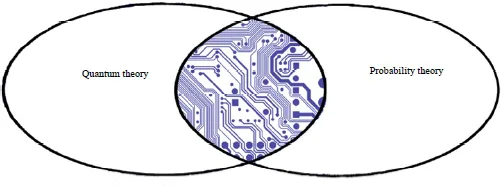
This structural disparity between the classic and quantum probability functions explains why it is not sufficient to assume that quantum mechanics uses probability theory. Quantum mechanics itself consists of a new and enlarged form of probability theory [BLI 29]. The new circuits are a conjunction of quantum theory and probability theory, as shown in Figure 1.1.
Figure 1.1. Connection between quantum theory and probability theory
The following references advance the same vision [THA 15, FER 08, FER 09] and [FER 11].
Starting from this analysis, it seems important to us to examine quantum communications on the basis of the probabilities and concepts related to this theory: covariance, correlation [FUR 12] inference and random processes, while including some concepts specific to quantum mechanics: contextuality [DZH 14], non-locality [RAB 14], paradoxes such as Schrodinger’s cat, the Einstein, Podolsky and Rosen paradox, Bell inequalities [KRE 14, RAS 15] and decoherence [KOK 11]. Subsequently, we will try to create a synthesis between proponents of determinism and randomness.
Standard quantum mechanics undeniably violates the notion of separability that we have normally considered valid under classical physics. In relating the phenomenon of non-separability to the all-important concept of potentiality, we effectively create a coherent picture of correlations between the spatially-separated entangled enigmatic systems. Moreover, we support the idea that the generalized phenomenon of quantum non-separability involves contextuality, which, in turn, results in a relational, structural design of quantum objects, considered to carry dispositional properties [KAR 07].
1.2. Contextuality
Quantum computers promise enormous advantages over their classic counterparts, but the source of their power in quantum IT remains inaccessible. Here, we show a remarkable equivalence between the appearance of contextuality and the possibility of universal quantum calculation via the magic state that we call distillation, which is the main model for creating a quantum computer with tolerance to breakdown. Furthermore, this connection suggests a unifying paradigm for quantum IT resources: the non-locality of quantum mechanics is a particular type of contextuality, and non-locality is already known to be an essential resource for realizing the advantages of quantum communication. In addition to clarifying these fundamental questions, this work sets out the resource framework for quantum calculation, which has a number of practical applications, such as characterizing efficiency and compromising between distinct theoretical and experimental schema to reach a robust quantum calculation, and to place limits for the classic simulation of quantum algorithms [HOW 14].
1.3. Indeterminism and contextuality
These two historic remarks, one on the link between the concept of probability and the secondary concept of quality, and the other on calculating probabilities, designed as an instrument of predictive control for our situation of entanglement in the network of natural relationships, will now help us to unravel two interpretative nodes of quantum physics, each relying on indeterminism.
The first involves the notion, very widely known from Heisenberg’s founding work of around 1927–1930, of an uncontrollable disturbance that the measuring agent is supposed to exercise on the microscopic subject measured. It is interesting to note that this “disturbance” was assigned a double role by its creators.
On the one hand, underlined by Bohr at the end of the 1920s, uncontrollable disturbance is the reason why the quantum phenomenon is indivisible, that is to say it is impossible to distinguish what in the phenomenon results from the object and what results from the measurement agent. The disturbance would explain, in other words, taken this time from Heisenberg, that quantum physics causes the mode of secondary qualities to become generalized, with their inevitable reference to the context in which they are manifested, to the detriment of that of the primary intrinsic qualities. But, on the other hand, according to an article from 1927 in which Heisenberg shows the relationships known as “uncertainty” relationships for the first time [HEI 27], the disturbance also accounts for indeterminism in quantum physics. The incompressible and uncontrollable disturbance created by the measuring agent is what prevents the two groups of variables that make up a particle’s initial state from being known completely; consequently, Heisenberg concludes, the principle of causality, which links an initial state and a final state, links them in a way which is binding and remains inapplicable in quantum physics. The model of the “disturbance” also enables a direct relationship between contextuality and indeterminism to be shown, since the disturbance results in the phenomena’s contextuality as much as in indeterminism for their subject. Later on, at the beginning of the 1950s, Paulette Destouches-Février demonstrated much more rigorously a theorem according to which any predictive theory relying on phenomena defined in relation to experimental contexts, some of which are mutually incompatible, is “essentially indeterminist” [BER 49].
1.4. Contextuality and hidden variables
The question of knowing if quantum phenomena can be explained by classic models with hidden variables has been the subject of lengthy debate. In 1964, Bell showed that certain types of classic models cannot explain the predictions of quantum mechanics for specific states of distant particles, and certain types of hidden variable models have been experimentally excluded. An intuitive characteristic of classic models is non-contextuality: the property that any measurement has a value independent of the other compatible measurements carried out at the same time. However, a theorem drawn up by Kochen, Specker and Bell shows that non-contextuality is in conflict with quantum mechanics. The conflict lies in the structure of the theory, which is independent of the properties of the special states. The question of knowing if the Kochen–Specker theorem could be tested experimentally has been discussed. The first tests for quantum contextuality have been suggested recently and undertaken with photons and neutrons. Here, we carry out an experiment with trapped ions, which shows a conflict between state independence and non-contextuality [KIR 09].
1.5. Non-locality and contextuality
We use the mathematical language of beam theory to give a unified treatment of non-locality and contextuality, in a framework that generalizes the familiar probability tables used in non-locality theory for arbitrary measurements: this includes Kochen–Specker configurations. We show that contextuality and non-locality, a particular case, correspond exactly to obstacles to the existence of global sections. We describe a linear, algebraic approach for calculating these obstacles, which permits a systematic treatment of non-locality and contextuality. We distinguish an adequate hierarchy of no-go theorem forces, and we show that the three main examples, taken from Bell, Hardy and Greenberger, and Horne and Zeilinger, respectively, occupy higher levels of this hierarchy. A general correspondence is shown between the existence of variable, local, hidden implementations using negative probabilities, and “no signaling”; this depends on a result showing the linear sub-spaces generated by the non-contextual and “no signaling” models. The maximal non-locality is generalized to maximal contextuality; it is characterized in purely qualitative terms, with Kochen–Specker results as generic. These models are independent proofs of maximal contextuality, and a new combinatorial state is given; it generalizes the “proofs of parity” much discussed in literature. This shows that quantum mecha...
Table of contents
Cover
Table of Contents
Dedication
Title
Copyright
Foreword
Preface
Introduction
1 The State of the Art in Quantum Communications
2 Concepts in Communications
3 Quantum Signal Processing
4 Quantum Circuits
5 Optical Fibers and Solitons
6 Photonic Crystals
7 ROADM
8 WDM
9 Quantum Algorithms
10 Applications
11 Quantum Cryptography
Conclusion
Bibliography
Index
End User License Agreement
Trusted by 375,005 students
Access to over 1.5 million titles for a fair monthly price.
Study more efficiently using our study tools.
Frequently asked questions
Yes, you can cancel anytime from the Subscription tab in your account settings on the Perlego website. Your subscription will stay active until the end of your current billing period. Learn how to cancel your subscription
No, books cannot be downloaded as external files, such as PDFs, for use outside of Perlego. However, you can download books within the Perlego app for offline reading on mobile or tablet. Learn how to download books offline
Perlego offers two plans: Essential and Complete
Essential is ideal for learners and professionals who enjoy exploring a wide range of subjects. Access the Essential Library with 800,000+ trusted titles and best-sellers across business, personal growth, and the humanities. Includes unlimited reading time and Standard Read Aloud voice.
Complete: Perfect for advanced learners and researchers needing full, unrestricted access. Unlock 1.5M+ books across hundreds of subjects, including academic and specialized titles. The Complete Plan also includes advanced features like Premium Read Aloud and Research Assistant.
Both plans are available with monthly, semester, or annual billing cycles.
We are an online textbook subscription service, where you can get access to an entire online library for less than the price of a single book per month. With over 1.5 million books across 990+ topics, we’ve got you covered! Learn about our mission
Look out for the read-aloud symbol on your next book to see if you can listen to it. The read-aloud tool reads text aloud for you, highlighting the text as it is being read. You can pause it, speed it up and slow it down. Learn more about Read Aloud
Yes! You can use the Perlego app on both iOS and Android devices to read anytime, anywhere — even offline. Perfect for commutes or when you’re on the go. Please note we cannot support devices running on iOS 13 and Android 7 or earlier. Learn more about using the app
Yes, you can access Quantum Communications in New Telecommunications Systems by Malek Benslama,Achour Benslama,Skander Aris in PDF and/or ePUB format, as well as other popular books in Technology & Engineering & Mobile & Wireless Communications. We have over 1.5 million books available in our catalogue for you to explore.