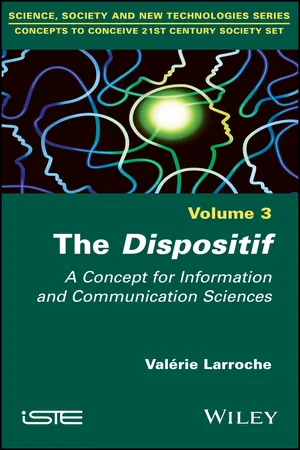
The notion of the dispositif (dispositive) is particularly relevant for understanding phenomena where one can observe the reproducibility of distributed technical activities, operational or discursive, between human and non-human actors.
This book reviews the concept of the dispositive through various disciplinary perspectives, analyzing in turn its technical, organizational and discursive dimensions. The relations of power and visibility enrich these discussions.
Regarding information and communication sciences, three main uses of this concept are presented, on the one hand to illustrate the heuristic scope of issues integrating the dispositive and, on the other hand, to demonstrate its unifying aspect in this disciplinary field. The first use concerns the complexity of media content production; the second relates to activity traces using the concept of the "secondary information dispositive"; finally, the third involves the use of the dispositive in contexts of digital participation.
- English
- ePUB (mobile friendly)
- Available on iOS & Android
eBook - ePub
About this book
Information
PART 1
Epistemological Foundations
Introduction to Part 1
As indicated in the general introduction, this first part helps us to understand the concept of the dispositive from its different aspects. Chapter 1 deals with technique, its relationship with humans, science and the notion of efficiency. Chapter 2 highlights the importance of the roles carried out by human actors and of the coordination activities to ensure a collective action within the dispositive. This action can also result from partnership-based configurations. Finally, Chapter 3 is dedicated to the place of discourse in the dispositive. Discourses and teleological documents circulating within operational devices are discussed. This last chapter also makes it possible to present dispositives whose purpose is to produce discourses made available to a public and those who facilitate the realization of collective representations, in particular those of power. Finally, the last dispositives studied move away from realization and have a heuristic aim. They make it possible to produce society models or better understand some social and psychoanalytic mechanisms.
1
Techne-Poiesis and the Dispositive
Technical actions take place in a dispositive, which we will detail in this chapter. Among these components are always found technical objects handled or conceptualized by humans. Jean-Pierre Meunier1 (1999) clearly conveys the pervasiveness of technique when one studies the dispositive: “At the center of the network corresponding to the concept of dispositive can surely be found meanings strongly implying technique […]”2 (p. 83). Expressions commonly used in the professional world such as mounting device, scenographic device, manufacturing device, etc., refer to hardware arrangements making possible the production of a product or object. A film is an object, or even an artwork produced by means of different devices, including the mounting device for example3. A car, décor, processed food, etc., are objects produced using a device. The latter is present whenever an object is reproduced in several copies.
Techne, from the Greek τέχνη, for the ancient Greeks referred to “production” or “physical manufacturing” and efficient action4. Techne-poiesis helps us to differentiate physical manufacturing from creative action5. The dispositive is a space implementing this relationship between techne and poiesis. The implementation of technical activities makes it possible to create artworks or perform repetitive operations. Some of these activities relate to art, and others relate to the technical or even industrial field. The proficiency of the cinematograph thus allows the production of a film (an artwork) and the assembly line of a car manufacturer the production of cars (a product).
In this chapter, we will discuss in the first part the timelines characterizing a dispositive, its reproducible and aesthetic aspect allowing us to revisit the definition of techne and its relationship with poiesis. The second part differentiates, on the one hand, technique, tool and instrument, and, on the other hand, dispositive and machine. It also introduces the notions of technical skill and arrangement, a consequence of the repetition of technical activities in a dispositive. In the last part, we compare the term technique with that of technology to discuss the scientific and efficient aspects of dispositives.
1.1. Timelines, reproducibility and technical action
We focus in this chapter on the technical aspect of a dispositive. This is why we have chosen to talk about its characteristics for a researcher–engineer, for whom “the technical issue comes down, in essence, to the dispositive issue”6 (Bachimont, 2004, p. 16)7. Timelines, the reproducibility of technical activities and their efficiency within a dispositive will be successively discussed.
1.1.1. Timelines within dispositives
To begin with, the first characteristic we wish to develop relates to timelines8 linked to a dispositive. The latter is defined as “a practical and spatial organizationable to produce and determine a future”9 (Bachimont, 2004, p. 16). This definition is linked to designers’ vision of the dispositive.
For this definition, the timeline is a defining feature of the dispositive whose function is “to convert a relationship with time into a relationship with space. Technique is, at this level, a de-temporalization of the future in order to spatialize it”10 (Bachimont, 2004, p. 18). To characterize this idea of space allocated to the dispositive, we borrow from Michel de Certeau11 his distinction between location and space. A location has an instantaneous configuration at a given time, where two elements are necessarily in well-defined positions. Space, on the other hand, takes into account the movement unfolding there, and Michel de Certeau (1990) refers to it as the “practiced location” (p. 173). The example of the street perfectly illustrates this distinction. The street becomes space because of walkers, while a street is geometrically defined by urban planners. By extension, it can be said that it is only during a theatrical performance that a theater becomes a space where the public and the actors act. Space, for Michel de Certeau (1990), integrates “the effect produced by the operations directing it, detailing it, temporalizing it, and leading it to function as versatile units of conflicting programs or contractual proximities”12 (p. 173). The street becomes space when the walker, the demonstrator, the seller, etc., occupy it. The dispositive, on the other hand, is defined as space, when users act to benefit from the service or to make it work, thus participating in a collective set where actions follow one another.
In the dispositive, the future becomes a modality of the present or, in other words, “the present makes the future available”13 (Bachimont, 2004, p. 18). A dispositive considers a depth of time, especially linked to the useful time to perform actions or facilitate the sequence of events. It models flows, since successive operations can be considered. The dispositive then reconciles the spatial and time dimensions. It is a space of possible futures. The dispositive is not just a simple arrangement observed at a given time, but an organized space where actions take place. An organization will be considered as a dispositive when it is animated by technical actions performed by machines or humans while respecting a sequence. In other words, actions influence and shape the dispositive. “The dispositive does not have the purity of structures14: its form is only the arrangement determined in space and time within which flows (forces) processed by it are balanced and stabilized”15 (Vouilloux, 2007, p. 157)16. Bernard Vouilloux17 illustrates this idea of flow within the dispositive when it justifies the success of the theatrical model in the criticism of dispositives:
“The theatrical dispositive provides a perfect legibility of two of the features thought to constitute notion, arrangement and technique, all occurring as if technique was the only force setting in motion the form of the arrangement”18 (p. 160).
In this quote, Bernard Vouilloux explains that the dispositive transforms the arrangement in space (here the décor, light, sound, etc.) when the play takes place and, more generally, when the action or event is effective within the dispositive.
The arrangement of the dispositive offers a potential and modalities for actions. We will be able to talk about a genuine dispositive when the latter is animated by the effect of the actions performed by humans and technical objects.
For Brigitte Albero19, who defines dispositives in the training sector, timelines are varied and strained. There are, of course, those of the actors – in her context, trainers and learners – who must deal with the contingencies linked to their activity and who modernize the dispositive. She adds to it “the time axis of the designers’ past experience, which led to the creation of the dispositive, as well as the projections and expectations directing its trajectory”20 (Albero, 2010, p. ...
Table of contents
- Cover
- Table of Contents
- Acknowledgments
- Preface
- Introduction
- PART 1: Epistemological Foundations
- PART 2: The Dispositive and ICS
- Conclusion
- References
- Index of Authors
- Index of Common Terms
- End User License Agreement
Trusted by 375,005 students
Access to over 1.5 million titles for a fair monthly price.
Study more efficiently using our study tools.
Frequently asked questions
Yes, you can cancel anytime from the Subscription tab in your account settings on the Perlego website. Your subscription will stay active until the end of your current billing period. Learn how to cancel your subscription
No, books cannot be downloaded as external files, such as PDFs, for use outside of Perlego. However, you can download books within the Perlego app for offline reading on mobile or tablet. Learn how to download books offline
Perlego offers two plans: Essential and Complete
- Essential is ideal for learners and professionals who enjoy exploring a wide range of subjects. Access the Essential Library with 800,000+ trusted titles and best-sellers across business, personal growth, and the humanities. Includes unlimited reading time and Standard Read Aloud voice.
- Complete: Perfect for advanced learners and researchers needing full, unrestricted access. Unlock 1.5M+ books across hundreds of subjects, including academic and specialized titles. The Complete Plan also includes advanced features like Premium Read Aloud and Research Assistant.
We are an online textbook subscription service, where you can get access to an entire online library for less than the price of a single book per month. With over 1.5 million books across 990+ topics, we’ve got you covered! Learn about our mission
Look out for the read-aloud symbol on your next book to see if you can listen to it. The read-aloud tool reads text aloud for you, highlighting the text as it is being read. You can pause it, speed it up and slow it down. Learn more about Read Aloud
Yes! You can use the Perlego app on both iOS and Android devices to read anytime, anywhere — even offline. Perfect for commutes or when you’re on the go.
Please note we cannot support devices running on iOS 13 and Android 7 or earlier. Learn more about using the app
Please note we cannot support devices running on iOS 13 and Android 7 or earlier. Learn more about using the app
Yes, you can access The Dispositif by Valerie Larroche in PDF and/or ePUB format, as well as other popular books in Languages & Linguistics & Communication Studies. We have over 1.5 million books available in our catalogue for you to explore.