The Director's Manual
eBook - ePub

The Director's Manual

A Framework for Board Governance

  1. English
  2. ePUB (mobile friendly)
  3. Available on iOS & Android
eBook - ePub

The Director's Manual

A Framework for Board Governance

About this book

Directors: Improve Board Performance

The Director's Manual: A Framework for Board Governance offers current and aspiring board members essential up-to-date governance guidance that blends rigorous research-based information with the wisdom found only through practical, direct experience. The book's flexible approach to solving governance issues reflects the authors' belief that no two boards and the cultural dynamics that drive them are the same. As such, the advice offered reflects recognizable leadership dynamics and real world, relevant organizational situations.

The book's two authors, Peter C. Browning, an experienced CEO and member of numerous boards and William L. Sparks, a respected organizational researcher, combine their individual experiences and talents to create a book that is both innovative and applicable to directors in any industry sector. Specific best practice guidance is designed to help board members and their directors understand the unique strengths and challenges of their own board while at the same time provide targeted information that drives needed improvements in board performance and efficiency. Specifically, this book will help board members:

  • Explore practical advice on key issues, including selection, meeting schedules, and director succession
  • Consider board performance from multiple perspectives, including cultural and group dynamics
  • Discover how to effectively manage classic problems that arise when making decisions as a group
  • Access a comprehensive set of assessment questions to test and reinforce your knowledge

The Director's Manual: A Framework for Board Governance offers practical advice to guide you as you lead your organization's board.
Frequently asked questions

Yes, you can cancel anytime from the Subscription tab in your account settings on the Perlego website. Your subscription will stay active until the end of your current billing period. Learn how to cancel your subscription.
No, books cannot be downloaded as external files, such as PDFs, for use outside of Perlego. However, you can download books within the Perlego app for offline reading on mobile or tablet. Learn more here.
Perlego offers two plans: Essential and Complete
  • Essential is ideal for learners and professionals who enjoy exploring a wide range of subjects. Access the Essential Library with 800,000+ trusted titles and best-sellers across business, personal growth, and the humanities. Includes unlimited reading time and Standard Read Aloud voice.
  • Complete: Perfect for advanced learners and researchers needing full, unrestricted access. Unlock 1.4M+ books across hundreds of subjects, including academic and specialized titles. The Complete Plan also includes advanced features like Premium Read Aloud and Research Assistant.
Both plans are available with monthly, semester, or annual billing cycles.
We are an online textbook subscription service, where you can get access to an entire online library for less than the price of a single book per month. With over 1 million books across 1000+ topics, we’ve got you covered! Learn more here.
Look out for the read-aloud symbol on your next book to see if you can listen to it. The read-aloud tool reads text aloud for you, highlighting the text as it is being read. You can pause it, speed it up and slow it down. Learn more here.
Yes! You can use the Perlego app on both iOS or Android devices to read anytime, anywhere — even offline. Perfect for commutes or when you’re on the go.
Please note we cannot support devices running on iOS 13 and Android 7 or earlier. Learn more about using the app.
Yes, you can access The Director's Manual by Peter C. Browning,William L. Sparks in PDF and/or ePUB format, as well as other popular books in Business & Leadership. We have over one million books available in our catalogue for you to explore.

Information

Publisher
Wiley
Year
2016
Print ISBN
9781119133360
eBook ISBN
9781119133384
Edition
1
Subtopic
Leadership

Chapter 1
The Changing World of Board Governance
How We Got Here

  • How and Why Boards Have Changed
  • A Barometer for CEO Compensation
  • Why Pay Ratios Have Changed Radically
  • A Board Governance Tipping Point
  • Impact of the 2008 Financial Meltdown
  • Chapter Summary and What's Next
One of the principle tenets of our consulting work is that every board is operationally and culturally unique. It is this simple fact that makes constructing a single, all-inclusive set of board governance best practices an impossible task. Therefore, the guidance in this book is not positioned as a set of ā€œhard and fastā€ rules or universally applied ā€œmust haveā€ characteristics. Rather, the guidance is based on a flexible framework approach that allows boards to meet their fiduciary and governance duties while remaining responsive to the real cultural dynamics that directly influence the quality and consistency of decision making.
A framework approach also has a second advantage: it allows boards to respond appropriately to an ever-changing external socioeconomic and political landscape. This is an important point, since society's swiftly moving cultural currents, along with the ebb and flow of an economy's strength, has a profound impact on the performance expectations of corporate boards. Of course, this is no grand revelation to anyone reading this book, but we believe these concepts are important to keep in mind as context for the board governance recommendations made in the pages that follow.

How and Why Boards Have Changed

If you were asked to make a list of the most important game-changing events or trends that have profoundly impacted the U.S. economy and culture in the last sixty-five years, the list that you would make would likely include at least the following:
  • A move away from a manufacturing economy to a service economy following decades of dominance in the post–Second World War global economy.
  • Improvements in automation and the manufacturing process of the 1970s and 1980s. It was a trend that further undermined the manufacturing sector over the years as computer-driven machinery and tools (robotics, CAD-CAM design tools, etc.) replaced individual workers. Global competition also slowly eroded the U.S. manufacturing base as more and more manufacturing jobs moved to countries outside U.S. borders with lower labor costs.
  • The diminishing influence and power of organized labor's ability to guarantee members a lifetime of a steady, living wage and a fully funded, secure pension upon retirement.
  • The ā€œcreative destructionā€ of industries in the 1980s brought about by the world of leveraged buyouts and a ruthless cadre of ā€œcorporate raidersā€ who broke up many marquee old-line companies and sold off the divisions to score huge profits for themselves.
  • The dot-com bubble that began its rise in the early 1990s and continued throughout the decade until it popped, to a devastating effect, in 2001. Investment strategy at the time was a race toward unrealistic valuation. Investors were willing to fund nearly any technological start-up venture even if it lacked a viable business plan. It is interesting to note that this investment setback did little to cloud the financial community's continued unrealistic economic outlook. In fact, this unsound enthusiasm in the marketplace was encouraged in large part by favorable economic policies of the federal government, supported by a period of low inflation due largely to lower cost of goods from China and a continuing worldwide technological revolution.
  • The impact of blatant corporate malfeasance in 2001, exemplified by three highly visible corporations at the time: WorldCom, Enron, and Tyco. It was a revelation that rocked both the investment community and individual stockholders. Again, high-flying investors and shareholders lost millions of dollars when these companies declared bankruptcy (Enron Corporation declared bankruptcy in December of 2001), a singular action that further exposed an underbelly of lies and deceit that had pervaded these organizations at the very top and eventually put thousands of ordinary workers out on the street without jobs or their life savings.
  • Finally, the 2008 huge financial meltdown and the economic panic that followed. It was a time of fear and shock as we watched once powerful brokerage houses as well as large banks and old-line industrial giants teeter on the brink of declaring bankruptcy. It took massive, last-minute, stopgap federal cash infusions to save the world's economy and to shore up institutions that were deemed ā€œtoo big to fail.ā€

Why These Events are Important

The reason for noting these historical and societal events is twofold. First, it demonstrates how past events impact the current expectations placed on corporate boards; and second, it establishes the contextual ā€œwatersā€ for the operational strategies, policies, and procedures that most boards follow today. This chapter will focus on two specific trends that grew out of these economic and social gyrations:
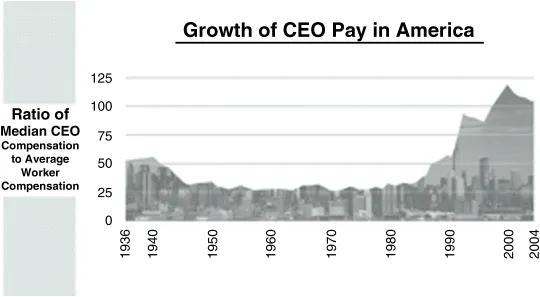
  • Ever-increasing chief executive officer (CEO) compensation (see Figure 1.1).
  • The impact of a 2002 change to the New York Stock Exchange (NYSE) Listed Company Manual that required ā€œnon-management directors to meet at regularly scheduled executive sessions without management.ā€ While this change to the NYSE Listed Company Manual (303A.03) occurred during the same time period as the passage of the 2002 Sarbanes-Oxley Act (Congress's response to public outrage over Enron's corporate malfeasance and greed), the fact that the two actions occurred at the same time is a coincidence of timing. The fact is, as important as the Sarbanes-Oxley legislation has been to curbing illegal corporate activities, we would argue that the NYSE Listed Company Manual change has ultimately produced the most far-reaching impact on board governance, performance, and effectiveness.
Graphical representation of history of CEO pay. The ratio of median CEO compensation to average worker compensation is plotted on the y-axis. The scale ranges from 0 to 125. The year is plotted on the x-axis. The scale ranges from 1936 to 2004. The plot depicts that from 1990 onward there has been a significant increase in the CEO pay.
Figure 1.1 History of CEO Pay
Source: Peter Browning Partners

A Barometer for CEO Compensation

According to Carola Frydman and Raven E. Saks, authors of ā€œHistorical Trends in Executive Compensation 1936–2003,ā€ CEO compensation experienced three distinct phases over the last seventy-five years: World War II, the mid-1940s to the 1970s, and the 1980s through the 1990s.1
Prior to World War II, the median executive compensation was about fifty-six times higher than average wages, although CEO compensation did decline sharply during World War II. After the war the U.S. economy experienced a period of unfettered growth and development. This expansion created a rapidly growing middle class that was confident about lifelong careers with the same company, steadily rising wages, and opportunities for career advancement. All of this confidence brought with it a predictable stream of disposable cash to buy American products.
Interestingly, executive salaries during this period of expansion remained relatively low and, in fact, slowly fell until 1970, when they reached a low point of twenty-five times average wages. During this period organizations promoted their most senior and capable executives to the CEO spot and then compensated them with a salary, cash bonuses, and limited stock options. As a rule, these groomed CEOs kept their jobs until retirement.

Global Competition Brings Change

Global competition in the 1970s imposed new economic pressures on corporate America. Nations previously ravaged by war, especially Japan, took full advantage of industrial redevelopment support from the United States. Soon these countries began to compete directly with their benefactor, especially in the car and consumer electronics markets. This competition resulted in the closing of many U.S. manufacturing plants, and once thriving towns, cities, and communities, and even whole regions, were economically decimated. All of this upheaval and uncertainty in the manufacturing sector from mid-1970 to the end of the 1980s resulted in a 2,000 percent increase in merger and acquisition activity (as compared to previous years) as companies struggled to keep control of their organizations and to avoid the ravages of a hostile corporate takeover (Gladwell, 2009).2

The Impact of Strategic Planning

Beginning in the early 1980s, CEO compensation policy began to radically change as U.S. corporations switched their focus to long-term strategic planning models and away from more traditional, short-term business planning approaches. This was a change in thinking that directly impacted corporate board management and its priorities.
A key proponent of this long-term strategic planning approach was Bruce Doolin Henderson, who in 1963 founded the Boston Consulting Group. Corporate leaders, including General Electric's CEO Jack Welch, became disciples of the approach in the early 1980s, as did many university business schools and scores of consultants who were eager for the business opportunity created by Henderson's ideas.
In his 2010 book, The Lords of Strategy: The Secret Intellectual History of the New Corporate World, which is about Henderson's influence on business practices worldwide, author Walter Kiechel notes that Henderson literally ā€œchanged the world.ā€ ā€œFew people,ā€ Kiechel says, ā€œhave had as much impact on international business in the second half of the twent...

Table of contents

  1. Cover
  2. Title Page
  3. Copyright
  4. Acknowledgments
  5. Preface
  6. Chapter 1: The Changing World of Board Governance: How We Got Here
  7. Chapter 2: Role of the Board
  8. Chapter 3: Key Board Leadership Roles
  9. Chapter 4: Board Culture
  10. Chapter 5: Group Dynamics and Board Decision Making
  11. Chapter 6: Board Structure and Schedule
  12. Chapter 7: Assessing Board Performance
  13. Chapter 8: The Challenge of The Disruptive Director
  14. Chapter 9: The Other Succession Challenge: The Board of Directors
  15. Chapter 10: What's Next in the Boardroom?
  16. Appendices: Board of Directors Assessment Forms
  17. About the Authors
  18. Index
  19. End User License Agreement