An authoritative guide to new product development for early career engineers and engineering students
Managing Technology and Product Development Programmes provides a clear framework and essential guide for understanding how research ideas and new technologies are developed into reliable products which can sold successfully in the private or business marketplace. Drawing on the author's practical experience in a variety of engineering industries, this important book fills a gap in the product development literature. It links back into the engineering processes that drives the actual creation of products and represents the practical realisation of innovation.
Comprehensive in scope, the book reviews all elements of new product development. The topics discussed range from the economics of new product development, the quality processes, prototype development, manufacturing processes, determining customer needs, value proposition and testing. Whilst the book is designed with an emphasis on engineered products, the principles can be applied to other fields as well. This important resource:
Takes a holistic approach to new product development
Links technology and product development to business needs
Structures technology and product development from the basic idea to the completed off-the-shelf product
Explores the broad range of skills and the technical expertise needed when developing new products
Details the various levels of new technologies and products and how to track where they are in the development cycle
Written for engineers and students in engineering, as well as a more experienced audience, and for those funding technology development, Managing Technology and Product Development Programmes offers a thorough understanding of the skills and information engineers need in order to successfully convert ideas and technologies into products that are fit for the marketplace.
Most aspiring engineers would like to see their name attached to a product, such as a car or plane, or a structure, such as a building or bridge – they want to make their mark. In the early stages of their careers, their contribution might just be a minor element of the whole; later, they would hope to take the lead, possibly even emulating Isambard Kingdom Brunel, Sir Frank Whittle, or Steve Jobs. But how does a product get from the glimmer of an idea to the finished item?
This book is concerned with the way that new research and technology ideas are converted into products that can be manufactured and sold to satisfied customers. Its emphasis is on engineered products but the principles can be applied more widely. It might be thought that this subject would already have extensive coverage, given that engineering has been taught in European countries as a degree‐level subject for over 200 years.
École Polytechnique in Paris, for example, was set up in 1794 specifically to address, amongst other things, the dearth of qualified engineers at that time (Ref. 1). The University of Glasgow was the first in the United Kingdom to set up a school of engineering with the appointment of Lewis Gordon (1815–1876) as Regius Professor of Civil Engineering and Mechanics at the University. He was in the post from 1840 until 1855, when he resigned to pursue his successful business interests – thus providing an early demonstration of the economic value of engineering (Ref. 2).
Engineering has been taught in Cambridge, where the author studied, since 1875, albeit sometimes using a different title such as ‘mechanical sciences’. But for some 100 years beforehand, ‘real and useful knowledge’ was taught as an extension of mathematics and covering such topics as steam engines and mechanisms (Ref. 3).
The content of such academically demanding courses has been biased towards the science of engineering, with an emphasis on mathematical analysis, although more practical and applied skills have also been covered through laboratory work, as well as through design and build projects. Those interested in the business aspects of engineering can then go on to acquire formal qualifications in this area, such as an MBA. This is a well‐trodden path for those wishing to pursue a managerial career in the engineering business.
However, there has been relatively little coverage of the processes by which engineering products are created and developed. These processes use the design, analysis, and other skills that are taught academically. However, the means by which a technology is turned into a design through to its being launched as a, hopefully, reliable product to a discerning public is something that a new engineer has to work out for him or herself – a process that can often take a full decade of puzzlement if the environment is complicated.
The management thinker Peter Drucker drew attention to this topic in a 1985 essay in which he stated: ‘We know how to train people to do technology such as engineering or chemistry. But we do not know how to endow managers with technological literacy, that is, with an understanding of technology and its dynamics…Yet technological literacy is increasingly a major requirement for managers….’
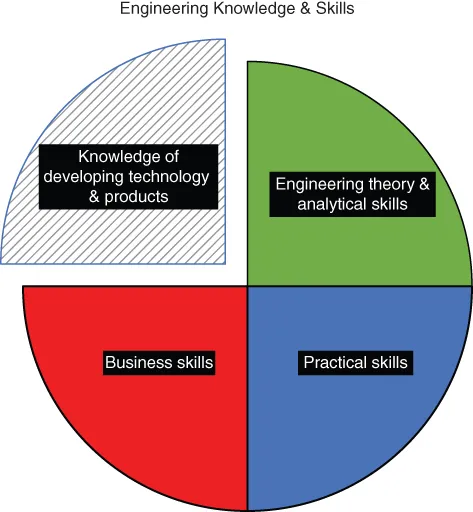
The purpose of this book, then, is to help fill this gap, as illustrated in Figure 1.1, by providing a framework that can be used to describe how new technologies, and then products, are created.
Figure 1.1 Context of the material in this book.
The word framework is used advisedly. It would be wrong to suggest that there is a universal, reliable, and prescriptive set of rules for developing technology; it is a far more hit‐and‐miss process, as will be described later. However, there are principles and approaches that can make the process more efficient and that engineers typically learn by trial and error.
1.2 Importance of the Product Development Process
There is widespread interest in this topic, and in innovation more widely, in business schools and similar organisations (Ref. 4). Their work has shown a clear link between the effectiveness of companies' product development processes and the overall performance of those companies. A number of large‐scale academic studies support these conclusions, and this has led to the considerable interest in the topic of innovation, which, as an academic topic, has been widely researched but essentially from a business, financial, and marketing perspective. Quite rightly, organisations are continually exhorted to ‘innovate or die!’
However, these studies rarely link back into the engineering processes that drive the actual creation of the products and that represent the practical realisation of innovation.
Hence, there is a strong business incentive for companies to become more proficient in renewing their products or services. The recognition that successful products achieve then provides an incentive to well‐rounded engineers making their vital contribution to this topic.
In terms of written material to support the development of proficiency, there is a significant body of literature on single topics within the product renewal process. For example, there are weighty books on risk management, design for manufacture, engineering analysis, and project management, to name but a few. However, there is little tying these topics together. The purpose of this book is to fill that void.
1.3 Perspective of This Book
Given this background and these early references to engineering topics, this book examines the processes for developing new products and technologies from an engineering perspective. It is based on the author's 45–50 years of practical experience in engineering industries, including aerospace, automotive, rail, and some process industries. Whilst the emphasis is based on practical experience, and hence what works, there is considerable academic underpinning to the approaches suggested, and this is referenced whenever possible. The book should not, however, be regarded as ‘research‐based’; it is ‘experience based’, if such a category exists, derived from participation rather than observation.
A strong thread permeating the book is the linkage between those engineering processes and the wider performance of the business. The point is frequently made that technology is only worth developing if it can be put to practical use. It must be deployed in the form of products or services bought by paying customers at a price which is economically sustainable for it to be of any useful interest. The book will help engineers to understand how their contribution fits into the wider context of the business.
1.4 Intended Readership
This book addresses the topics above and is aimed at those who are still trying to understand the processes for turning science into technology and then into products. The readership could include:
Engineers in their final stage of university education, perhaps undertaking final year, capstone projects, or MSc programmes
Technologists or engineers in the early stages of their careers, particularly those working in industry on technology and product development
Technology researchers who would like to understand more about the means by which their research work could eventually lead to commercial products
Business school researchers who are working in the field of innovation
Commercial managers, finance managers, and business people whose work involves managing, funding, or approving technology development but who do not necessarily have a direct involvement or direct experience
Investors who might be asked to fund technology‐based ventures
Seasoned engineers and engineering managers, who will recognise most of the material in this book but who might find its content brings further structure to their thoughts
The language of the book is, of necessity, somewhat technical, as it is impossible to describe engineering processes without using some technical language. However, it is intended to be straightforward and easily understood – there is no arcane language, and there are no formulae!
1.5 Science, Technology, Innovation, Engineering, and Product Development
Some definitions are appropriate ...
Table of contents
Cover
Table of Contents
About the Author
1 Introduction
2 Engineering as a Process
3 Evaluating the Maturity of Developing Technology
4 Aligning Technology Development with Business and Manufacturing Strategy
5 Planning and Managing the Work
6 Developing the Concept
7 Identifying and Managing Engineering Risks
8 Validation by Modelling and Physical Testing
9 Engineering Delivery
10 Funding the Programme
11 Running Teams and Working with Partners
12 Decision‐Making and Problem Solving
13 Improving Product Development Performance
14 Summary, Concluding Points, and Recommendations
15 Future Direction
Final Thoughts
Appendix A: TRL and MRL Definitions
Appendix B: Toyota Product Development System 13 Principles and Their Cross‐Referencing
Glossary of Terms
Index
End User License Agreement
Trusted by 375,005 students
Access to over 1.5 million titles for a fair monthly price.
Study more efficiently using our study tools.
Frequently asked questions
Yes, you can cancel anytime from the Subscription tab in your account settings on the Perlego website. Your subscription will stay active until the end of your current billing period. Learn how to cancel your subscription
No, books cannot be downloaded as external files, such as PDFs, for use outside of Perlego. However, you can download books within the Perlego app for offline reading on mobile or tablet. Learn how to download books offline
Perlego offers two plans: Essential and Complete
Essential is ideal for learners and professionals who enjoy exploring a wide range of subjects. Access the Essential Library with 800,000+ trusted titles and best-sellers across business, personal growth, and the humanities. Includes unlimited reading time and Standard Read Aloud voice.
Complete: Perfect for advanced learners and researchers needing full, unrestricted access. Unlock 1.5M+ books across hundreds of subjects, including academic and specialized titles. The Complete Plan also includes advanced features like Premium Read Aloud and Research Assistant.
Both plans are available with monthly, semester, or annual billing cycles.
We are an online textbook subscription service, where you can get access to an entire online library for less than the price of a single book per month. With over 1.5 million books across 990+ topics, we’ve got you covered! Learn about our mission
Look out for the read-aloud symbol on your next book to see if you can listen to it. The read-aloud tool reads text aloud for you, highlighting the text as it is being read. You can pause it, speed it up and slow it down. Learn more about Read Aloud
Yes! You can use the Perlego app on both iOS and Android devices to read anytime, anywhere — even offline. Perfect for commutes or when you’re on the go. Please note we cannot support devices running on iOS 13 and Android 7 or earlier. Learn more about using the app
Yes, you can access Managing Technology and Product Development Programmes by Peter Flinn in PDF and/or ePUB format, as well as other popular books in Technology & Engineering & Technology & Engineering Research & Skills. We have over 1.5 million books available in our catalogue for you to explore.