- Presents the results of an innovative ten-year project initiated the World Council of Churches
- Features contributions from religious scholars and leaders of Buddhist, Christian, Hindu, Jewish, and Muslim traditions
- Considers myriad issues relating to the nature, methods, and effects of religious conversion in the major world faiths
- Addresses questions on religious freedom, legal considerations, and the future for religious conversion
- English
- ePUB (mobile friendly)
- Available on iOS & Android
eBook - ePub
About this book
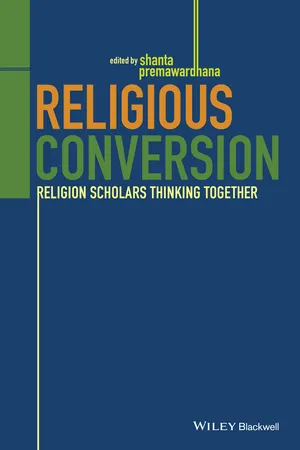
Religious Conversion: Religion Scholars Thinking Together explores various issues relating to the nature, methods, and effects of religious conversion in the major world faiths.
Information
Part I
Preliminary Considerations
1
Thinking Together
A Story and a Method
M. Thomas Thangaraj
What is the next stage in our journey of interreligious dialogue and cooperation? In other words, while we have been engaged in constructing and articulating a theology of and for interreligious dialogue, what would our own theologies look like if our experiences of dialogue were brought right into the very process of theologizing?1 This is what many who were participating in the programs of the Office of Interreligious Relations at the World Council of Churches (WCC) or in events and ventures in their own local settings were asking. In the early years of WCC’s involvement in interreligious dialogue, the focus was on discovering a biblical or theological warrant for such interreligious engagement. This was rightly called a theology for dialogue. The next stage was viewing dialogue as a theological issue in order to reflect on it and to articulate a theology of dialogue. So the question now was to reconstruct one’s own theology in light of and in the process of engaging in active interreligious dialogue. Could this be the next stage in our journey of interfaith relations?
Interestingly, this initiative by the WCC coincided with the challenges faced by theologians and thinkers in various religious traditions in different parts of the world who themselves were actively involved in interreligious conversations. They were asking themselves more and more the following question: Why is it that my own theological thinking is always done in my solitude, in the privacy of my study, or in consultation with theologians of my own religious community, and without the physical presence of all my interreligious conversation partners, while my life is lived out in lively interfaith relations and dialogical engagements? The Christian theologians in the academy began to address this question with utmost seriousness. The emergence of a discipline, called Comparative Theology, is a result of this ferment. Francis Clooney is one of the pioneers in the development of this discipline.2 Several others have also worked along these lines in constructing their theologies in conversation with other religious traditions. As John Thattamanil, a comparative theologian, writes:
Comparative theology is conversational theology. Such theology goes beyond taking an inventory of other people’s convictions for the sake of specifically Western intellectual projects like comparative religion or ethnography. Comparative theology takes the content of other people’s ideas seriously, seriously enough to be changed by those ideas. Comparative theology, as a work of Christian faith, strives mightily to avoid bearing false witness against our neighbors. We do this by entering into dialogue with them in a common inquiry about ultimate matters.3
Comparative theology is by no means peculiar to Christian theological enterprise alone. For example, some members of the Thinking Together group have been involved in such comparative thinking for some time. Rita Gross has been involved in comparative “theological” thinking for years, Rambachan’s writings clearly exhibit a comparative character, and so do Rashied Omar’s.
Thinking Together: Our Story
Once this ferment was discovered, it became clear to Dr. Hans Ucko, the Director of the Office of Interreligious Relations, that such a move involved constructing one’s own religious or theological thinking in the presence or in the company of thinkers and theologians belonging to religious traditions other than one’s own. With this in mind, a group was invited to think together, and, as the group began to meet yearly, it took “Thinking Together” as its name. The mandate for this group of 12–15 theologians/thinkers from five different religious traditions, such as Buddhism, Christianity, Hinduism, Islam, and Judaism, was to engage in thinking and articulating their own religious tradition in the presence of others. The group met for the first time in Bossey, Switzerland to address the question: What difference does religious plurality make for my thinking and my theology?
Over the years the composition of the group changed because some of the invitees left the group due to personal and professional reasons. While some found this method of thinking together unsuitable for their own theological/religious thinking, others were unable to devote the amount of time and the kind of energy this process demanded. New members were invited to take their places. The group was saddened to lose Professor Tikva Frymer-Kensky, who taught Hebrew Bible and the History of Judaism at University of Chicago Divinity School. She passed away in 2006 after a four-year battle against breast cancer. She made a lasting impression on the members of the group through her insightful contribution toward our thinking together.
The current group, which has been responsible for this volume on religious conversion, consists of Vinu, a medical doctor who works among the poor in South India; Mahinda, a Buddhist monk from Sri Lanka, and Parichart, a Buddhist lay woman from Thailand, both of whom are professors in universities in England and Thailand respectively; Rita, a Buddhist teacher and professor from Wisconsin, USA; Debbie, an Orthodox Jewish educator in Israel; Amy, a rabbi from Minnesota, USA; Anant, a Hindu from Trinidad who teaches religion in St. Olaf’s College in Minnesota, USA; Thomas, a Christian theologian from India who taught World Christianity in Atlanta, USA; Rashied, an imam and professor from South Africa; Rabia, a Muslim educator from the USA; Jay, a Presbyterian church leader in the USA; Hans, the former Director of the Office of Interreligious Relations, WCC, Geneva; Ravin, a Hindu who is a specialist in medicine and an advocate in South Africa; Wesley, a veteran in interfaith dialogue who had served as the Director of the Office of Interreligious Relations of the WCC for many years and currently teaches theology at Drew University School of Theology in the USA; and Shanta, a Christian theologian from Sri Lanka and the USA, who succeeded Hans Ucko as the Director of the program.
The tragedy of September 11, 2001 brought a sense of urgency and seriousness to the group as it met in St. Petersburg, Florida in January 2002. Engaging the theme of religion and violence, the group moved to think together on how each religious tradition viewed the “other” or the “outsider,” during the years 2003 and 2004.4 The discussion on “the other,” was crystallized in a book, entitled Faces of the Other: A Contribution by the Group – Thinking Together.5 Two conferences that took place in Geneva in 2005 – Critical Moment in Interfaith Dialogue and Interfaith Youth Event – brought to the forefront the issue of religious conversion as the next agenda for Thinking Together. That interest coincided with what was happening in India and Sri Lanka with regard to the legitimacy and the legality of religious activities that aim at converting the other.6 The group met in 2006 at Shanti Ashram in Coimbatore, India to begin its thinking on religious conversion, and it continued its wrestling with the issue through 2007 and 2008. What is found in this book is the result of three years of thinking together as Buddhists, Christians, Hindus, Jews, and Muslims on religious conversion.
There has been a great sense of excitement about this process of thinking together among the members of the group. We always looked forward to every meeting with great expectation and enthusiasm. There were several factors that helped the success of this group to think together, as I discuss below.
Freedom from constraints
The group is indebted to WCC whose generous funding made this process possible. Without this, theologians and thinkers from different parts of the world representing five different religions could not have met year after year like this. Therefore, the group experienced great freedom from financial restraints. Further, under the leadership of Hans Ucko, the WCC gave us utmost freedom to shape the direction and dynamics of this process. We were never compelled or constrained to come up with a particular product or result. WCC took the risk of letting the process discover and gain its own direction. The participants experienced a safe space and a holding environment within which one could think boldly together. This was possible because we met for several years and came to know each other as fellow travelers on the path of religious life. Another source of freedom was that none of us in the group were chosen as “official representatives” of our religious traditions. Our accountability was to one another, even though we were quite conscious of our commitment and responsibility to our own religious communities. Therefore, religions were not in conversation; but practitioners and thinkers of various traditions were. It was not a dialogue among systems and institutions, but rather an encounter of minds, a dialogue of hearts, and a conversation of souls with an experience of true religious freedom.
Celebration of diversity
Even though most of the participants held jobs in the United States of America during this period, the group did represent significant geographical diversity – hailing from India, Sri Lanka, Trinidad, South Africa, Thailand, Israel, Sweden, and the USA. The group was intentionally inclusive with regard to gender, unlike many interreligious dialogue activities that tend to be dominated by men. Our meetings were held in English even though for most of us English is our second language and not our mother tongue. This meant that we spoke English each in our own peculiar ways. Vocationally, we had differences too, even though most of us were educators of one kind or another. Some were ordained leaders in their religious traditions such as Amy, a rabbi, Rashied, an imam, Wesley, a Christian minister, and Rita, a recognized Buddhist mentor. The coming together of lay and ordained made our diversity richer and more valuable it than otherwise would have been. Diversity was not simply something we brought to the group but something we discovered in the very process of thinking together. The national and political backgrounds from which we came were diverse as well: India, the largest democracy, America the most powerful nation, South Africa, a community in transformation with a history of religious and political persecution, Israel with all its political and religious challenges, Sri Lanka with its ethnic conflicts, and so on. As a policy we made sure that there were at least two persons from each religious tradition so that we could appreciate the intra-religious diversity. The recognition of similarities in our commitments and intentions often led to the epiphany of our differences. We stood amazed at how much together we could be in the midst of this rich variety of religions commitments!
Exploring common concerns
One of the strengths of our thinking together was that the agenda was not set by someone outside the group; the agenda grew out of our recognizing common concerns that affect each and every one of us in the group and our religious communities. Of course, the first two sessions did have themes that were suggested by Hans Ucko. It was not just a particular religion’s problem that we were going to think about; rather we were focusing on matters that affected all of us, though in various forms and at various times. Violence attributed to religion was indeed one such issue that gripped us all following the horrific event of September 11, 2001. In addressing this issue, we discovered another common concern. We together recognized that our perception of the other often led to violence and so we focused on how each of our religious traditions viewed the outsider. The interreligious conflicts in India, Sri Lanka, and elsewhere triggered by the issue religious conversion became our common con...
Table of contents
- Cover
- Title page
- Table of Contents
- Notes on Contributors
- Introduction
- Part I: Preliminary Considerations
- Part II: Views from Five Religious Traditions
- Part III: Conversion and Human Rights
- Part IV: Looking to the Future
- Index
- End User License Agreement
Trusted by 375,005 students
Access to over 1.5 million titles for a fair monthly price.
Study more efficiently using our study tools.
Frequently asked questions
Yes, you can cancel anytime from the Subscription tab in your account settings on the Perlego website. Your subscription will stay active until the end of your current billing period. Learn how to cancel your subscription
No, books cannot be downloaded as external files, such as PDFs, for use outside of Perlego. However, you can download books within the Perlego app for offline reading on mobile or tablet. Learn how to download books offline
Perlego offers two plans: Essential and Complete
- Essential is ideal for learners and professionals who enjoy exploring a wide range of subjects. Access the Essential Library with 800,000+ trusted titles and best-sellers across business, personal growth, and the humanities. Includes unlimited reading time and Standard Read Aloud voice.
- Complete: Perfect for advanced learners and researchers needing full, unrestricted access. Unlock 1.5M+ books across hundreds of subjects, including academic and specialized titles. The Complete Plan also includes advanced features like Premium Read Aloud and Research Assistant.
We are an online textbook subscription service, where you can get access to an entire online library for less than the price of a single book per month. With over 1.5 million books across 990+ topics, we’ve got you covered! Learn about our mission
Look out for the read-aloud symbol on your next book to see if you can listen to it. The read-aloud tool reads text aloud for you, highlighting the text as it is being read. You can pause it, speed it up and slow it down. Learn more about Read Aloud
Yes! You can use the Perlego app on both iOS and Android devices to read anytime, anywhere — even offline. Perfect for commutes or when you’re on the go.
Please note we cannot support devices running on iOS 13 and Android 7 or earlier. Learn more about using the app
Please note we cannot support devices running on iOS 13 and Android 7 or earlier. Learn more about using the app
Yes, you can access Religious Conversion by Shanta Premawardhana in PDF and/or ePUB format, as well as other popular books in Theology & Religion & Religion. We have over 1.5 million books available in our catalogue for you to explore.