Business Chemistry: How to Build and Sustain Thriving Businesses in the Chemical Industry is a concise text aimed at chemists, other natural scientists, and engineers who want to develop essential management skills. Written in an accessible style with the needs of managers in mind, this book provides an introduction to essential management theory, models, and practical tools relevant to the chemical industry and associated branches such as pharmaceuticals and consumer goods. Drawing on first-hand management experience and in-depth research projects, the authors of this book outline the key topics to build and sustain businesses in the chemical industry. The book addresses important topics such as strategy and new business development, describes global trends that shape chemical companies, and looks at recent issues such as business model innovation.
Features of this practitioner-oriented book include:
Eight chapters covering all the management topics relevant to chemists, other natural scientists and engineers.
Chapters co-authored by experienced practitioners from companies such as Altana, A.T. Kearney, and Evonik Industries.
Featured examples and cases from the chemical industry and associated branches throughout chapters to illustrate the practical relevance of the topics covered.
Contemporary issues such as business model design, customer and supplier integration, and business co-operation.
1 Management Challenges in the Chemical and Pharmaceutical Industry by Jens Leker and Hannes Utikal
2 Principles of Strategy: How to Develop Strategy by Jens Leker and Tobias Lewe
3 Strategic Analysis: Understanding the Strategic Environment of the Firm by Jens Leker and Manuel Bauer
4 Management of Business Cooperation by Theresia Theurl and Eric Meyer
1 Management Challenges in the Chemical and Pharmaceutical Industry
Jens Leker1 and Hannes Utikal2
1University of Münster, Department of Chemistry and Pharmacy
2Provadis School of International Management and Technology AG
For time and the world do not stand still. Change is the law of life. And those who look only to the past or the present are certain to miss the future.
John F. Kennedy (1917–1963), 35th President of the United States of America
The first chapter of this book outlines the specific characteristics of the chemical and pharmaceutical industry regarding, for example, products, site locations, competition, and research efforts. Additionally, the chapter summarizes results of a survey in the German chemical and pharmaceutical industry on business transformation processes and drivers of change that affect the industry. From these findings, management challenges and solutions to these problems will be derived.
1.1 Introducing the Chemical Industry as a Source of Innovation and Prosperity
The chemical industry is one of the major global industries affecting all parts of human life. Advances in chemicals and pharmaceuticals have contributed to improving living conditions and particularly nutrition and health levels worldwide. Enhancements in the field of automobiles as well as new developments concerning battery electric or fuel cell vehicles have resulted, not least because of new materials and new formulations originating from the chemical industry. New electronic devices such as smartphones have only been possible due to a change of pace in the development of electronic materials and an increase in their purity. Continuous research for and production of active pharmaceutical ingredients (APIs) are of central importance for fighting (new) diseases and improving therapeutic methods.
The chemical and pharmaceutical industry alters modern life through the transformation of scientific findings into marketable products. The invention and industrialization of production pathways such as the Haber(–Bosch) process for ammonia synthesis, the Fischer–Tropsch process to produce liquid hydrocarbons, or the contact process for producing sulfuric acid laid the foundations of the chemical industry. These processes acted as prerequisites for overall industry growth, technological change and wealth creation, whereby the underlying reaction pathways still apply today. Enormous advancements in technology in recent years have additionally enabled the sector to have an economically, ecologically, and socially positive impact on society in the future as well as today. In order to continue to achieve this goal, the chemical industry is reconsidering its modes of operation and finds itself in a phase of transformation [1].
From an economic perspective, the crucial role of the chemical industry for different customer value chains and the connection to nearly every end‐consumer market is reflected by the impressive size of world chemicals sales in 2013 of €3156 billion and the average global growth rate slightly above the global gross domestic product (GDP) [2]. It has to be considered that this overall development is mainly driven by high growth rates in the Asian–Pacific region, eventually compensating for lower growth rates in Western countries. Asia has already become the largest market for chemicals, with now more than 50% of the global market. This share is very likely to increase even more due to the growing population in Asia and the declining demand in the West, especially in Europe.
All these facets and volatilities make the chemical industry one of the most fascinating industries, not only from a scientific, technological or societal perspective, but also from a business point of view. In the following, we first characterize this highly interesting industry with regard to its specific characteristics and then subsequently highlight current managerial challenges relevant to the industry. In order to do so, we combine results from a literature review with findings from one of our own empirical studies on the management challenges in the chemical industry.
1.2 Characteristics of the Chemical and Pharmaceutical Industry
The chemical industry today is one of the largest industries in the world, with an impressive history (see, e.g., [1, 3]). This is reflected by the variety of products, processes, and market characteristics.
1.2.1 Product and Process Characteristics
The chemical industry is a process industry where firms “add value to materials by mixing, separating, forming, or chemical reactions” [4: 28]. Process industries differ from so‐called discrete industries with regard to the production process. In discrete industries, for example the automotive or engineering industry, production pathways converge as final products are assembled by using multiple discrete input components [5]. In contrast, a product in the chemical industry can simultaneously act as an intermediate, be processed further to synthesize other products, or serve as a finished, salable product. Production processes can therefore be convergent and divergent at the same time, resulting in an increased complexity for the planning and optimizing of such processes. In each process, components are mixed and react under well‐defined physical conditions. In order to obtain high reaction yields, chemical companies rely on experience and knowledge from different fields, especially chemistry and engineering, and in some cases biology and biotechnology. Hence, the special nature of the highly complex processes sets the framework for all managerial decisions in the chemical industry.
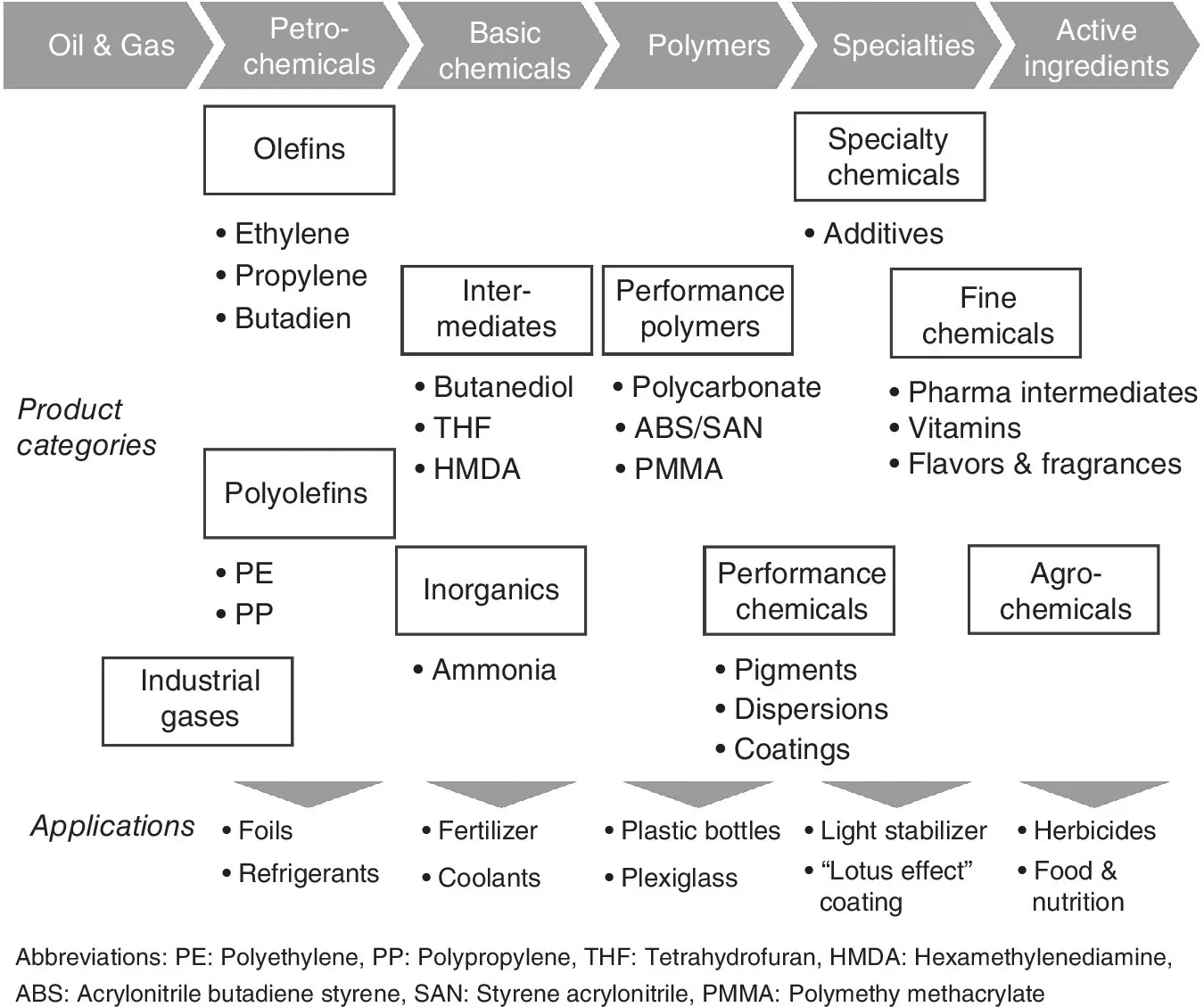
By adapting a value chain perspective, the chemical industry appears to convert organic and inorganic raw materials into value added products (see Figure 1.1). The upstream stages are closely linked to the petrochemical and exploration industry and are only manufacturing a few products, such as fertilizers or basic plastics originating from the Naphtha fraction of crude oil, and, in the case of inorganic materials, deriving from chlorine and salts. In the downstream steps, products of the upstream operations are further processed into a variety of products, which then enter various end markets. The customers of chemical companies are usually other firms who process the materials into end products, so that most relations are business‐to‐business (B2B) in nature.
Figure 1.1 Chemical products in the industry value chain
Within the chemicals value chain, the production processes vary. One can distinguish continuous, campaign, and batch production processes. Each process requires specific production assets, which tie up capital:
Continuous processes run on single‐purpose resources, steadily producing one product and not requiring regular changeover decisions. This type of process avoids downtime and scrap. However, flexibility in applying a different feedstock and input is limited as the production line is specialized for a certain product or process. Continuous processes can typically be found at the beginning of the chemicals value chain, involving petrochemicals, basis chemicals, and bulk polymers.
Campaign production is related to multi‐purpose assets, so that different processes and products can run on the same production resource.
Batch production is also related to multi‐purpose resources and, in addition, is suitable for steps implying a well‐defined start, throughput, and end production time as well as the ability to customize the huge amounts of the desired product. This is typically the case in the specialty chemicals segment [5].
There are different approaches to classify products of the chemical industry. Kline (1976) [6] distinguishes between commodities and specialty/fine chemicals. Following this categorization, commodities demonstrate a low degree of differentiation and a high production volume. They can be found in the early stages of the value chain and are manufactured by means of continuous production processes. These standard, high‐volume products with few variants are typically characterized by a low unit value and a low unit margin. Thus, the main buying criterion is the price. On the contrary, the specialty segments show a high degree of differentiation and a small production volume. Specialty chemicals are typically located at later stages in the value chain and are produced in batches. These products are often available in many variations and generate fairly high unit values and margins. Customers buy specialty chemicals due to their specific and unique product properties.
The different segments of the chemical sector can furthermore be described by looking at the relative importance of additional key success factors, such as the intensity and contribution of research and development (R&D) to success, the relevance of distinctive knowledge about specific markets and customer insights, and the importance of highly qualified personnel for the success of a business. These aspects are particularly decisive for the pharmaceutical and specialty chemicals segment, whereas the extent of investment in production facilities, the energy intensity of manufacturing, and an immediate access to raw materials significantly affect the success of commodity businesses.
1.2.2 Market Characteristics
The chemical industry has been growing since its emergence in the 1860s. By encompassing all parts of modern life and creating new materials or new active ingredients for pharmaceuticals, the chemical industry has always been a trigger for innovation in its customer industries. The chemical industry has a share of 3 to 4% of the global GDP. The main markets are the European Union, the United States, and Asia, with Japan and China as central markets. While th...
Table of contents
Cover
Title Page
Table of Contents
List of Contributors
Preface
Part I: Strategy
Part II: Innovation
Index
End User License Agreement
Trusted by 375,005 students
Access to over 1.5 million titles for a fair monthly price.
Study more efficiently using our study tools.
Frequently asked questions
Yes, you can cancel anytime from the Subscription tab in your account settings on the Perlego website. Your subscription will stay active until the end of your current billing period. Learn how to cancel your subscription
No, books cannot be downloaded as external files, such as PDFs, for use outside of Perlego. However, you can download books within the Perlego app for offline reading on mobile or tablet. Learn how to download books offline
Perlego offers two plans: Essential and Complete
Essential is ideal for learners and professionals who enjoy exploring a wide range of subjects. Access the Essential Library with 800,000+ trusted titles and best-sellers across business, personal growth, and the humanities. Includes unlimited reading time and Standard Read Aloud voice.
Complete: Perfect for advanced learners and researchers needing full, unrestricted access. Unlock 1.5M+ books across hundreds of subjects, including academic and specialized titles. The Complete Plan also includes advanced features like Premium Read Aloud and Research Assistant.
Both plans are available with monthly, semester, or annual billing cycles.
We are an online textbook subscription service, where you can get access to an entire online library for less than the price of a single book per month. With over 1.5 million books across 990+ topics, we’ve got you covered! Learn about our mission
Look out for the read-aloud symbol on your next book to see if you can listen to it. The read-aloud tool reads text aloud for you, highlighting the text as it is being read. You can pause it, speed it up and slow it down. Learn more about Read Aloud
Yes! You can use the Perlego app on both iOS and Android devices to read anytime, anywhere — even offline. Perfect for commutes or when you’re on the go. Please note we cannot support devices running on iOS 13 and Android 7 or earlier. Learn more about using the app
Yes, you can access Business Chemistry by Jens Leker,Carsten Gelhard,Stephan von Delft in PDF and/or ePUB format, as well as other popular books in Physical Sciences & Chemistry. We have over 1.5 million books available in our catalogue for you to explore.