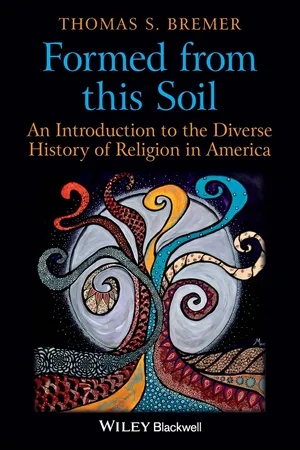
Formed from This Soil offers a complete history of religion in America that centers on the diversity of sacred traditions and practices that have existed in the country from its earliest days.
Organized chronologically starting with the earliest Europeans searching for new routes to Asia, through to the global context of post-9/11 America of the 21st century
Includes discussion of race, ethnicity, gender, sexual orientation, socio-economic class, political affiliations, and other elements of individual and collective identity
Incorporates recent scholarship for a nuanced history that goes beyond simple explanations of America as a Protestant society
Discusses diverse beliefs and practices that originated in the Americas as well as those that came from Europe, Asia, and Africa
Pedagogical features include numerous visual images; sidebars with specialized topics and interpretive themes; discussion questions for each chapter; a glossary of common terms; and lists of relevant resources to broaden student learning
In this chapter, we learn about religious encounters between peoples of the Americas, Africa, and Europe as they established new relationships in an increasingly complex world of social, political, economic, and cultural connections and interdependence. In this emerging Atlantic world, people relied on religious orientations and understandings to guide their encounter of, and often violent conflict with, people, cultures, landscapes, and traditions very different from their own. The new worlds that the indigenous Americans, Africans, and Europeans made in their first encounters served as the foundation for the religious history of America.
America astonished Christopher Columbus (1451–1506). The legendary Admiral of the Ocean Sea, whose voyages initiated permanent European settlement in the Americas, encountered wonders beyond his imagination. He reported seeing mermaids with “something masculine in the countenance,” armored with copper plates and brandishing bows and arrows.1 He reveled in the astounding variety of plant life as well as an abundant array of strangely unfamiliar animals. Resorting to the imagery of his Christian faith, Columbus described one place he explored as the Garden of Eden, stating, “I believe the earthly paradise lies here, which no one can enter except by God's leave.”2
Although few details are known concerning his personal life, the surviving record of his voyages reveals that Christopher Columbus stood at the crossroads of the medieval and Renaissance periods of European cultural history.3 Historians recognize his capabilities as a superb seaman, a skillful navigator, and a sensitive observer of the places he encountered. His observations reveal an educated curiosity typical of the European Renaissance, reflecting a mind well informed of the scientific understandings of his era. On the other hand, Columbus retained a deep Christian piety that reflected centuries of medieval concern for the human place in the cosmos. His scientific observations were tempered by a pious struggle to fit new findings into a medieval Christian view of divine order.
Figure 1.1 The European entry into the contact zones of America was later imagined as a pious act of bringing Christianity to the “pagan” peoples of America, as illustrated in this nineteenth-century engraving of Columbus' first landing in the New World.
(Courtesy of the Library of Congress, LC-DIG-pga-01974.)
This struggle becomes apparent in Columbus' ambivalence toward native peoples who inhabited the islands and other lands that he explored in the western hemisphere. His widely divergent views of indigenous Americans reflect his circumstance in a changing European world; in particular, they draw attention to a dramatic tension between the medieval world of the old and a newly emerging modern perspective. On the one hand, Columbus often expresses genuine admiration of the indigenous people he encountered in the Americas. “They are affectionate people,” he wrote of the natives who came to his aid in December 1492, when his ship had run aground, “free from avarice and agreeable to everything.” In fact, he concludes, “in all the world I do not believe there is a better people or a better country. They love their neighbors as themselves, and they have the softest and gentlest voices in the world and are always smiling.” He commends their propensity for Christian values; indeed, calling them people who “love their neighbors as themselves.” But elsewhere, he condemns people who violate his deepest human convictions. For instance, Columbus learned of a people called Caribes, who, he surmised, “must be a very daring people since they go to all the islands and eat the people they are able to capture.” When one of his exploring parties came under attack, he concluded that “the people here are evil, and I believe they are from the island of Caribe, and that they eat men.”4
Box 1.1 Zones of contact
As he landed on the island beaches of the Americas, Christopher Columbus entered an ambiguous space between worlds. His Atlantic crossing had removed him from the familiar places of Europe, and as he stepped from his boat onto the sand the captain passed into a borderland of worlds altogether unknown to him. Columbus carried with him into this borderland his own universe of European tradition, worldview, and especially his Christian ethos, and he found there indigenous people with their own sense of tradition, worldview, and ethos.
The ambiguous space where very different people first encounter each other has been described by literary historian Mary Louise Pratt as a “contact zone.” Pratt uses this term “to refer to the space of colonial encounters, the space in which peoples geographically and historically separated come into contact with each other and establish ongoing relations, usually involving conditions of coercion, radical inequality, and intractable conflict.”5 This idea of a contact zone draws attention to the momentous encounters between individuals and groups of people who had no previous familiarity or even knowledge of each other. These encounters most often resulted in the establishment of colonial relationships where one group dominated and controlled the other group, usually for economic advantage. But, in nearly all cases, subjugated peoples did not accept colonial domination with passive submissiveness. Even when they found themselves in traumatic circumstances of forced submission that involved relinquishment of lands, separation from families and communities, and prohibitions against religious traditions that had sustained their communities for centuries, colonized people found creative ways to engage the dominant cultures that kept them in submission. Pratt emphasizes a process of “transculturation” to describe “how subordinated or marginal groups select and invent from materials transmitted to them by a dominant or metropolitan culture.”6 In this way, dominated and colonized people continuously engaged with the dominant culture and made it their own through incorporating the ideas, practices, and material objects of the foreign culture into their own worldviews and ways of living, sometimes creating altogether new cultural forms that in turn found their way back into the dominant culture.
Contact zones, then, are the circumstances in which unfamiliar people encounter each other and initiate colonial relationships. But the term can have more broad applications; in particular, we can think of a contact zone as the space and time of encounter with otherness and difference. In other words, contact zones are historical moments and places where people are confronted by new and unanticipated modes of living and manners of social interaction, by moral codes that contradict their own moral understandings and commitments, and by religious traditions that involve alien conceptions of reality and peculiar devotional practices. Many times the encounters of difference that occur in these contact zones devolve into violent conflict as each side perceives threats to its own ways of living and understandings of the world. But the circumstances of encounter can also generate opportunities for creative and productive engagements with otherness. Throughout human history people have forged altogether new and unforeseen modes of social organization and ways of living from their mutual engagement with others who were complete strangers before their initial encounter. The results have nearly always involved one group benefiting at the expense of others, but at the same time dominated groups have shown remarkable resourcefulness in finding ways to resist and subvert domination, and to adapt and survive by creatively using the resources of the dominating people for their own gain.
The profound strangeness of peoples and places that he encountered in the Americas amazed Columbus, yet he never relented in his commitment to the triumph of the Christian gospel in ushering in a new world order. In fact, he reveals in the log of his first voyage that his true purpose for sailing to the Indies was to gain the wealth necessary to launch an assault to recapture Jerusalem from the Muslims who controlled the holy city; he relates, “I have already petitioned Your Highness to see that all the profits of this, my enterprise, should be spent on the conquest of Jerusalem.”7 In other words, Columbus sailed the ocean sea not to prove that the world was round or even to expand Spanish claims in new lands, but to reclaim the Holy Land for Christian pilgrims.
The importance of pilgrimage in the piety of Christopher Columbus became evident on the return trip across the Atlantic from his initial voyage to the Indies. Columbus appealed to his Christian faith when faced with disaster on the high seas. On the morning of February 14, 1493, with fierce winds driving huge waves that broke over the sides of his ship, Columbus “ordered that a pilgrimage to Santa María de Guadalupe be pledged.” He himself drew the lot, and he thereby “considered [himself] obliged to fulfill the vow and make the pilgrimage.” In the same storm, he ordered that two more pilgrimages be pledged.8 Upon his safe return to Spain, Columbus endeavored to fulfill these vows; his Christian faith brought him to the Spanish shrine of the Virgin of Guadalupe following his first voyage to the Americas.
As both Christian pilgrim and accomplished mariner, Columbus straddled a world suffused with the scientific and philosophical thinking of the Renaissance period while remaining deeply implicated in the medieval world of Christian religiosity. His superb skill as a navigator and his excellent seamanship enabled his bold crossing of the Atlantic Ocean into lands previously unknown to Europeans, but in his mind it was only by God's providence that the strange and marvelous lands of what he thought were the far eastern reaches of Asia were delivered to him and the S...
Table of contents
Cover
Title page
Copyright page
Dedication page
Acknowledgments
Prelude for Instructors
Beginnings
Part I: New Worlds
Part II: The New Nation
Part III: The Modern World
Glossary
Index
Access to Companion Website
End User License Agreement
Trusted by 375,005 students
Access to over 1.5 million titles for a fair monthly price.
Study more efficiently using our study tools.
Frequently asked questions
Yes, you can cancel anytime from the Subscription tab in your account settings on the Perlego website. Your subscription will stay active until the end of your current billing period. Learn how to cancel your subscription
No, books cannot be downloaded as external files, such as PDFs, for use outside of Perlego. However, you can download books within the Perlego app for offline reading on mobile or tablet. Learn how to download books offline
Perlego offers two plans: Essential and Complete
Essential is ideal for learners and professionals who enjoy exploring a wide range of subjects. Access the Essential Library with 800,000+ trusted titles and best-sellers across business, personal growth, and the humanities. Includes unlimited reading time and Standard Read Aloud voice.
Complete: Perfect for advanced learners and researchers needing full, unrestricted access. Unlock 1.5M+ books across hundreds of subjects, including academic and specialized titles. The Complete Plan also includes advanced features like Premium Read Aloud and Research Assistant.
Both plans are available with monthly, semester, or annual billing cycles.
We are an online textbook subscription service, where you can get access to an entire online library for less than the price of a single book per month. With over 1.5 million books across 990+ topics, we’ve got you covered! Learn about our mission
Look out for the read-aloud symbol on your next book to see if you can listen to it. The read-aloud tool reads text aloud for you, highlighting the text as it is being read. You can pause it, speed it up and slow it down. Learn more about Read Aloud
Yes! You can use the Perlego app on both iOS and Android devices to read anytime, anywhere — even offline. Perfect for commutes or when you’re on the go. Please note we cannot support devices running on iOS 13 and Android 7 or earlier. Learn more about using the app
Yes, you can access Formed From This Soil by Thomas S. Bremer in PDF and/or ePUB format, as well as other popular books in Theology & Religion & Religion, Politics & State. We have over 1.5 million books available in our catalogue for you to explore.