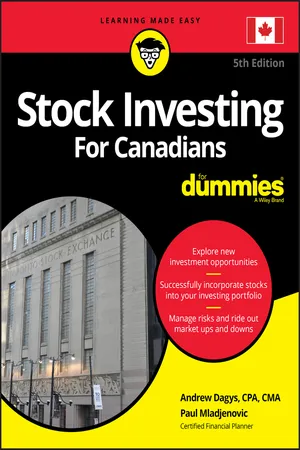
Stock Investing For Canadians For Dummies arms you with trusted information on stock investing in both bear and bull markets; unique investment segments like the legal medical marijuana sector; stock investing for different types of goals, styles, and stages of life; and examples straight from the real world of stock investing as they have occurred in the past few years.
With up-to-date references and resources, this fundamentally powerful yet easy-to-read book is the most reliable Canadian resource on stock market investment you can get your hands on. It covers the latest stock market trends, explores investing in digital currencies, provides expert tips and advice on how to navigate domestic and foreign markets, and helps you maximize your returns.
There’s no time like the present to start investing in the stock market, and this comprehensive reference gives you all the information you need to make sure your investments grow.
- English
- ePUB (mobile friendly)
- Available on iOS & Android
eBook - ePub
Stock Investing For Canadians For Dummies
About this book
Part 1
The Essentials of Stock Investing
IN THIS PART …
Get to know the basics, preparing to buy stocks, and figuring out how to pick good ones.
Tally up your personal balance sheet and cash flow statement and set some personal financial goals.
Come up with strategies to match your investing goals.
Look at different types of risk, understand volatility, and balance risk versus return.
Know similarities and differences between ETFs and mutual funds and the basics of indexes.
Chapter 1
Surveying the World of Stock Investing
IN THIS CHAPTER

For Canadians who are new to stock investing, the stock market must certainly look both enticing and scary at the same time. Since we wrote the last edition, the world-leading U.S. stock market has gone nowhere but up. During this time, the much smaller but still exciting Canadian stock market has gone up too, though nowhere near as much. No matter where you invest, or what level the stock market is at today, the decision to buy or sell is never easy.
We wrote much of this 5th Canadian Edition as the United States, Canada, and the rest of the world were wondering if international military tensions would escalate, or whether international economic trade agreement disputes would lead to financial turbulence or even an economic abyss. (Events such as these directly affect stock investing because our world and our financial markets are more interrelated and connected than ever.) Too many folks are pining for the good ’ol days of the 80s and 90s, when choosing winning stocks was easier than finding aliens in Star Wars. Today’s stock market is more than a little puzzling … but it can still be rewarding. And it can be better understood. We can only promise you that if you read this book seriously and apply its fundamental lessons, you’ll do much better than the average investor. Just keep in mind that patience and discipline count now more than ever.
The purpose of this book is not only to tell you about the basics of stock investing but also to let you in on solid investment strategies that can help you profit from the stock market. Before you invest, you need to understand the fundamentals of stock investing, which we introduce in this chapter. Then we give you an overview of how to put your money where it will count the most. We even point you to some emerging and exciting areas that represent great opportunities. But first things first.
Understanding the Basics
The basics of stock investing are so elementary that few people recognize them. When you lose track of the basics or first principles, you lose track of why you invested to begin with. Part 1 of this book helps you grasp these basics:
- Knowing the risk and volatility involved: Perhaps the most fundamental (and therefore most important) concept to grasp is the risk you face whenever you put your hard-earned money in an investment such as a stock. In fact, very few investors have the risk tolerance to invest 100 percent in stocks. They generally invest in a balanced, diversified portfolio composed of multiple stocks, fixed income, and other assets. This important asset allocation decision (how many stocks, bonds, and other assets you should own) helps determine the overall risk of your total portfolio.Related to risk is the concept of volatility: Volatility refers to a condition in which there is rapid movement in either direction in the price of a particular stock (or other investment); investors use this term especially when there’s a sudden drop in price in a relatively short period of time. Fixed income investments (bonds, bank certificates of deposit, etc.) tend to be less volatile than stocks. Find out more about both risk and volatility in Chapter 4.
- Assessing your financial situation: You need a firm awareness of your starting point and where you want to go. Chapter 2 helps you take stock of your current financial status and your goals, two fundamental building blocks that need to be in place and understood before you invest in stocks.
- Understanding approaches to investing: You want to approach investing in a way that works best for you. Chapter 3 discusses investment time horizons, as well as purpose- and style-driven approaches to investing.
- Seeing what exchange-traded funds have to offer: Exchange-traded funds are like mutual funds, but are growing in popularity much faster than mutual funds because they can be traded like stocks. See Chapter 5 for the lowdown on Canadian and other exchange-traded funds.

- Common stock: Common stock (the type we cover throughout this book) entitles the owner to vote at shareholders’ meetings and receive any dividends that the company issues.
- Preferred stock: Preferred stock doesn’t usually confer voting rights, but it does include some rights that exceed those of common stock. Preferred stockholders, for example, have priority in certain conditions, such as receiving dividends before common stockholders in the event that the corporation goes bankrupt. Additionally, preferred stocks operate similarly to a bond for those investors who seek stable income. However, you should be aware that bondholders generally hold priority over both common and preferred stockholders. (In this book, we mostly cover common stock.)
In addition to common stock, in this new Canadian edition we also cover exchange-traded funds because they can be a very valuable part of the Canadian stock investor’s portfolio (see Chapter 5 for more details on exchange-traded funds).
Preparing to Buy Stocks
Gathering information is critical in your stock-investing pursuits. You should gather information on your stock picks two times: before you invest and after. Obviously, you should become more informed before you invest your first dollar, but you also need to stay informed about what’s happening to the company whose stock you buy as well as about the industry and the general Canadian and world economies. All too many Canadians don’t make it a habit to check up on their stock holdings, which is risky business. To find the best information sources to stay on top of your stocks, check out Chapter 6.
When you’re ready to invest, you need a Canadian brokerage account, and you may even need some advice about things like portfolio allocation options. How do you know which broker to use? What type of portfolio best aligns with your financial goals and risk appetite? Chapter 7 provides some answers and resources to help you choose brokers and advisors that serve your needs.
Knowing How to Pick Winners
When you get past the basics, you can get to the meat of stockpicking. Successful stockpicking isn’t mysterious, but it does take some time, effort, and ...
Table of contents
- Cover
- Table of Contents
- Introduction
- Part 1: The Essentials of Stock Investing
- Part 2: Before You Jump In
- Part 3: Picking Winners
- Part 4: Investment Strategies and Tactics
- Part 5: The Part of Tens
- Part 6: Appendixes
- Index
- About the Authors
- Connect with Dummies
- End User License Agreement
Trusted by 375,005 students
Access to over 1.5 million titles for a fair monthly price.
Study more efficiently using our study tools.
Frequently asked questions
Yes, you can cancel anytime from the Subscription tab in your account settings on the Perlego website. Your subscription will stay active until the end of your current billing period. Learn how to cancel your subscription
No, books cannot be downloaded as external files, such as PDFs, for use outside of Perlego. However, you can download books within the Perlego app for offline reading on mobile or tablet. Learn how to download books offline
Perlego offers two plans: Essential and Complete
- Essential is ideal for learners and professionals who enjoy exploring a wide range of subjects. Access the Essential Library with 800,000+ trusted titles and best-sellers across business, personal growth, and the humanities. Includes unlimited reading time and Standard Read Aloud voice.
- Complete: Perfect for advanced learners and researchers needing full, unrestricted access. Unlock 1.5M+ books across hundreds of subjects, including academic and specialized titles. The Complete Plan also includes advanced features like Premium Read Aloud and Research Assistant.
We are an online textbook subscription service, where you can get access to an entire online library for less than the price of a single book per month. With over 1.5 million books across 990+ topics, we’ve got you covered! Learn about our mission
Look out for the read-aloud symbol on your next book to see if you can listen to it. The read-aloud tool reads text aloud for you, highlighting the text as it is being read. You can pause it, speed it up and slow it down. Learn more about Read Aloud
Yes! You can use the Perlego app on both iOS and Android devices to read anytime, anywhere — even offline. Perfect for commutes or when you’re on the go.
Please note we cannot support devices running on iOS 13 and Android 7 or earlier. Learn more about using the app
Please note we cannot support devices running on iOS 13 and Android 7 or earlier. Learn more about using the app
Yes, you can access Stock Investing For Canadians For Dummies by Andrew Dagys,Paul Mladjenovic in PDF and/or ePUB format, as well as other popular books in Business & Stocks. We have over 1.5 million books available in our catalogue for you to explore.