A comprehensive overview of the research developments in the burgeoning field of metal-air batteries
An innovation in battery science and technology is necessary to build better power sources for our modern lifestyle needs. One of the main fields being explored for the possible breakthrough is the development of metal-air batteries. Metal-Air Batteries: Fundamentals and Applications offers a systematic summary of the fundamentals of the technology and explores the most recent advances in the applications of metal-air batteries. Comprehensive in scope, the text explains the basics in electrochemical batteries and introduces various species of metal-air batteries.
The author-a noted expert in the field-explores the development of metal-air batteries in the order of Li-air battery, sodium-air battery, zinc-air battery and Mg-O2 battery, with the focus on the Li-air battery. The text also addresses topics such as metallic anode, discharge products, parasitic reactions, electrocatalysts, mediator, and X-ray diffraction study in Li-air battery. Metal-Air Batteries provides a summary of future perspectives in the field of the metal-air batteries. This important resource:
-Covers various species of metal-air batteries and their components as well as system designation -Contains groundbreaking content that reviews recent advances in the field of metal-air batteries -Focuses on the battery systems which have the greatest potential for renewable energy storage
Written for electrochemists, physical chemists, materials scientists, professionals in the electrotechnical industry, engineers in power technology, Metal-Air Batteries offers a review of the fundamentals and the most recent developments in the area of metal-air batteries.
Frequently asked questions
Yes, you can cancel anytime from the Subscription tab in your account settings on the Perlego website. Your subscription will stay active until the end of your current billing period. Learn how to cancel your subscription.
No, books cannot be downloaded as external files, such as PDFs, for use outside of Perlego. However, you can download books within the Perlego app for offline reading on mobile or tablet. Learn more here.
Perlego offers two plans: Essential and Complete
Essential is ideal for learners and professionals who enjoy exploring a wide range of subjects. Access the Essential Library with 800,000+ trusted titles and best-sellers across business, personal growth, and the humanities. Includes unlimited reading time and Standard Read Aloud voice.
Complete: Perfect for advanced learners and researchers needing full, unrestricted access. Unlock 1.4M+ books across hundreds of subjects, including academic and specialized titles. The Complete Plan also includes advanced features like Premium Read Aloud and Research Assistant.
Both plans are available with monthly, semester, or annual billing cycles.
We are an online textbook subscription service, where you can get access to an entire online library for less than the price of a single book per month. With over 1 million books across 1000+ topics, we’ve got you covered! Learn more here.
Look out for the read-aloud symbol on your next book to see if you can listen to it. The read-aloud tool reads text aloud for you, highlighting the text as it is being read. You can pause it, speed it up and slow it down. Learn more here.
Yes! You can use the Perlego app on both iOS or Android devices to read anytime, anywhere — even offline. Perfect for commutes or when you’re on the go. Please note we cannot support devices running on iOS 13 and Android 7 or earlier. Learn more about using the app.
Yes, you can access Metal-Air Batteries by Xin-bo Zhang in PDF and/or ePUB format, as well as other popular books in Technologie et ingénierie & Ingénierie de l'électricité et des télécommunications. We have over one million books available in our catalogue for you to explore.
1 Introduction to Metal–Air Batteries: Theory and Basic Principles
Zhiwen Chang and Xin‐bo Zhang
Chinese Academy of Sciences, Changchun Institute of Applied Chemistry, State Key Laboratory of Rare Earth Resource Utilization, 5625 Renmin Street, Changchun, 130022, PR China
Nowadays, energy is the power engine that sustains the operation of our society. In the energy field, we are confronted with a daunting challenge caused by the gradual depletion of fossil fuel. To secure a safe and sustainable energy supply, renewable energies such as solar and wind have been developed. However, these energies are geographically limited and intermittent, thus calling for reliable electrical energy storage (EES) system for stable and efficient power delivery. Simultaneously, the growing number of transportation vehicles has made the development of reliable EES system a task of urgency. Among various EES systems, rechargeable batteries are the most promising to meet these needs thanks to their high energy density and high energy efficiency [1]. Among them, the lithium‐ion battery (LIB), which is operated on the basis of intercalation mechanism, has played an important role in our society in the past two decades [2]. However, the low energy density of LIB has restricted its application as the energy supplier of next generation. Under this circumstance, the development of metal–air battery has provided a solution benefitting from its much higher energy theoretical energy density than that of LIB.
In contrast to the closed system of LIB, the metal–air battery are featured with an open cell structure, in which the cathode active material, oxygen, coming from ambient atmosphere. In general, the metal–air battery consists of metal anode, electrolyte, and porous cathode. Metals such as Li, Na, Fe, Zn, etc. can be used as anode materials in metal–air batteries. And the theory and battery electrochemistry will be briefly discussed on the basis of metal–air battery with different metallic anodes in the following section, which will be discussed in detail in the following chapters.
1.1 Li–O2 Battery
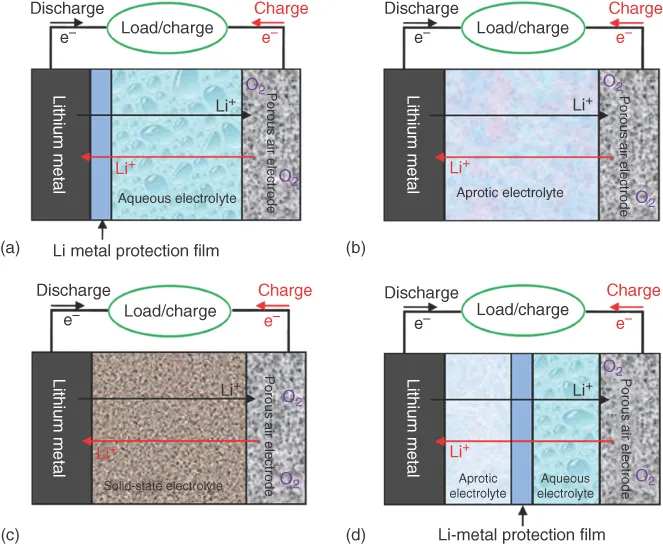
Of all rechargeable metal–air batteries, the Li–O2 battery (usually the aprotic Li–O2 battery) possesses an ultrahigh theoretical energy density and is a promising EES. The theoretical energy density of the Li–O2 battery can be around 11 586 Wh kg−1 based on the mass of Li metal alone. When the mass of Li and Li2O2 is involved, the theoretical energy density of the Li–O2 battery is still as high as 3505 Wh kg−1, which is much higher than that of LIB [3]. The exceptionally high energy density of Li–O2 battery mainly originates from two aspects. First, oxygen, the cathode material, is sourced from outside environment rather than being stored within the battery, thus helping to reduce the weight of the assembled cell. Second, during discharge, the lithium anode can deliver an extremely high specific capacity and rather low electrochemical potential (−3.04 V vs standard hydrogen electrode (SHE)), ensuring a desirable discharge capacity and a high operation voltage, respectively [4]. The history regarding the development of Li–O2 battery is introduced briefly as follows. The first prototype of Li–O2 battery was reported by Semkow and Sammells [5]. In 1996, a Li–O2 battery with polymer‐based electrolyte was introduced by Abraham [6]. During the following couples of years, Read et al. have carried out relevant researches in the Li–O2 field, and Bruce has demonstrated the rechargeability of the system [7–9]. Since then, numerous efforts have been devoted into the Li–O2 field along with success of varying degrees. Currently, there are four types of Li–O2 batteries under investigation, which can be categorized on the basis of the applied electrolyte species (aprotic, aqueous, hybrid, and all solid‐state electrolytes) [10]. All the four types of lithium–air batteries use lithium metal and oxygen (air) as anode and cathode active materials, respectively. Their fundamental electrochemical reaction mechanisms are closely associated with the electrolytes used. Simultaneously, the schematic illustration of these four types of Li–O2 batteries is provided in Figure 1.1, being able to provide the readers with an easy access to their configuration.
Figure 1.1 Schematic illustration of Li–O2 battery based on (a) aqueous electrolyte, (b) aprotic electrolyte, (c) solid‐state electrolyte, and (d) hybrid electrolyte.
Compared with the Li–O2 batteries with aqueous, hybrid, and solid‐state electrolytes, the researches on the Li–O2 battery has taken the dominant place. So in the following section, all the discussion is around the Li–O2 battery with aprotic electrolyte. A typical Li–O2 battery consists of a lithium‐metal anode, a porous carbon cathode, and a separator saturated with aprotic electrolyte, which is shown in Figure 1.1. In principle, the Li–O2 chemistry is based on the following conversion reaction: [11]
1.1
The ideal operation of a Li–O2 battery is based on the electrochemical formation (discharge) and decomposition (charge) of lithium peroxide (Li2O2). The reduction proceeds through the following general steps:
1....
Table of contents
Cover
Table of Contents
Preface
Chapter 1: Introduction to Metal–Air Batteries: Theory and Basic Principles
Chapter 2: Stabilization of Lithium‐Metal Anode in Rechargeable Lithium–Air Batteries
Chapter 3: Li–Air Batteries: Discharge Products
Chapter 4: Electrolytes for Li–O2 Batteries
Chapter 5: Li–Oxygen Battery: Parasitic Reactions
Chapter 6: Li–Air Battery: Electrocatalysts
Chapter 7: Lithium–Air Battery Mediator
Chapter 8: Spatiotemporal Operando X‐ray Diffraction Study on Li–Air Battery
Chapter 9: Metal–Air Battery: In Situ Spectroelectrochemical Techniques
Chapter 10: Zn–Air Batteries
Chapter 11: Experimental and Computational Investigation of Nonaqueous Mg/O2 Batteries
Chapter 12: Novel Methodologies to Model Charge Transport in Metal–Air Batteries
Chapter 13: Flexible Metal–Air Batteries
Chapter 14: Perspectives on the Development of Metal–Air Batteries
