Workplace Wellness that Works
eBook - ePub

Workplace Wellness that Works

10 Steps to Infuse Well-Being and Vitality into Any Organization

  1. English
  2. ePUB (mobile friendly)
  3. Available on iOS & Android
eBook - ePub

Workplace Wellness that Works

10 Steps to Infuse Well-Being and Vitality into Any Organization

About this book

A smarter framework for designing more effective workplace wellness programs

Workplace Wellness That Works provides a fresh perspective on how to promote employee well-being in the workplace. In addressing the interconnectivity between wellness and organizational culture, this book shows you how to integrate wellness into your existing employee development strategy in more creative, humane, and effective ways. Based on the latest research and backed by real-world examples and case studies, this guide provides employers with the tools they need to start making a difference in their employees' health and happiness, and promoting an overall culture of well-being throughout the organization. You'll find concrete, actionable advice for tackling the massive obstacle of behavioral change, and learn how to design and implement an approach that can most benefit your organization.

Promoting wellness is a good idea. Giving employees the inspiration and tools they need to make changes in their lifestyles is a great idea. But the billion-dollar question is: what do they want, what do they need, and how do we implement programs to help them without causing more harm than good? Workplace Wellness That Works shows you how to assess your organization's needs and craft a plan that actually benefits employees.

  • Build an effective platform for well-being
  • Empower employees to make better choices
  • Design and deliver the strategy that your organization needs
  • Drive quantifiable change through more creative implementation

Today's worksite wellness industry represents a miasma of competing trends, making it nearly impossible to come away with tangible solutions for real-world implementation. Harnessing a broader learning and development framework, Workplace Wellness That Works skips the fads and shows you how to design a smarter strategy that truly makes a difference in employees' lives—and your company's bottom line.
Frequently asked questions

Yes, you can cancel anytime from the Subscription tab in your account settings on the Perlego website. Your subscription will stay active until the end of your current billing period. Learn how to cancel your subscription.
No, books cannot be downloaded as external files, such as PDFs, for use outside of Perlego. However, you can download books within the Perlego app for offline reading on mobile or tablet. Learn more here.
Perlego offers two plans: Essential and Complete
  • Essential is ideal for learners and professionals who enjoy exploring a wide range of subjects. Access the Essential Library with 800,000+ trusted titles and best-sellers across business, personal growth, and the humanities. Includes unlimited reading time and Standard Read Aloud voice.
  • Complete: Perfect for advanced learners and researchers needing full, unrestricted access. Unlock 1.4M+ books across hundreds of subjects, including academic and specialized titles. The Complete Plan also includes advanced features like Premium Read Aloud and Research Assistant.
Both plans are available with monthly, semester, or annual billing cycles.
We are an online textbook subscription service, where you can get access to an entire online library for less than the price of a single book per month. With over 1 million books across 1000+ topics, we’ve got you covered! Learn more here.
Look out for the read-aloud symbol on your next book to see if you can listen to it. The read-aloud tool reads text aloud for you, highlighting the text as it is being read. You can pause it, speed it up and slow it down. Learn more here.
Yes! You can use the Perlego app on both iOS or Android devices to read anytime, anywhere — even offline. Perfect for commutes or when you’re on the go.
Please note we cannot support devices running on iOS 13 and Android 7 or earlier. Learn more about using the app.
Yes, you can access Workplace Wellness that Works by Laura Putnam in PDF and/or ePUB format, as well as other popular books in Business & Business General. We have over one million books available in our catalogue for you to explore.

Information

Publisher
Wiley
Year
2015
Print ISBN
9781119055914
eBook ISBN
9781119055723
Edition
1

Section III
Make it Last (Workplace Wellness That Works)

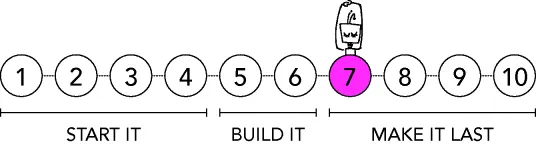
The final set of steps focus on how to sustain a wellness movement in your organization—by giving employees the tools to engage with the movement.
Step 7: Create Meaning explores tangible ways to shift away from incentives and go deeper by connecting with our intrinsic, human needs. By creating alignment between the purpose of the individual and the purpose of the organization, your wellness movement will have the framework to last.
Step 8: Design Nudges and Cues discusses tangible ways to change the environment through nudges and cues that promote wellness throughout the organization. This chapter helps you continue to evolve the culture of the organization to authentically support and sustain individuals' efforts to integrate well-being into their daily activities.
Step 9: Launch and Iterate discusses the importance of fostering a growth mind-set to nurture ongoing support of wellness for individuals, teams, and for the organization as a whole. This chapter offers tips on how to experiment more, learn more, and devise wellness programs that actually work.
Step 10: Go Global goes beyond national borders and discusses how to grow the movement across the international branches of your organization. Even if you're a domestic organization, you can take a global outlook for unexpected answers. This chapter explores effective wellness movements that have gone global, such as Chade-Meng Tan's “Search Within Yourself,” to help you discover wellness approaches that resonate for individuals and cultures of all nationalities.

Step 7
Create Meaning
(The Engagement Imperative)

img
When I taught history in an urban high school, my students used to ask, “Why do I need to know this stuff about history?” For a long time, I fired back, “So you can get a good grade.” Or, if I got really frustrated, “You need to pay attention or I'll send you to the principal's office.”
Then, one day, I stopped. I turned the question around. “Well,” I asked, “why do you think we're studying this?” Rather than simply giving the normal “do this—or else” response, I began to go deeper. By turning a one-way question into a collaborative quest for meaning, I discovered that my students started listening more and taking more ownership into looking at what history meant in their own lives.
My initial responses to my students, while understandable, focused on what the lesson in history would get them (or help them to avoid). My initial answers sometimes led to the desired short-term result, namely a student paying attention to what I thought was a brilliant history lecture. Usually, however, this didn't last. What I learned as a teacher is that grades and threats are only part of the motivation package. Encouraging long-lasting motivation has to stem from a place of inquiry and a search for meaning.
This brings us back to our original billion-dollar dilemma: How do we motivate employees to make healthy behavior changes? While many organizations have turned to short-term fixes like incentives and penalties, there is increasing evidence that change is only sustainable through intrinsic motivation. In this chapter, we'll discuss what intrinsic motivation is and how to build it into your wellness movement.
In this chapter, we'll discuss:
  1. Short-term behavior change versus sustainable behavior change,
  2. The distinction between extrinsic and intrinsic motivation,
  3. Current trends in workplace wellness around the use of incentives and penalties,
  4. Some potential pitfalls in having a strategy that overly relies on incentives,
  5. How you can create the conditions for promoting intrinsic motivation, and
  6. How to apply these findings toward taking action.

Your Step 7 Checklist

  • img
    Create your motivation plan.
  • img
    Devise activities and programs to support intrinsic motivators: competency, autonomy, relatedness, purpose, and play.

Awareness Is Not Enough

What we definitively know is that awareness is not enough—recall the billion-dollar dilemma. When it comes to health and wellness, most of us know what to do; we just have a hard time translating that knowledge into action. Michael O'Donnell, founder and editor-in-chief of the American Journal of Health Promotion, estimates that awareness only accounts for 5 percent of behavior change. Motivation, skills, and opportunities, the remaining three legs of his AMSO model, a framework for developing behavior change programs, are the critical elements that factor into behavior change. In this chapter, we're going to zero in on the motivation piece. Unlocking the keys to motivation has perhaps generated the greatest amount of controversy in the field of workplace wellness. So let's dive in!

Moving beyond Awareness to Incentives

In an effort to motivate people to change behaviors, we have moved beyond building awareness to using incentives. According to behavioral economists David Asch and Kevin Volpp, “The implicit argument is that if we pay people for health-promoting behaviors, they will engage in them. It works to a certain extent, but typically not as much as program sponsors would like.”1
Incentives will never serve as a motivation panacea. They may lead to a jump in participation rates at the beginning, but in most cases, adding more incentives results in only incremental (but disappointing) differences, and in some cases, it can even diminish or extinguish intrinsic motivation. In one study, post-cardiac patients were incentivized through free medication in an effort to increase the rates of compliance (actually taking the medication). The result? Compliance only increased by five percentage points, from 39 percent to 44 percent.2
The use of incentives can be frustrating and expensive. In an effort to mitigate these costs, some employers are actually transferring incentive costs to employees through reduced deductions in other areas. Not a nice tactic. Nor is it effective. According to Asch and Volpp, “Money has its limits as a carrot, yet an enormous industry in wellness is devoted to this highly transactional approach of delivering points, badges, miles, or dollars to encourage good behavior.”
So if incentives, by and large, don't work, how do we create meaningful behavior change when it comes to wellness? Let's take a closer look.

Behavior Change: Easy to Start, Hard to Sustain

Behavior change is the mantra for any worksite wellness program and the key selling point for any wellness vendor. Examples of behavior-change solutions include campaigns, team challenges, health coaching, gamification platforms, weight loss competitions, and, of course, incentives.
“Behavior change is easy! The real issue is sustaining the behavior,” says Michelle Segar, author of No Sweat: How the Simple Science of Motivation Can Bring You a Lifetime of Fitness and director of the Sport, Health, and Activity Research and Policy Center (SHARP) at the University of Michigan. In her view, the lack of sustainability largely comes down to motivation and how to stay motivated over time. Segar has spent her career looking into motivation, primarily behind exercise, but we can apply her findings toward workplace wellness.
Lasting motivation, she proposes, starts with finding the “...

Table of contents

  1. Cover
  2. Title Page
  3. Copyright
  4. Dedication
  5. Preface
  6. Acknowledgments
  7. Introduction: An Overview of Workplace Wellness
  8. Section I: Start it (Workplace Wellness That Excites)
  9. Section II: Build it (Workplace Wellness That Grows)
  10. Section III: Make it Last (Workplace Wellness That Works)
  11. Pull It All Together
  12. About the Author
  13. Index
  14. End User License Agreement