The new edition of this popular and widely-used American history textbook has been thoroughly updated to include a wealth of new scholarship on American diplomacy in the decade leading up to Japan's attack on Pearl Harbor.
Features new material on the Washington Conference of 1921-22, early American diplomacy in the Manchurian crisis, the Panay incident, Russia's invasion of Finland, the destroyer-bases deal, and much more
Pays particular attention to Roosevelt's policies towards Jewish refugees, the battle between domestic groups like the America First Committee and Fight for Freedom, and the Welles mission of 1940
Includes concise biographical sketches of major world leaders, including Hoover, FDR, Churchill, Hitler, Stalin, Mussolini, and Tojo
Outlines and examines the debates of historians over the wisdom of U.S. policies
As the gray light of dawn was breaking over Washington, D.C., windows of government buildings were ablaze with light. Automobiles jammed the streets. At the Capitol, workmen, their breath visible in the frosty morning air, drove wooden stakes into the ground around the House of Representatives’ wing. Others followed, stringing wire cable to hold back the crowds expected later in the day. By midmorning, policemen and marines, with fixed bayonets, swarmed Capitol Hill.
Slightly over a mile away, at 1600 Pennsylvania Avenue, anxious crowds pressed against the iron fence of the mansion, while dozens of police patrolled the grounds. At 11:30 a.m., two open automobiles filled with Secret Service men moved into the driveway of the White House, rolling to a stop under the portico. Riot guns hung menacingly from the sides of the automobiles.
At 12:00 p.m. sharp, the big glass doors of the building swung open. Into the chilly midday air walked President Franklin D. Roosevelt, supported by his son James, who was wearing the uniform of a marine officer. Grim-faced and silent, the president slowly descended the steps and entered a limousine bearing the White House insignia. Other automobiles quickly filled with aides, officials, and members of the chief executive’s family. A moment later, the cars were moving down the driveway, through the East Gate, turning right on Pennsylvania Avenue. Quiet crowds lined the streets. Skies were leaden, the temperature in the upper forties. A few brown leaves still clung to the city's larger trees.
Minutes later, the presidential caravan entered the Capitol plaza and rolled to a stop near a special entrance. Onlookers broke into a cry. His mouth tightly drawn, the president ignored the cheering, slowly lifted himself from the limousine, and went into the office of House speaker Sam Rayburn (Dem.-TX).
Members took their seats in the House chamber. Meanwhile Senators strode two-by-two down a long corridor and through the rotunda to the House side. A moment later the black-robed justices of the Supreme Court, led by Harlan Fiske Stone, entered the chamber and marched down the center aisle. At 12:24, the vice president rapped his gavel, and everyone stood up. Down the aisle filed the president's cabinet, led by the white-haired secretary of state, Cordell Hull. Then, five minutes later, Rayburn rapped for silence, announcing: “The President of the United States.” Automatically, the members of Congress, guests at the rear of the chamber, officials, diplomats, and a handful of servicemen and ordinary citizens rose to their feet. For an instant, there was silence, then applause. The clapping increased but ended abruptly when Rayburn pounded the gavel. Still supported by James Roosevelt, the president appeared, slowly making his way up a ramp to the rostrum. More applause, then cheering, and for the next two or three minutes Roosevelt received the most tumultuous ovation of his presidency. Powerful lights enveloped the president in a blazing glow, movie cameras whirred, a dozen microphones made a jagged pattern across the rostrum.
After the House chaplain offered a brief prayer, the president, dressed in formal morning attire, stood alone. The large clock at his back showed 12:34. At that moment, a hush fell over the Republic. Millions of Americans turned toward radios to receive their president's words. Roosevelt opened a black loose-leaf notebook, and in restrained, staccato tones began: “Yesterday, December 7, 1941—a date which will live in infamy—the United States was suddenly and deliberately attacked by naval and air forces of the empire of Japan.”
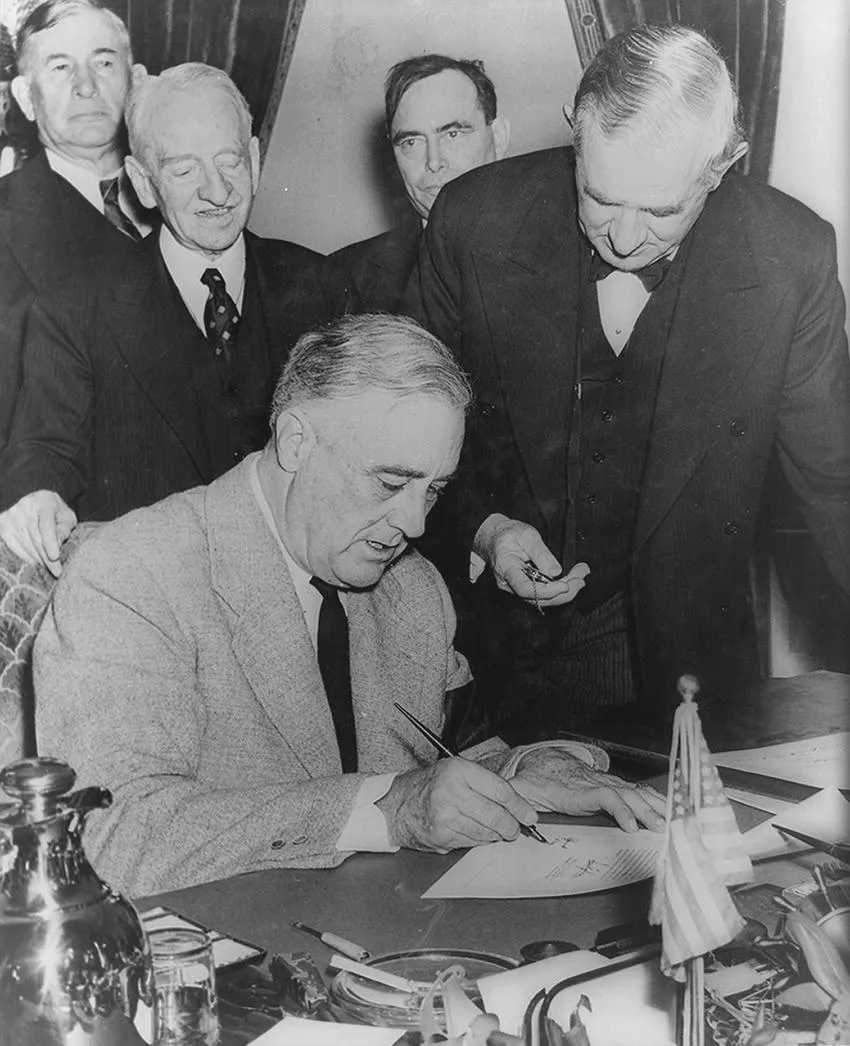
Figure 1.1 President Franklin Delano Roosevelt signs the declaration of war on Japan, December 1941.
Source: Library of Congress, Prints and Photographs Division LC-USZ62-15185.
Several of those in the House chamber could remember a similar day just twenty-four years before, when President Woodrow Wilson had made an identical trip to the Capitol. He asked Congress to recognize that a state of war existed between the United States and Germany. The parallel between April 1917 and December 1941 made the drama of FDR’s message curiously poignant.
The Roots of Anti-Interventionism
When, in November 1918, peace had finally settled over the Western Front in France, President Wilson made his plans to attend the peace conference in Paris. Over the past year and a half, he had led what he saw as a crusade for democracy; now he would direct the world to a settlement resting on justice and supported by a League of Nations. That December, as the steamer George Washington slipped out of New York Harbor, the president jauntily paced the deck, smiling, full of confidence. He believed he had the support of war-weary people the world over. When he landed in France a week later, he was met with unparalleled enthusiasm. A Paris newspaper reported that “never has a king, never has an emperor received such a welcome.”
Then something went wrong. The U.S. Senate rejected the peace drafted at Paris. It refused to join the League of Nations, and by 1923 Wilson's successor in the White House, Warren Gamaliel Harding, could announce that the matter was “as dead as slavery.” Americans were determined to keep their distance—to insulate themselves from Europe’s troubles. Over the next decade and a half, this sentiment increased. By the mid-1930s, Congress was writing this attitude into law.
This is not to say, however, that Americans closed their eyes entirely to the rest of the world. They took considerable interest in events elsewhere, underwriting Europe’s postwar recovery while continually expanding their own foreign trade. Thus, although commonly used—and even accepted—the term “isolationist” does not accurately describe U.S. foreign policy between World Wars I and II.
When historians use the term “isolationism,” they are really referring to opposition to intervention in wars overseas, particularly in Europe, and to entering into such “entangling alliances” as collective security agreements or international organizations such as the League of Nations. Because “isolationist” connotes a host of vices—indifference, reckless naiveté, appeasement of dictators—one finds “anti-interventionism” a far more accurate term. People harboring this sentiment often referred to themselves as “nationalists” or “neutralists.”
Anti-interventionism was an old habit for Americans, one that had several roots. One source was geography. From its birth, the United States had enjoyed security to a degree unparalleled in the history of modern nations. The Atlantic and Pacific oceans served as giant barriers against overseas aggression, while the nation’s neighbors in the Western Hemisphere were too weak to threaten any attack.
Another source lay in continental expansion. The North American continent, awaiting ax and plow, offered such splendid rewards that Americans inevitably turned their energy to developing their own empire. Once new markets were secured, they believed, the nation’s prosperity would be guaranteed.
Then there was a combination of precedent and patriotism. Americans remembered the counsel of their first president. In his famous Farewell Address of September 1796, George Washington had warned of “the insidious wiles of foreign influence,” urged “as little political connection as possible” with foreign countries, and celebrated “our detached and distant situation.” Thomas Jefferson, who used the very term “entangling alliances,” shared these sentiments. More important, so did most Americans. They contrasted a corrupt, quarrelsome, autocratic Old World—the antithesis of a truly democratic nation—with a New World that they perceived as an Edenic utopia, or in the words of Thomas Paine, “an asylum for mankind.” To use the metaphor of Abraham Lincoln, the United States was “the world's last best hope,” the final outpost against feudal despotism or revolutionary anarchy. Down to the closing years of the nineteenth century, no responsible politician dared to challenge Washington's position. Isolation became identified with Americanism.
To those fearful of foreign involvement, by the 1920s, the Old World embodied two dangers in particular: British imperialism and Russian Bolshevism. The United States, anti-interventionists maintained, could not afford to be the unwitting agent of either colonial autocracy or revolutionary terror.
From 1776, many Americans had regarded Britain in particular with the greatest of suspicion. Not all were as vocal as the nineteenth-century diplomat Townsend Harris, whose parents had supposedly raised him to offer prayers, fear God, and hate the British, but most of them saw “Perfidious Albion” as ever seeking to foster its domestic plutocracy and archaic empire. So long as Britain maintained dominion over much of the globe, it would be oppressing billions of subjects and attempting to hoard much of the world's wealth. All too often, many claimed, the United States had served as its unthinking instrument, the primary example being the rescue of Britain during WWI. Just before World War II broke out in Europe, the pundit H. L. Mencken accused the United States of serving as “the client and goon” of its traditional enemy, in fact acting “precisely like an English colony.” Even the urbane news analyst Quincy Howe wrote a book in 1938 entitled England Expects Every American to Do His Duty.
The Union of Soviet Socialist Republics embodied a newer threat but one no less pernicious. To more conservative Americans, the Soviet Union stood for the persecution of religion, failure to pay the debts incurred by the Tsarist regime, and the liquidation of the entire Kulak class of relatively affluent farmers. True, for many liberals, not until the middle of the 1930s did Russia become, in the words of a British author and politician, “the God that failed.” Even reformers, however, became deeply disillusioned by the actions of the Soviet government: the artificially created famines in the Ukraine, extermination of the top army command, obviously trumped-up accusations of Stalin's purge trials, and establishment and administration of labor camps that later became known as the Gulag.
It is hardly surprising, then, that anti-interventionism was particularly strong among certain ethnic groups, particularly Americans of German, Irish, and Italian origin. In the 1920s, in the wake of WWI, German Americans were embittered over the harshness of the Versailles Diktat, Irish Americans furious that their beloved Eire had not been granted full independence, and Italian Americans disappointed by the meager gains secured by Italia at Paris. Urged on by the Republican party, these ethnic groups reacted against the Democrats—the party of Woodrow Wilson, who appeared committed to a League of Nations and a decidedly “internationalist” approach to world affairs. When war again threatened in the late 1930s, many among these groups, though seldom sympathizing with the Axis, feared that involvement would make the United States a full-scale partner of Great Britain. As there was never any chance of an American alliance with Germany and Italy, the only alternative was aloofness.
Yet even as early as the end of the nineteenth century, the long tradition of American anti-interventionism seemingly had started to weaken. As a result of the Spanish-American War, the United States began to acquire an overseas empire, one that included the Philippines and Puerto Rico. Within two decades, President Wilson sent American youths to France (in 1917–18) and, when the war ended, sought to take the United States into the League of Nations. The departure from old lines of thought, however, had been more superficial than real. In the next two decades, it was easy for the anti-interventionist habit to reassert itself. In 1935, Representative Maury Maverick (Dem-TX) was undoubtedly expressing a popular sentiment when he announced: “In our Revolution against the British, Lafayette came over here, and Baron von Steuben, also a foreigner, came to train our Revolutionary troops, and we were glad to have them; but we do not like foreigners any more.”
The Disillusionment of the 1920s
Americans, disillusioned by the results of the conflict of 1914–18, turned inward. In the 1920s, as historian William E. Leuchtenburg notes, the Great War (as people continued to call it) became “a dirty, unheroic war which few men remembered with any emotion save distaste.”
Why had this happened?
America’s leaders, historians agree, had oversold the World War. Instead of presenting U.S. participation as a matter of national interest, distasteful but necessary, they had turned it into a crusade for democracy. At the Paris peace conference and after, however, the public saw as much selfish nationalism in the world as ever, and, if anything, less democracy. Many felt disgusted for having been so foolish as to become party to what they saw fundamentally as a European affair, that is, a war fought over European problems for European ends. No American interest had ever been at stake. Senator Homer T. Bone (Dem.-WA) said in 1935 that “the Great War was utter social insanity, and was a crazy war, and we had no business in it at all.” As late as January 1937, 70 percent of those polled responded that entry in the conflict had been a mistake.
Particularly disillusioning was an apparently vindictive settlement that the victors had imposed at Paris in 1919. Many Americans had thrilled to President Wilson's idea of a “peace without victory.” They had hailed his Fourteen Points, the last item of which endorsed “a gen...
Table of contents
Cover
Title Page
Table of Contents
Preface
1 In Search of Peace
2 Manchuria
3 The Dilemmas of Neutrality
4 Toward War in Europe
5 Toward War in the Pacific
6 Day of Infamy
Bibliographical Essay
Author Index
Subject Index
End User License Agreement
Trusted by 375,005 students
Access to over 1.5 million titles for a fair monthly price.
Study more efficiently using our study tools.
Frequently asked questions
Yes, you can cancel anytime from the Subscription tab in your account settings on the Perlego website. Your subscription will stay active until the end of your current billing period. Learn how to cancel your subscription
No, books cannot be downloaded as external files, such as PDFs, for use outside of Perlego. However, you can download books within the Perlego app for offline reading on mobile or tablet. Learn how to download books offline
Perlego offers two plans: Essential and Complete
Essential is ideal for learners and professionals who enjoy exploring a wide range of subjects. Access the Essential Library with 800,000+ trusted titles and best-sellers across business, personal growth, and the humanities. Includes unlimited reading time and Standard Read Aloud voice.
Complete: Perfect for advanced learners and researchers needing full, unrestricted access. Unlock 1.5M+ books across hundreds of subjects, including academic and specialized titles. The Complete Plan also includes advanced features like Premium Read Aloud and Research Assistant.
Both plans are available with monthly, semester, or annual billing cycles.
We are an online textbook subscription service, where you can get access to an entire online library for less than the price of a single book per month. With over 1.5 million books across 990+ topics, we’ve got you covered! Learn about our mission
Look out for the read-aloud symbol on your next book to see if you can listen to it. The read-aloud tool reads text aloud for you, highlighting the text as it is being read. You can pause it, speed it up and slow it down. Learn more about Read Aloud
Yes! You can use the Perlego app on both iOS and Android devices to read anytime, anywhere — even offline. Perfect for commutes or when you’re on the go. Please note we cannot support devices running on iOS 13 and Android 7 or earlier. Learn more about using the app
Yes, you can access From Isolation to War by Justus D. Doenecke,John E. Wilz in PDF and/or ePUB format, as well as other popular books in History & North American History. We have over 1.5 million books available in our catalogue for you to explore.