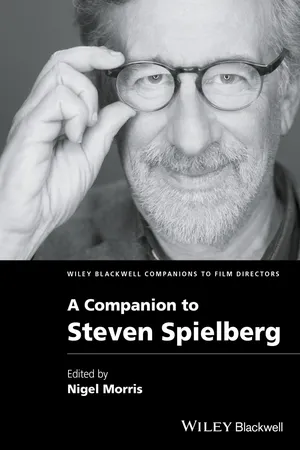
A Companion to Steven Spielberg in part assesses the achievements and legacy of one of the most commercially successful and influential artists and entertainers (in any field) of the twentieth and twenty‐first centuries. The collection overall is neither celebratory nor hostile but seeks to be analytical, informative, and critical. Within a rigorous academic ethos, contributors’ different backgrounds, assumptions, and approaches ensure liveliness, contradiction, and passion rather than bland agreement, dry detachment, or strident uniformity. World‐renowned scholars participate alongside emergent voices, offering fresh perspectives.
No other filmmaker’s standing matches the career of one who has seen and lived through the 1970s Hollywood renaissance and the corporate retrenchment of the 1980s, and has adopted multiple roles through those and the ensuing decades, including director, producer, story deviser, businessman, popular historian, Holocaust memorialist, educator, and brand personification; these continue to develop within a synergistic approach that sets Spielberg apart from those contemporaries and protégés with whom he has been most often and readily associated.
While affirming that the Companion’s guiding principle is to be prospective – to advance understanding and debates – it must be acknowledged that the project would have been unthinkable only a decade previously. A “landmark” international conference1 in November 2007, enabled by six contributors to this volume, all of whom might until then have considered themselves lone voices, assembled a “remarkably wide range” of speakers who adopted an “overwhelmingly positive” tone and “largely lacked the defensiveness that only a few years earlier might have colored any such undertaking” (McBride 2009, 1–2). “The critical literature on Spielberg,” as Joseph McBride points out, “is studded with astonishingly bilious and intemperate assaults” (2). Fred A. Holliday notes that “Spielberg and his cinema are often held up as the paradigm of everything that is wrong with contemporary Hollywood and its blockbuster‐driven mentality” – including “dumbing‐down of American culture” and propagation of “right‐wing ideologies” (2008, 91). So powerful has been this tendency that colleagues at a Society for Cinema and Media Studies conference told Lester D. Friedman that Spielberg was the “antichrist” (2006, 3) and that writing about his work would be career suicide: “the academic equivalent of appearing in a porn movie” (2).
This Companion emphatically eschews the defensiveness such inordinate comments or politer insinuations once elicited, even if it lingers in some contributions – as a latent presence in this introduction, perhaps – given the not fully reformed context in which they are written. As McBride opines, “critical debates about his films have become more nuanced, and the remaining Spielberg haters … seem increasingly passé” (2009, 1–2). Newfound esteem is indicated by an Irish Film Institute retrospective of Spielberg’s work in January 2012, and the British Film Institute’s use of images of E.T. in posters publicizing BFI Southbank (previously the National Film Theatre) in 2015. Nevertheless, background to the Companion includes blanket dismissal, not least by critics and academics who confuse Spielberg with other blockbuster directors. Enormous commercial appeal suggests that Spielberg’s work must be symptomatic, expressive, and reflexive of the culture it responds to and contributes toward shaping, although the exact relationship is typically a matter of presupposition. Many pundits adopt an oppositional stance, either elitist or more or less consciously political, in relation to Hollywood cinema as predictable propaganda for the American way – of which Spielberg’s output is at once one of the most salient, apparently typical, and hence, in view of its international success, most reprehensible embodiments. Spielberg’s apparent adherence to classical form is, by many critics, confused, conflated, or equated with political conservatism, not least because of the association of blockbuster filmmaking with business and marketing strategies focused on maximizing profit and thereby pleasing the largest possible audience. Such classicism nevertheless sits awkwardly alongside Spielberg’s multivocal address to different audiences, attendant stylistic range, and adoption of technological advancements in the realization of his audiovisual ambitions and his centrality to economic and industrial transformations. The latter associate him with the “post‐Classical” Hollywood model of complex intersecting interests (Maltby 2003, 220), in terms of which his films are too often associated erroneously – at least, those that he has directed are – with simplistic, marketing‐led, action‐driven spectacle at the expense of character, narrative complexity, and thematic significance. Such assumptions are challenged and repeatedly disproven in the essays featured here.
With Lincoln2 and Bridge of Spies, Spielberg has continued to consolidate a career phase in which much of his output, less characterized by blockbuster values than was always the case, receives respect although not universal admiration. Those two films maintain his lifelong exploration of, and experimentation with, cinematic form, based on or alluding to precedents both mainstream and – more than negative criticism acknowledges – sometimes notably abstruse. In this parallel concern with showmanship and artistry, based on the director’s extensive knowledge of the medium’s history and ceaseless curiosity about its function and possibilities, Spielberg echoes two of his more obvious formative influences: Alfred Hitchcock and John Ford, who, until nearly 50 years into their filmmaking, were similarly not taken seriously by arbiters of taste and quality (McBride 2011, 514).
Even at its most stately and classical, Spielberg’s filmmaking does not default to a safe, unquestioning, would‐be mimetic mode but rather uses style to highlight (should the spectator be inclined to notice) its own mediation and construction. Self‐consciously dialogic positioning in relation to precedents in Hollywood and alternative traditions interrogates the adequacy of Lincoln, Bridge of Spies, or indeed any cinema, to events and issues portrayed. As an example of blindness to such possibility, former Village Voice film critic (and academic) J. Hoberman has reprinted in a book his original review (2004) of The Terminal. The unamended article follows new material that describes the same (Presidential election) year’s “extraordinary pageant of Ronald Reagan’s funeral” as “subsuming all political conflict in a simplified, sentimental, personality‐driven narrative – … the year’s preeminent example of Spielbergization” (2012, 95). Gratuitous assumptions are made with the expectation of knee‐jerk agreement, particularly offensive in that one might concur with the writer’s world‐view generally if reasoned evidence replaced the self‐righteous harangue. Instead Hoberman glosses over the function and form of funerals, the links between personality, privilege, and the Presidency (and a particularly conservative one at that, aligned explicitly with religious groups such as the Moral Majority), the relationship between American individualism, popular fictions, and exemplary lives in politics and show business, the politics of news and the conventions of reporting, and the hegemonic connections between these important issues. The review then plunges intermittently from Hoberman’s characteristic New York intellectual urbanity into an emotive and debased discourse, and logic constructed through impressionistic association and damning non sequiturs, neither of which are uncommon in hostile writing about Spielberg (Morris 2007, 4–5, 389–90), as if the author has to expend aggression to protect against contamination through enjoyment. It describes Tom Hanks’s protagonist as “a real goat‐fucker” who learns to speak “increasingly accomplished, cutely accented English,” which in turn reminds Hoberman of certain Robin Williams roles, and thereby “more than passing resemblance to the repellently cloying Russian immigrant … in the Reagan‐era heart‐warmer Moscow on the Hudson [Paul Mazursky, 1984]” (Hoberman 2012, 96). Soon after, Hoberman’s free association refers to “the most memorably offensive” of the multi‐ethnic airport workers Hanks’s character befriends, and calls them “elves” (97). The point here is not to attack any particular critic or their right to hold certain views, but rather to suggest how a pre‐existent discourse – in this instance of “Reaganite entertainment” (Britton 1986) – dialogically fortified by anticipation of its audience’s response, determines the argument and evidence presented.
Such negativity, damnation by association, and harsh rhetoric point to ongoing debates around popular culture and highbrow taste – entertainment versus art – as well as unresolved disputes specifically concerning ideological propensities and alleged effects of Spielberg’s work. This Companion intervenes authoritatively into such tendencies. Focused primarily on Spielberg as director – as the series’ remit demands – it acknowledges that his profitability in that role quickly elevated him into a major industry player whose work has considerable influence, as writer, producer, executive producer, or studio head, and in television and computer gaming, as well as the 30 feature films so far directed. Inevitably auteurist in orientation, then, the Spielberg Companion contextualizes and problematizes assumptions of that approach. It does so by recognizing the commercial author function as a marketing strategy, as pointed out by Barthes (1975) and Foucault (1977), and paying attention in some of the essays to Spielberg’s early self‐promotion, and subsequent reinvention of his image as a serious artist, a public figure, a celebrity, an educator, and so on. Beyond examining such attempts at consolidating preferred meanings, many of the authors are attuned to the ambiguity and complexity of Spielberg’s directorial work that help make it popular across generations internationally and increasingly intriguing to criticism and scholarship.
The validity of authorship study and Spielberg’s importance as a director, in terms of artistic value or, according to different criteria, as a cultural or economic phenomenon, are pragmatically taken as given. Nevertheless, from various perspectives within the now mature disciplines of Film, Media, and Cultural Studies, contributors explore aspects of how such discourses function and are constructed. For all the shortcomings and contradictions associated with single director study – of which most writers of these pages are, as seasoned academics, aware – in practice directors are central to how cineastes and some types of fans classify movies and to how film industries promote, and reviewers judge, many of them. After all, The Terminal might mean something different if its director’s name – evoking fixed connotations for some – did not associate it with what Jaws purportedly represents. Paradoxically, though, Spielberg’s presence has confused perceptions of authorial provenance, due to the fact that he has sometimes written, often produced, and frequently been credited as executive producer without directing, with his name figuring at least as prominently as the director’s. Poltergeist (Tobe Hooper, 1982) represents an extreme case in point.
Spielberg’s status and significance are inseparable from the aesthetic, financial, technical, and cultural developments his image personifies – conveniently for journalism and public relations, although proper academic scrutiny demands more circumspection – irrespective of whether he is their cause or effect or, more complicatedly, their embodiment. Since Jaws supposedly inaugurated blockbuster production values and revolutionized marketing strategies,3 Spielberg, as an extraordinarily popular filmmaker with a formidable record, is the most visible and widely known representative of the industry other than on‐screen stars. As an example, the MacRobert Arts Centre at the University of Stirling, the venue where this editor as a 1970s undergraduate immersed himself in European Art Cinema and New Hollywood movies, has had a banner near the campus gate since 2015 proclaiming, “JAW‐dropping prices.” Its graphics and typography evoke the movie and the preceding cross‐marketed bestseller. Forty years on, the narrative image retains potent recognition value and synonymity with “cinema,” significantly disavowing distinction between popular and arthouse that the location’s former status as a Regional Film Theatre upheld. To the extent that Spielberg now is associated with that film, he is cinema.
The centrality of auteurism to film culture, and of Spielberg’s now widespread acceptance, as well as the approach’s function as a marketing tool, are reiterated by press advertisements in April 2016 that proclaimed: “We are Hitchcock. We are the Coens. We are Spielberg. We are BFI Southbank.” Such recognition, together with the popular and variably acclaimed titles and eventual industry prestige that followed Jaws, is cause for celebration by fans – and journalism that serves them – and a public relations coup for Hollywood. As a distinguished contributor to this volume put it a quarter of a century ago, Spielberg – with his colleague, collaborator, and rival, George Lucas – was “replacing the director‐as‐auteur with a director‐as‐superstar ethos” (Schatz 1993, 20). This makes Spielberg a scapegoat for critics who hold him responsible for tendencies they bemoan.
Part of the wider background to Spielberg’s career is the emergence in the 1950s of la politique des auteurs. This was a youthfully provocative assertion of cinephilia, fandom, and cultural rebellion in France – la politique meant a “policy” or deliberate attitude – that had prompted the misleadingly termed authorship “theory” in the United States in the 1960s (Sarris 1968). The two were essentially different. The first valorized freedom and individualism promoted by Hollywood cinema that had been banned under Nazi occupation. Coinciding with recriminations, shortages, and national soul‐searching, an extensive back catalogue had become suddenly av...