A groundbreaking, evidence-based text to the growing field of evolutionary medicine
Evidence-Based Evolutionary Medicine offers a comprehensive review of the burgeoning field of evolutionary medicine and explores vital topics such as evolution, ecology, and aging as they relate to mainstream medicine. The text integrates Darwinian principles and evidence-based medicine in order to offer a clear picture of the underlying principles that reflect how and why organisms have evolved on a cellular level.
The authors—noted authorities in their respective fields—address evolutionary medicine from a developmental cell-molecular perspective. They explore the first principles of physiology that explain the generation of existing tissues, organs, and organ systems. The text offers an understanding of the overall biology as a vertically integrated whole, from unicellular to multicellular organisms. In addition, it addresses clinical diagnostic and therapeutic approaches, both traditional and cell-homeostatic. This groundbreaking text:
Offers a much-needed, logical, and fundamental approach to biology and medicine
Provides a clear explanation of complex physiology and pathophysiology
Integrates topics like evolution, ecology and aging into mainstream medicine, making them more relevant
Contains the first evidence-based text on evolutionary medicine
Written for medical and graduate students in biology, physiology, anatomy, endocrinology, reproductive biology, medicine, pathology, systems biology, this vital resource offers a unique text of both biology as an integrated whole with universal properties; and of medicine seeing the individual as a whole, not an inventory of parts and diseases.
Evolution is as close to a general theory of biology as we have. Remarkably, the central tenets of the theory can be traced back to the nineteenth‐century work of Charles Darwin. Darwin was influenced by his predecessors and by the social and political currents of his time. Darwinian evolution can be summarized as “heritable variation subject to natural selection.” Darwin’s avowed goal was to counter the theory of special creation. Nevertheless, his theory was not widely embraced. Where did variation come from? How was it inherited? Darwin had no answer to these questions. One class of answers to these questions was provided by the rediscovery of Mendel’s work in the early twentieth century and the development of the science of genetics. The merging of Darwin’s theory and Mendelian genetics into the Modern Synthesis led naturally to the search for the chemical basis of heredity and the founding of molecular biology. Evolution was reconceptualized as changes in allele frequencies in populations over time. Among other advances, the development of rigorous, sequence‐based phylogenetic methods greatly enhanced our understanding of the history of life. Nevertheless, as the modern synthesis emerged in the early twentieth century, the darkest chapter in the history of evolutionary thinking unfolded. Eugenics – controlling breeding to improve the human race – took hold throughout the world. Yet Darwin himself was not a eugenicist. By arguing that controlling breeding might be favored at the level of individuals but not at the level of tribes or societies, Darwin both refuted the intellectual basis for eugenics and anticipated the development of a multilevel theory of evolution.
Introduction
As Dobzhansky [1] famously pointed out, “Nothing in biology makes sense except in the light of evolution.” Evolution, the closest to a general theory of biology that we have, thus provides common intellectual ground for all biologists. For instance, consider the growing field of genomics. When biologists seek to identify portions of genomes that are functionally important, they compare genomes of different species. Areas that are conserved between species likely reflect such functional importance [2, 3]. The thinking here is entirely evolutionary. Shortly after two species diverge from a common ancestor, their genomes are expected to be highly similar. As time passes, mutation acts to break down this similarity. In species that share a distant ancestor, parts of the genome may show little similarity. However, purifying selection will remove organisms whose genomes contain deleterious mutations in areas that are functionally important. To the extent that deleterious mutations commonly occur, these areas of the genome will thus appear conserved relative to areas that lack functional importance. Genomic studies routinely take advantage of these consequences of evolution.
A cynic, however, might suggest that evolutionary biologists traditionally focus more‐or‐less exclusively on organisms and genes (and now genomes). Evolutionary theory thus has had little impact on many fields of biology. As Wilkins [4] notes:
The subject of evolution occupies a special, and paradoxical, place within biology as a whole. While the great majority of biologists would probably agree with Theodosius Dobzhansky’s dictum that ‘nothing in biology makes sense except in the light of evolution’, most can conduct their work quite happily without particular reference to evolutionary ideas. ‘Evolution’ would appear to be the indispensible unifying idea and, at the same time, a highly superfluous one.
Wilkins [5] later elaborated on these remarks: “…many biologists who investigate proximal causes in various biological processes (in, for instance, biochemistry, physiology, development) often have little or no recourse to evolutionary ideas or explanations.” Such statements from the founding editor of the notably interdisciplinary journal BioEssays suggest that while evolutionary theory may have the potential to unite all biological disciplines, it has not yet done so. At least some biology continues to be conducted with no particular reference to an evolutionary framework. The role that evolution could play in uniting biological disciplines has thus not yet been fully realized.
Yet this is changing. Minimally, since biology must embrace the history of life, virtually all biologists recognize the need for a historical framework. Further, the tools for providing this framework are increasingly well developed. Modern techniques of phylogenetic systematics analyze increasingly massive nucleotide sequence datasets with more and more sophisticated models of mutational change. As a result, we are progressively better able to apply evolutionary thinking to biological data of all sorts. The promise of over 150 years of evolutionary thinking is beginning to be realized.
Darwin
Remarkably, even in the age of genomics, evolutionary theory can be traced relatively intact back to the work of a nineteenth‐century individual, Charles Darwin. The year 2009 was the 200th anniversary of Darwin’s birth and the 150th anniversary of publication of one of his most important works, On the Origin of Species by Means of Natural Selection. Of course, Darwin built on earlier ideas. In particular, we will mention two.
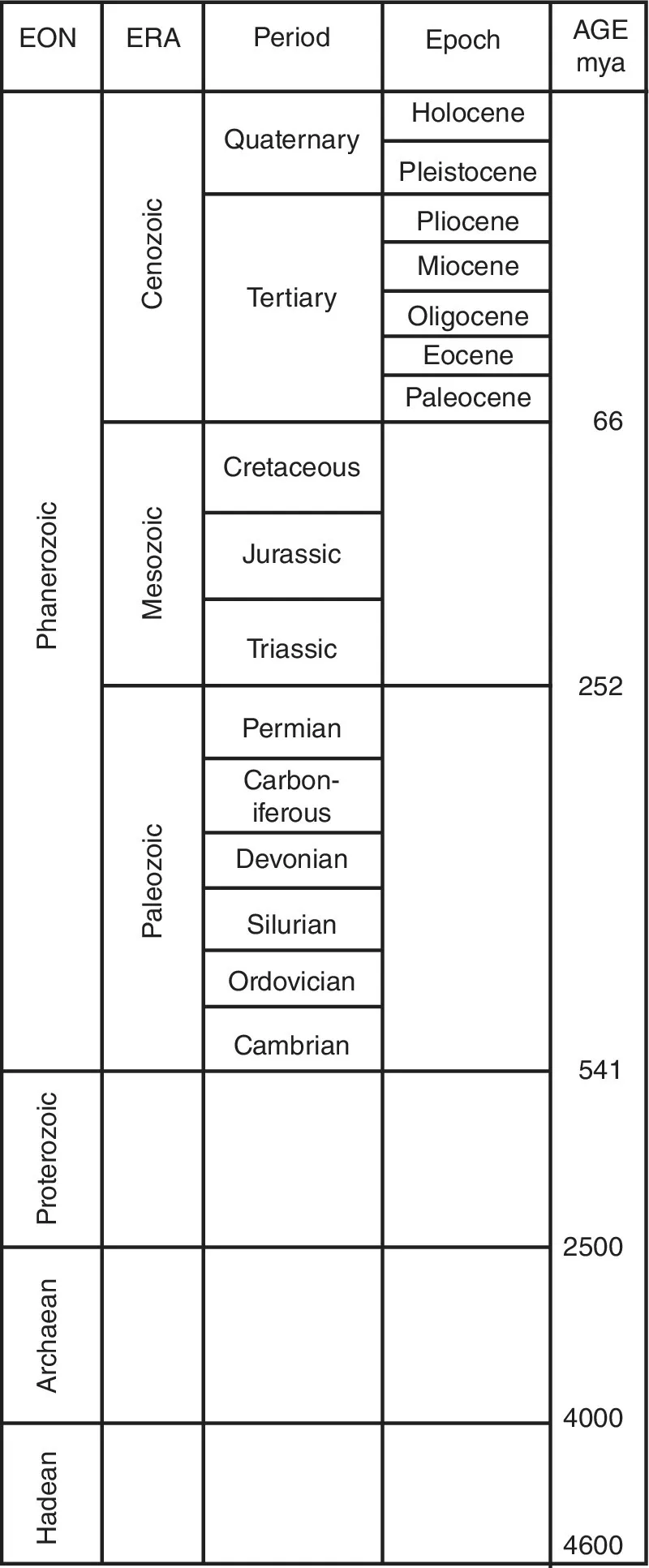
One of the very powerful ideas that developed in the nineteenth‐century Europe was the “uniformitarian” view of the Earth’s geology. Developed by James Hutton and others, this view, summarized by “the present is the key to the past,” eventually led to the geological time scale, which is central to our understanding of the history of life and is shown in Figure 1.1. Hutton was unfortunately so brilliant that no one could really understand a word he said, and his theory was popularized and made more accessible by Charles Lyell’s Principles of Geology, which had a lasting influence on Darwin.
Figure 1.1The geological time scale. Originally based on relative time derived from uniformitarian principles, radiometric dating of geological strata now allows both relative and chronological time measures. Newly ratified periods of the Proterozoic (e.g. the Cryogenian) are based not on stratigraphic events but on measures of chronological time.
Other political and social developments in the nineteenth‐century Europe include the Communist Manifesto, published in 1848. Communism closely identifies with the evolutionary theory of Lamarck, a predecessor of Darwin. Lamarck’s theory of evolution – usually summarized as “the inheritance of acquired characteristics” – emphasizes that the organism must strive for the acquisition of novel characteristics. For instance, a giraffe with a short neck must struggle to lengthen its neck, stretching it every day, year in, year out. Only then will it acquire and pass on the longer neck. Thus, the parallel to the dialectic of communist ideology is clear.
Darwin’s theory, on the other hand, was strongly rooted in capitalistic society. Darwin was from the English middle classes in the nineteenth century. This was Victorian England. Class structure was still very strong in England at this time, although the hereditary English nobility had lost a lot of its power to the English middle classes. This was a very gradual process; there were no revolutions. Numerous vestiges survived from earlier times – the House of Lords in Parliament and Queen Victoria, herself. At the same time, England was carving an empire out of the rest of the world. There was perhaps the need to justify this process in terms of the “natural order.” The assumption that because something is natural it is also morally right was widely embraced.
At the same time that English society was changing gradually, and England was conquering much of the world, there was the prevailing view that change was progressive; the world was getting better. The gain of power of the middle classes led to economic advances, industry, science, medicine, and so on; the conquering of other countries was alleged to have a “civilizing” influence, although perhaps those conquered countries would have debated this.
These societal influences were no doubt important, particularly for young Charles Darwin when he set off on his voyage around the world on the HMS Beagle, 1831–1836. On this trip Darwin examined various aspects of geological and natural history – coral reefs, finches, tortoises, and so on. Darwin would ask himself: Why were areas of South America that were climatically similar to England nevertheless populated by distinct flora and fauna? And why when he unearthed South American fossils were they more similar to the modern South American creatures, while English fossils were likewise similar to modern English creatures? These were daunting questions to an inquiring mind.
Darwin’s Theory
After his return to England, Darwin thought about these and other questions for a number of years and eventually came up with the theory of evolution by natural selection. After resisting publication for some time, a paper by Alfred Russell Wallace forced his hand. Darwin published a short paper in 1858 with Walla...
Table of contents
Cover
Preface
1 A Brief History of Evolutionary Thinking
2 Outlining the Major Transitions in the History of Life
3 One Central Mystery
4 A Levels‐of‐Selection View of Evolutionary Physiology
5 The Cell as the Smallest Functional Unit of Biology/Physiology
10 Endogenous and Exogenous Mechanisms for Healing
11 Systems Biology as Recapitulation of Ontogeny and Phylogeny
12 Terminal Addition as Physiologic Homeostasis and Regeneration, or Evolutionary Medicine
13 Phantom Limbs
14 Man’s Place in the Universe
15 Evolution, Deception, and Public Health
Index
End User License Agreement
Trusted by 375,005 students
Access to over 1.5 million titles for a fair monthly price.
Study more efficiently using our study tools.
Frequently asked questions
Yes, you can cancel anytime from the Subscription tab in your account settings on the Perlego website. Your subscription will stay active until the end of your current billing period. Learn how to cancel your subscription
No, books cannot be downloaded as external files, such as PDFs, for use outside of Perlego. However, you can download books within the Perlego app for offline reading on mobile or tablet. Learn how to download books offline
Perlego offers two plans: Essential and Complete
Essential is ideal for learners and professionals who enjoy exploring a wide range of subjects. Access the Essential Library with 800,000+ trusted titles and best-sellers across business, personal growth, and the humanities. Includes unlimited reading time and Standard Read Aloud voice.
Complete: Perfect for advanced learners and researchers needing full, unrestricted access. Unlock 1.5M+ books across hundreds of subjects, including academic and specialized titles. The Complete Plan also includes advanced features like Premium Read Aloud and Research Assistant.
Both plans are available with monthly, semester, or annual billing cycles.
We are an online textbook subscription service, where you can get access to an entire online library for less than the price of a single book per month. With over 1.5 million books across 990+ topics, we’ve got you covered! Learn about our mission
Look out for the read-aloud symbol on your next book to see if you can listen to it. The read-aloud tool reads text aloud for you, highlighting the text as it is being read. You can pause it, speed it up and slow it down. Learn more about Read Aloud
Yes! You can use the Perlego app on both iOS and Android devices to read anytime, anywhere — even offline. Perfect for commutes or when you’re on the go. Please note we cannot support devices running on iOS 13 and Android 7 or earlier. Learn more about using the app
Yes, you can access Evidence-Based Evolutionary Medicine by John S. Torday,Neil W. Blackstone,Virender K. Rehan in PDF and/or ePUB format, as well as other popular books in Medicine & Medical Theory, Practice & Reference. We have over 1.5 million books available in our catalogue for you to explore.