Fuel Cells, Solar Panels, and Storage Devices
eBook - ePub

Fuel Cells, Solar Panels, and Storage Devices

Materials and Methods

  1. English
  2. ePUB (mobile friendly)
  3. Available on iOS & Android
eBook - ePub

Fuel Cells, Solar Panels, and Storage Devices

Materials and Methods

About this book

This book focuses on the materials used for fuel cells, solar panels, and storage devices, such as rechargeable batteries.

Fuel cell devices, such as direct methanol fuel cells, direct ethanol fuel cells, direct urea fuel cells, as well as biological fuel cells and the electrolytes, membranes, and catalysts used there are detailed. Separate chapters are devoted to polymer electrode materials and membranes.

With regard to solar cells, the types of solar cells are detailed, such as inorganic-organic hybrid solar cells, solar powered biological fuel cells, heterojunction cells, multi-junction cells, and others. Also, the fabrication methods are described. Further, the electrolytes, membranes, and catalysts used there are detailed. The section that is dealing with rechargeable batteries explains the types of rechargeable devices, such as aluminum-based batteries, zinc batteries, magnesium batteries, and lithium batteries. Materials that are used for cathodes, anodes and electrolytes are detailed.

The text focuses on the basic issues and also the literature of the past decade. Beyond education, this book may serve the needs of polymer specialists as well as other specialists, e.g., materials scientists, electrochemical engineers, etc., who have only a passing knowledge of these issues, but need to know more.
Frequently asked questions

Yes, you can cancel anytime from the Subscription tab in your account settings on the Perlego website. Your subscription will stay active until the end of your current billing period. Learn how to cancel your subscription.
No, books cannot be downloaded as external files, such as PDFs, for use outside of Perlego. However, you can download books within the Perlego app for offline reading on mobile or tablet. Learn more here.
Perlego offers two plans: Essential and Complete
  • Essential is ideal for learners and professionals who enjoy exploring a wide range of subjects. Access the Essential Library with 800,000+ trusted titles and best-sellers across business, personal growth, and the humanities. Includes unlimited reading time and Standard Read Aloud voice.
  • Complete: Perfect for advanced learners and researchers needing full, unrestricted access. Unlock 1.4M+ books across hundreds of subjects, including academic and specialized titles. The Complete Plan also includes advanced features like Premium Read Aloud and Research Assistant.
Both plans are available with monthly, semester, or annual billing cycles.
We are an online textbook subscription service, where you can get access to an entire online library for less than the price of a single book per month. With over 1 million books across 1000+ topics, we’ve got you covered! Learn more here.
Look out for the read-aloud symbol on your next book to see if you can listen to it. The read-aloud tool reads text aloud for you, highlighting the text as it is being read. You can pause it, speed it up and slow it down. Learn more here.
Yes! You can use the Perlego app on both iOS or Android devices to read anytime, anywhere — even offline. Perfect for commutes or when you’re on the go.
Please note we cannot support devices running on iOS 13 and Android 7 or earlier. Learn more about using the app.
Yes, you can access Fuel Cells, Solar Panels, and Storage Devices by Johannes Karl Fink in PDF and/or ePUB format, as well as other popular books in Medicine & Pediatric Medicine. We have over one million books available in our catalogue for you to explore.

Information

Year
2017
Print ISBN
9781119480105
eBook ISBN
9781119480068
Edition
1

Chapter 1
Fuel Cells

Fuel cells produce more electricity than batteries or combustion engines, with far fewer emissions. An introduction to the principles and practicalities behind fuel cell technology has been presented (1). Beginning with the underlying concepts, the discussion explores the thermodynamics of fuel cells, kinetics, transport, and modeling before moving onto the application side with guidance on system types and design, performance, costs, and environmental impact.
The latest technological advances and relevant calculations have been presented, along with enhanced chapters on advanced fuel cell design and electrochemical and hydrogen energy systems (1).
Fuel cells are commonly classified on the basis of their electrolyte according to which they can be divided into five main groups (2, 3):
  1. Alkaline fuel cells (AFC),
  2. Phosphoric acid fuel cells (PAFC),
  3. Polymer electrolyte fuel cells (PEFC),
  4. Molten carbonate fuel cell (MAFC), and
  5. Solid oxide fuel cells (SOFC).
Polymer electrolyte fuel cells can be further subdivided into three general groups: The polymer electrolyte fuel cells feed on hydrogen, direct methanol fuel cells and direct ethanol fuel cells.
The basic issues of fuel cells have been collected in a way also suitable for beginners (2, 4).
Also, the issues of direct liquid fuel cells have been reviewed (5). Direct liquid fuel cells are one of the most promising types of fuel cells due to their high energy density, simple structure, small fuel cartridge, instant recharging, and ease of storage and transport. Alcohols such as methanol and ethanol are the most common types of fuel.

1.1 Conventional Fuel Cells

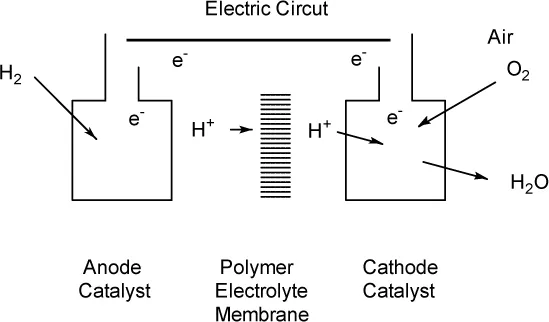
A schematic view of a polymer electrolyte membrane fuel cell is shown in Figure 1.1.
Figure 1.1 Polymer Electrolyte Membrane Fuel Cell (6).

1.1.1 Sealing Material for Solid Polymer Fuel Cell Separator

A sealing material for solid polymer fuel cells includes a silicone rubber composition and, compounded therewith, a layered double hydroxide has an excellent resistance to hydrofluoric acid (7).
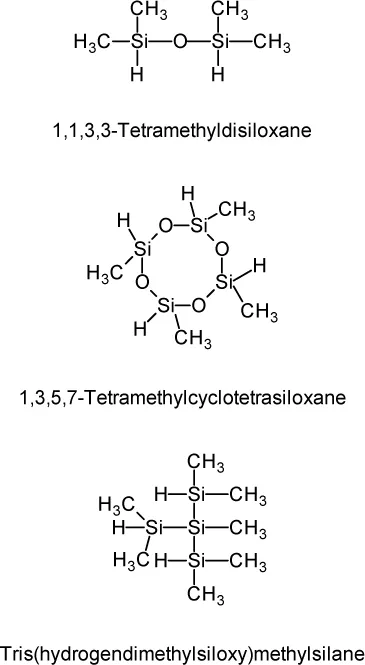
The molecular structure of the organohydrogen poly(siloxane) may be a linear, cyclic, branched or three-dimensional network structure. Illustrative examples of the organohydrogen poly(siloxane) component are summarized in Table 1.1. Some of the components are shown in Figure 1.2.
Table 1.1 Organohydrogen poly(siloxane) (7).
Compound
1,1,3,3-Tetramethyldisiloxane
1,3,5,7-Tetramethylcyclotetrasiloxane
Tris(hydrogendimethylsiloxy)methylsilane
Tris(hydrogendimethylsiloxy)phenylsilane
Methylhydrogencyclo poly(siloxane)
Methylhydrogensiloxane-dimethylsiloxane cyclic copolymers
Methylhydrogen poly(siloxane) capped at both ends with trimethylsiloxy groups
Dimethylsiloxane-methylhydrogensiloxane copolymers capped at both ends with trimethylsiloxy groups
Dimethyl poly(siloxane) capped at both ends with dimethylhydrogensiloxy groups
Dimethylsiloxane-methylhydrogensiloxane copolymers capped at both ends with dimethylhydrogensiloxy groups
Methylhydrogensiloxane-diphenylsiloxane copolymers capped at both ends with trimethylsiloxy groups
Methylhydrogensiloxane-diphenylsiloxane-dimethylsiloxane copolymers capped at both ends with trimethylsiloxy groups
Methylhydrogensiloxane-methylphenylsiloxane-dimethylsiloxane copolymers capped at both ends with trimethylsiloxy groups
Methylhydrogensiloxane-dimethylsiloxane-diphenylsiloxane copolymers capped at both ends with dimethylhydrogensiloxy groups
Methylhydrogensiloxane-dimethylsiloxane-methylphenylsiloxane copolymers capped at both ends with dimethylhydrogensiloxy groups
Copolymers consisting of (CH3)2HsiO
units and SiO
units
Figure 1.2 Siloxanes (7).

1.1.2 Water Management in a Polymer Electrolyte Fuel Cell

Water management of polymer electrolyte fuel cell has been extensively studied because of its effect on the performance of a polymer electrolyte fuel cell system (8). The transport and congelation of water significantly affect the efficiency and durability of a polymer electrolyte fuel cell.
The electrochemical reaction in a polymer electrolyte fuel cell produces water, thereby dampening the electrolyte membrane. The electrochemical reaction at the anode is
(1.1)
Graphic
and the reaction at the cathode is
(1.2)
Graphic
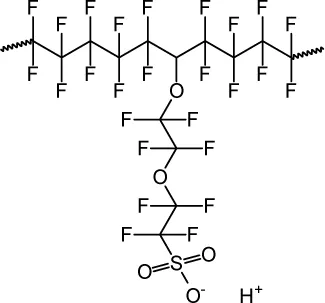
Nafion®, c.f. Figure 1.3, is typically used as the electrolyte membrane. However, Nafion exhibits a proton conductivity only in the presence of water.
Figure 1.3 Nafion®.
Therefore, the reactive gases supplied to the fuel cell should be humidified in order to ensure an efficient transport of protons. Unfortunately, an excessive amount of accumulated water in the gas diffusion layer reduces the performance and the durability of a cell (9).
In contrast, operating with a high current density and back diffusion dehydrates the gas diffusion layer of the anode and the membrane (10).
An efficient water management is essential to maintain the performance of a polymer electrolyte fuel cell. Therefore, water in a polymer electrolyte fuel cell system should be accurately analyzed for understanding the water balance. Therefore, the water balance and the removal of water from a polymer electrolyte fuel cell system are the key parameters that govern its efficiency and durability (8).
Several empirical methods have been used to visualize the distribution of water in a polymer electrolyte fuel cell. These methods include (8):
  1. Optical imaging (11–13),
  2. Magnetic resonance imaging (MRI) (14),
  3. Neutron radiography (15–18), and
  4. X-ray imaging techniques.
Experimental studies using high-resolution imaging techniques have been conducted to reveal the unknown morphological aspects that reduce the performance of a polymer electrolyte fuel cell system.
The X-ray imaging technique is the preferred method over other imaging techniques because of its high spatial and temporal resolution. Recen...

Table of contents

  1. Cover
  2. Title page
  3. Copyright page
  4. Preface
  5. Chapter 1: Fuel Cells
  6. Chapter 2: Polymer Electrodes
  7. Chapter 3: Polymer Membranes
  8. Chapter 4: Solar Cells
  9. Chapter 5: Rechargeable Batteries
  10. Index
  11. End User License Agreement