A single-volume resource featuring state-of-the art reviews of key elements of the roll-to-roll manufacturing processing methodology
Roll-to-roll (R2R) manufacturing is an important manufacturing technology platform used extensively for mass-producing a host of film-type products in several traditional industries such as printing, silver-halide photography, and paper. Over the last two decades, some of the methodologies and know-how of R2R manufacturing have been extended and adapted in many new technology areas, including microelectronics, display, photovoltaics, and microfluidics. This comprehensive book presents the state-of-the-art unit operations of the R2R manufacturing technology, providing a practical resource for scientists, engineers, and practitioners not familiar with the fundamentals of R2R technology.
Roll-to-Roll Manufacturing: Process Elements and Recent Advances reviews new developments in areas such as flexible glass, display, and photovoltaics and covers a number of process innovations implemented recently to extend and improve the capabilities of traditional R2R lines. It covers such topics as: coating and solidification processes, in-line vacuum deposition, drying, web handling and winding, polymer film substrates, novel hybrid composite films, flexible solar cells and more. Additionally, this book:
Examines key elements (unit operations) of the R2R technology, and discusses how these elements are utilized and integrated to achieve desired process efficiencies in a host of applications.
Illustrates several established and novel application areas where R2R processing is utilized in current or future products.
Discusses process design methodology and key advantages of R2R manufacturing technology over batch or sheet-to-sheet operations.
Roll-to-Roll Manufacturing: Process Elements and Recent Advances is an ideal book for undergraduate and graduate students in various science and engineering disciplines, as well as for scientists, engineers, and technical and business leaders associated in any way with the development, commercialization, and manufacture of a variety of film products.
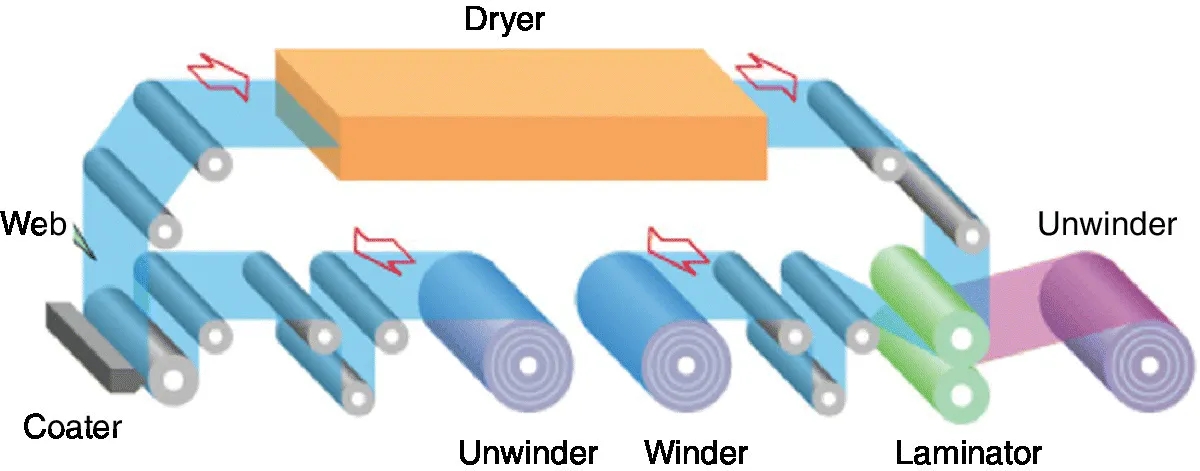
Roll‐to‐roll (R2R) manufacturing is an important manufacturing technology platform widely used for a host of applications and product categories, spanning many industries. These cover the gamut from traditional and mature technologies such as printing and silver halide photography to more novel application areas including flexible microelectronics [1–4], thin flexible batteries [5, 6], photovoltaics [7–10], and display [11–13]. A typical R2R production line, with standard coating, drying, and lamination steps, is depicted in Figure 1.1. This particular line, however, represents only one specialized process layout from within a multitude of manufacturing processes that can be broadly classified as R2R operations. A common thread in all these diverse manufacturing operations is that in all cases relatively thin and flat, film‐type two‐dimensional (2D) structures are processed continuously on a flexible moving web that is conveyed at some fixed speed between two or more rotating rollers. The web comprises an inert and flexible substrate on which a layer (or layers) of a functional material is applied by some means. The functional layer possesses some desired physical/chemical property that has special utility to its intended application. Many types of functional layers are applied in R2R operations reflecting the wide variety of applications utilizing this manufacturing platform. These include chemically sensitized layers used in traditional photography, ink layers used in various printing lines, optically refractive, diffusive, or collimating layers used in optical films for liquid crystal displays, photovoltaic layers used in flexible solar cells, barrier layers used in various packaging applications and magnetic layers used in magnetic tape, to name just a few. The functional layers are often flat and featureless films applied by some common coating method onto a moving substrate. However, in some application areas, the functional layers can be patterned by standard printing methods or by various novel photolithographic, embossing [14], or other patterning techniques. The various printing techniques fall under the general category of additive patterning, while some photolithographic techniques, where excess material is removed, are generally classified as subtractive patterning methods. The patterned functional layers are designed to enable a particular function such as light collimation (as in the case of prism films used in liquid crystal displays [15]) or special fluid management (as in the case of microfluidic films [16]), and are either directly printed or replicated onto the moving substrate from a master roll or belt having a corresponding relief (“negative”) pattern. A wide variety of micro‐ and nano‐patterning methods are highly compatible with a continuous web, R2R‐type operation and have been described at length in the literature [17, 18]. Various printing methods such as inkjet printing, flexography, and screen printing are used extensively for producing patterned functional layers in R2R operations [19–22]. Patterning of the functional layer can also be achieved by self‐assembly of block copolymers [23].
Figure 1.1 Typical roll‐to‐roll production line.
In addition to the functional layers, the final film structure often comprises additional so‐called ancillary layers whose function is secondary to the intended application, but these layers are critical to the effective processability and successful function of the film product. Examples of ancillary layers include adhesion promoting layers, sometimes referred to as “primers” or “subbing layers,” that ensure good adhesion of the functional layer or an ancillary layer to the substrate or to another layer [24], antistatic layers [25] that dissipate static charges during conveyance and final use, various protective layers such as “hard coats” that protect the functional layers from environmental or mechanical damage [26], slip layers used to minimize friction during conveyance and end use, and barrier layers used to minimize contact with ambient gases, especially oxygen and water. (Barrier layers could be classified as functional layers if the main function of the film product is to minimize contact with ambient gasses, e.g., in packaging applications.)
The substrate layer itself is often polymeric or paper‐based although it could also be a metal foil or inorganic glass [27, 28]. Aside from being flexible, this layer serves as a physical foundation and carrier1 for the functional layer(s), which is often mechanically not sufficiently sturdy to withstand on its own mechanical deformations applied during the R2R manufacturing process or during its functional lifetime use. Thus, substrate materials must be generally dimensionally, mechanically, and environmentally stable under the conditions the film product is expected to withstand over its functional lifetime in order to ensure a durable and useful product. Some mechanical stiffness and rigidity are usually attained by making the substrate layer considerably thicker than the functional layer(s) and by ensuring that its glass transition temperature and melting point are well above the product’s processing or application temperature ranges. Although the bending stiffness of the film is significantly increased with an increase in thickness of the substrate layer, there is a myriad of factors that go into selecting the thickness and type of the substrate layer; the thickness is mostly dictated by product design considerations, but it can also adversely impact material cost, web conveyance, and winding, so proper selection of substrate thickness and type is critical to product performance, manufacturability, and cost. For many optical applications, the optical properties of the substrate such as transmittance, birefringence, and color are often critical to the performance of the film product [27] and must be carefully considered in selecting the appropriate substrate material for the application at hand. Otherwise, the substrate is expected to interfere as little as possible with the performance of the functional layer.
The origins of R2R manufacturing technology can be traced to the tail end of the Industrial Revolution in the second half of the 19th Century. In fact, the emergence of two traditional industries, printing and photography, is closely linked to a...
Table of contents
Cover
Title Page
Table of Contents
Preface
1 Roll‐to‐Roll Manufacturing: An Overview
2 Coating and Solidification
3 Drying of Polymer Solutions: Modeling and Real‐Time Tracking of the Process
4 In‐Line Vacuum Deposition
5 Web Handling and Winding
6 Polymer Film Substrates for Roll‐to‐Roll Manufacturing: Process–Structure–Property Relationships
7 Curl Effects in Roll‐to‐Roll Operations
8 Roll‐to‐Roll Processing of Glass
9 Novel Hybrid Composite Films by Roll‐to‐Roll Processing
10 Roll‐to‐Roll Manufacturing of Flexible Displays
11 Flexible Solar Cells
12 Field‐Assisted Self‐Assembly of Nanocomposite Films: A Roll‐to‐Roll Approach
Index
End User License Agreement
Trusted by 375,005 students
Access to over 1.5 million titles for a fair monthly price.
Study more efficiently using our study tools.
Frequently asked questions
Yes, you can cancel anytime from the Subscription tab in your account settings on the Perlego website. Your subscription will stay active until the end of your current billing period. Learn how to cancel your subscription
No, books cannot be downloaded as external files, such as PDFs, for use outside of Perlego. However, you can download books within the Perlego app for offline reading on mobile or tablet. Learn how to download books offline
Perlego offers two plans: Essential and Complete
Essential is ideal for learners and professionals who enjoy exploring a wide range of subjects. Access the Essential Library with 800,000+ trusted titles and best-sellers across business, personal growth, and the humanities. Includes unlimited reading time and Standard Read Aloud voice.
Complete: Perfect for advanced learners and researchers needing full, unrestricted access. Unlock 1.5M+ books across hundreds of subjects, including academic and specialized titles. The Complete Plan also includes advanced features like Premium Read Aloud and Research Assistant.
Both plans are available with monthly, semester, or annual billing cycles.
We are an online textbook subscription service, where you can get access to an entire online library for less than the price of a single book per month. With over 1.5 million books across 990+ topics, we’ve got you covered! Learn about our mission
Look out for the read-aloud symbol on your next book to see if you can listen to it. The read-aloud tool reads text aloud for you, highlighting the text as it is being read. You can pause it, speed it up and slow it down. Learn more about Read Aloud
Yes! You can use the Perlego app on both iOS and Android devices to read anytime, anywhere — even offline. Perfect for commutes or when you’re on the go. Please note we cannot support devices running on iOS 13 and Android 7 or earlier. Learn more about using the app
Yes, you can access Roll-to-Roll Manufacturing by Jehuda Greener, Glen Pearson, Miko Cakmak, Jehuda Greener,Glen Pearson,Miko Cakmak in PDF and/or ePUB format, as well as other popular books in Technologie et ingénierie & Science des matériaux. We have over 1.5 million books available in our catalogue for you to explore.