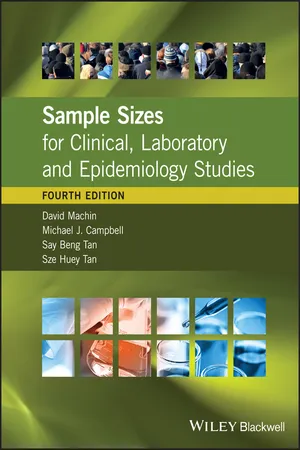
Sample Sizes for Clinical, Laboratory and Epidemiology Studies
eBook - ePub

Sample Sizes for Clinical, Laboratory and Epidemiology Studies

  1. English
  2. ePUB (mobile friendly)
  3. Available on iOS & Android
eBook - ePub

Sample Sizes for Clinical, Laboratory and Epidemiology Studies

About this book

An authoritative resource that offers the statistical tools and software needed to design and plan valid clinical studies

Now in its fourth and extended edition, Sample Sizes for Clinical, Laboratory and Epidemiology Studiesincludes the sample size software (SSS) and formulae and numerical tables needed to design valid clinical studies. The text covers clinical as well as laboratory and epidemiology studies and contains the information needed to ensure a study will form a valid contribution to medical research.Ā 

The authors, noted experts in the field, explain step by step and explore the wide range of considerations necessary to assist investigational teams when deriving an appropriate sample size for their when planned study. The book contains sets of sample size tables with companion explanations and clear worked out examples based on real data. In addition, the text offers bibliography and references sections that are designed to be helpful with guidance on the principles discussed.

This revised fourth edition:

  • Offers the only text available to include sample size software for use in designing and planning clinical studies
  • Presents new and extended chapters with many additional and refreshed examples
  • Includes clear explanations of the principles and methodologies involved with relevant practical examples
  • Makes clear a complex but vital topic that is designed to ensure valid methodology and publishable resultsĀ 
  • Contains guidance from an internationally recognised team of medical statistics experts

Written for medical researchers from all specialities and medical statisticians, Sample Sizes for Clinical, Laboratory and EpidemiologyStudies offers an updated fourth edition of the important guide for designing and planning reliable and evidence based clinical studies.

Frequently asked questions

Yes, you can cancel anytime from the Subscription tab in your account settings on the Perlego website. Your subscription will stay active until the end of your current billing period. Learn how to cancel your subscription.
No, books cannot be downloaded as external files, such as PDFs, for use outside of Perlego. However, you can download books within the Perlego app for offline reading on mobile or tablet. Learn more here.
Perlego offers two plans: Essential and Complete
  • Essential is ideal for learners and professionals who enjoy exploring a wide range of subjects. Access the Essential Library with 800,000+ trusted titles and best-sellers across business, personal growth, and the humanities. Includes unlimited reading time and Standard Read Aloud voice.
  • Complete: Perfect for advanced learners and researchers needing full, unrestricted access. Unlock 1.4M+ books across hundreds of subjects, including academic and specialized titles. The Complete Plan also includes advanced features like Premium Read Aloud and Research Assistant.
Both plans are available with monthly, semester, or annual billing cycles.
We are an online textbook subscription service, where you can get access to an entire online library for less than the price of a single book per month. With over 1 million books across 1000+ topics, we’ve got you covered! Learn more here.
Look out for the read-aloud symbol on your next book to see if you can listen to it. The read-aloud tool reads text aloud for you, highlighting the text as it is being read. You can pause it, speed it up and slow it down. Learn more here.
Yes! You can use the Perlego app on both iOS or Android devices to read anytime, anywhere — even offline. Perfect for commutes or when you’re on the go.
Please note we cannot support devices running on iOS 13 and Android 7 or earlier. Learn more about using the app.
Yes, you can access Sample Sizes for Clinical, Laboratory and Epidemiology Studies by David Machin,Michael J. Campbell,Say Beng Tan,Sze Huey Tan in PDF and/or ePUB format, as well as other popular books in Medicine & Medical Theory, Practice & Reference. We have over one million books available in our catalogue for you to explore.

Information

1
Basic Design Considerations

SUMMARY

This chapter reviews the reasons why sample size considerations are important when planning a clinical study of any type. The basic elements underlying this process include the null and alternative study hypotheses, effect size, statistical significance level and power, each of which are described. We introduce the notation to distinguish the population parameters we are trying to estimate with the study, from their anticipated value at the planning stages and also from their estimated value once the study has been completed. We emphasise for comparative studies that, whenever feasible, it is important to randomise the allocation of subjects to respective groups.
The basic properties of the standardised Normal distribution are described. Also discussed is how, once the effect size, statistical significance level and power for a comparative study using a continuous outcome are specified, the Fundamental Equation (which essentially plays a role in most sample size calculations for comparative studies) is derived.
The Student’s t‐distribution and the Non‐central t‐distribution are also described. In addition the Binomial, Poisson, Negative‐Binomial, Beta and Exponential statistical distributions are defined. In particular, the circumstances (essentially large study sizes) in which the Binomial and Poisson distributions have an approximately Normal shape are described. Methods for calculating confidence intervals for a population mean are indicated together with (suitably modified) how they can be used for a proportion or a rate in larger studies. For the Binomial situation, formulae are also provided where the sample size is not large. Finally, a note concerning numerical accuracy of the calculations in the illustrative examples of later chapters is included.

1.1 Why Sample Size Calculations?

To motivate the statistical issues relevant to sample size calculations, we will assume that we are planning a two‐group clinical trial in which subjects are allocated at random to one of two alternative treatments for a particular medical condition and that a single endpoint measure has been specified in advance. However, it should be emph...

Table of contents

  1. Cover
  2. Table of Contents
  3. Preface
  4. 1 Basic Design Considerations
  5. 2 Further Design Considerations
  6. 3 Binary Outcomes
  7. 4 Ordered Categorical Outcomes
  8. 5 Continuous Outcomes
  9. 6 Rate Outcomes
  10. 7 Survival Time Outcomes
  11. 8 Paired Binary, Ordered Categorical and Continuous Outcomes
  12. 9 Confidence Intervals
  13. 10 Repeated Outcome Measures
  14. 11 Non-Inferiority and Equivalence
  15. 12 Cluster Designs
  16. 13 Stepped Wedge Designs
  17. 14 More than Two Groups Designs
  18. 15 Genomic Targets and Dose-Finding
  19. 16 Feasibility and Pilot Studies
  20. 17 Therapeutic Exploratory Trials
  21. 18 Therapeutic Exploratory Trials
  22. 19 The Correlation Coefficient
  23. 20 Observer Agreement Studies
  24. 21 Reference Intervals and Receiver Operating Curves
  25. 22 Sample Size Software
  26. Cumulative References
  27. Index
  28. End User License Agreement