Veterinary Anesthetic and Monitoring Equipment is the first veterinary-specific resource solely dedicated to anesthetic and monitoring equipment used in clinical practice.
Offers a practical guide to anesthetic and monitoring equipment commonly used in veterinary medicine
Provides clinically oriented guidance to troubleshooting problems that may occur
Discusses general principles applicable to any equipment found in the practice
Presents information associated with novel anesthetic equipment and monitors
European Specialist in Veterinary Anaesthesia & Analgesia, Consultant Veterinary Anaesthetist, ACE Vets Ltd, Rossett, UK
1.1 Medical Gas Cylinders
Gas cylinders are used to store and supply medical gases to clinical areas of the veterinary hospital, including anesthetic machines, mechanical ventilators and surgical instruments. Cylinders are attached, either directly or using a pipeline and distribution system to the anesthetic machine or outlet. Cylinders are available in a number of sizes, described by the letters A–J. Their designated letter is dependent on their size; A is the smallest and J the largest (British Oxygen Company 2016). The size used is dependent on the intended use and region of the world. For example, in the United Kingdom (UK) and European Union (EU), the most commonly used sizes are E, F and J, whereas in North America, E and H are more usual. Table 1.1 details the sizes and volumes of the these cylinders.
Table 1.1 Gas cylinder dimensions and capacity.
UK
US
E
F
G
J
E
F
G
H
Dimensions (inches)
34 × 4
36 × 5½
54 × 7
56½ × 9
26 × 4½
51 × 5½
51 × 8½
51 × 9¼
Oxygen (L)
680
1360
3400
6800
650
2062
5300
6900
Nitrous oxide (L)
1800
3600
9000
18 000
1590
5260
13 800
15490
Cylinders are available containing a number of different medical gases. The medical gases most used in veterinary practice include oxygen, nitrous oxide and medical air, although carbon dioxide may also be found in certain situations. For example, carbon dioxide is used for body cavity insufflation during minimally invasive procedures.
1.1.1 Gas Pressures
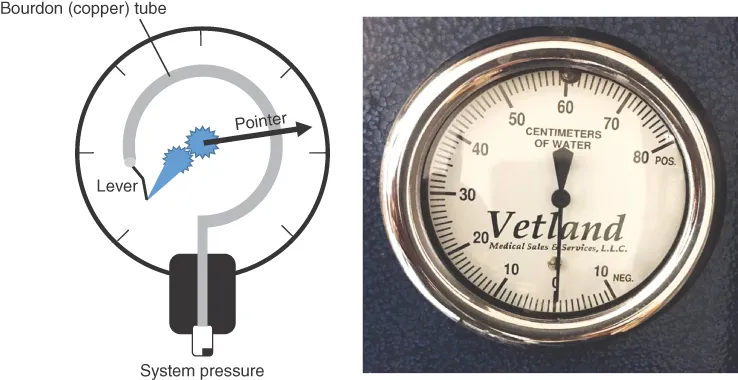
A pressure gauge, most commonly of the Bourdon type (Figure 1.1), should be associated with the cylinder connection to the system. A Bourdon gauge consists of a coiled tube that changes shape, dependent on gas pressure. As the coil changes shape, an attached pointer moves over the scale to display the pressure (Davis and Kenny 2007). The gauge reads the pressure generated within the cylinder or pipeline distribution system, dependent on the amount of gas or vapor supplied. The term “gas” is used to describe the contents of a cylinder containing a non‐liquefied compressed gas. Examples include oxygen and medical air (Davis and Kenny 2007). The cylinder contents are present in this state when the gas does not change into a liquid at room temperature regardless of pressure applied, since room temperature is above the critical temperature of gas. The critical temperature is the temperature above which a substance cannot be liquefied, regardless of the pressure applied. The term “vapor” is the gaseous state of a substance when, at ambient temperature, it is present below its critical temperature (Davis and Kenny 2007). The liquid phase is present in the cylinder with the vapor phase remaining on top; nitrous oxide is an example of a medical gas stored in this state.
Figure 1.1 Left: Interior schematic of a Bourdon type pressure gauge including the expandable copper tubing and pointer. Right: Example of a common Bourdon gauge routinely located on an anesthetic machine.
The International System of Units (SI) used for pressure is the pascal (Pa) which, for convenience, is commonly expressed as kilopascal (kPa). However, conversion to other commonly used pressure units is frequently performed and is as follows:
(1.1)
1.1.2 Medical Gases
Oxygen and medical air are stored as compressed gases (Highley 2009; Westwood and Rieley 2012), whereas nitrous oxide and carbon dioxide are stored as a liquid with a vapor phase above. The gauge pressure will depend on the particular gas. For example, those stored as compressed gases will have a gauge pressure that is directly related to cylinder contents at all times, whereas t...
Table of contents
Cover
Table of Contents
Dedication
List of Contributors
Preface
1 Medical Gas Cylinders and Pipeline Systems
2 Oxygen Concentrators
3 Small Animal Anesthetic Machines and Equipment
4 Large Animal Anesthesia Machines and Equipment
5 Anesthetic Vaporizers
6 Anesthetic Ventilators
7 Humidification and Positive Pressure Equipment
8 Waste Anesthetic Gas Collection and Consequences
9 Hazards of the Anesthetic Delivery System and Operating Room Fires
10 Components of the Breathing System
11 Mapleson Breathing Systems
12 The Circle System
13 Laryngoscopes
14 Supraglottic Airway Devices and Tracheal Tubes and Stylets
15 Oxygen Delivery Systems
16 Gas Monitoring
17 Airway Volumes, Flows and Pressures
18 Pulse Oximetry
19 Cardiovascular Monitoring
20 Electrocardiography
21 Neuromuscular Transmission Monitoring
22 Temperature Regulation and Monitoring
23 Fluid Regulation and Monitoring
24 Anesthetic Records
25 Equipment for the Magnetic Resonance Imaging System
26 Equipment for Environmental Extremes and Field Techniques
27 Equipment Checkout and Maintenance
28 Equipment Cleaning and Sterilization
29 Unique Species Considerations: Dogs and Cats
30 Unique Species Considerations: Ruminants and Swine
31 Unique Species Considerations: Equine
32 Unique Species Considerations: Avian
33 Unique Species Considerations: Rabbits
34 Unique Species Considerations: Rodents
35 Unique Species Considerations: Fish and Amphibians
36 Unique Species Considerations: Reptiles
37 Unique Species Considerations: Non‐Human Primates
Index
End User License Agreement
Trusted by 375,005 students
Access to over 1.5 million titles for a fair monthly price.
Study more efficiently using our study tools.
Frequently asked questions
Yes, you can cancel anytime from the Subscription tab in your account settings on the Perlego website. Your subscription will stay active until the end of your current billing period. Learn how to cancel your subscription
No, books cannot be downloaded as external files, such as PDFs, for use outside of Perlego. However, you can download books within the Perlego app for offline reading on mobile or tablet. Learn how to download books offline
Perlego offers two plans: Essential and Complete
Essential is ideal for learners and professionals who enjoy exploring a wide range of subjects. Access the Essential Library with 800,000+ trusted titles and best-sellers across business, personal growth, and the humanities. Includes unlimited reading time and Standard Read Aloud voice.
Complete: Perfect for advanced learners and researchers needing full, unrestricted access. Unlock 1.5M+ books across hundreds of subjects, including academic and specialized titles. The Complete Plan also includes advanced features like Premium Read Aloud and Research Assistant.
Both plans are available with monthly, semester, or annual billing cycles.
We are an online textbook subscription service, where you can get access to an entire online library for less than the price of a single book per month. With over 1.5 million books across 990+ topics, we’ve got you covered! Learn about our mission
Look out for the read-aloud symbol on your next book to see if you can listen to it. The read-aloud tool reads text aloud for you, highlighting the text as it is being read. You can pause it, speed it up and slow it down. Learn more about Read Aloud
Yes! You can use the Perlego app on both iOS and Android devices to read anytime, anywhere — even offline. Perfect for commutes or when you’re on the go. Please note we cannot support devices running on iOS 13 and Android 7 or earlier. Learn more about using the app
Yes, you can access Veterinary Anesthetic and Monitoring Equipment by Kristen G. Cooley, Rebecca A. Johnson, Kristen G. Cooley,Rebecca A. Johnson,Kristen G. Cooley in PDF and/or ePUB format, as well as other popular books in Medicine & Veterinary Medicine. We have over 1.5 million books available in our catalogue for you to explore.